Jerky
How to Make Beef Jerky at Home in Under 2 Hours: Oven and Air Fryer Methods
By Editorial Team. Updated . 19 min read. 5 recipes, each under 2 hours.
Store links may be affiliate links. We may earn a commission; it never changes what we recommend.
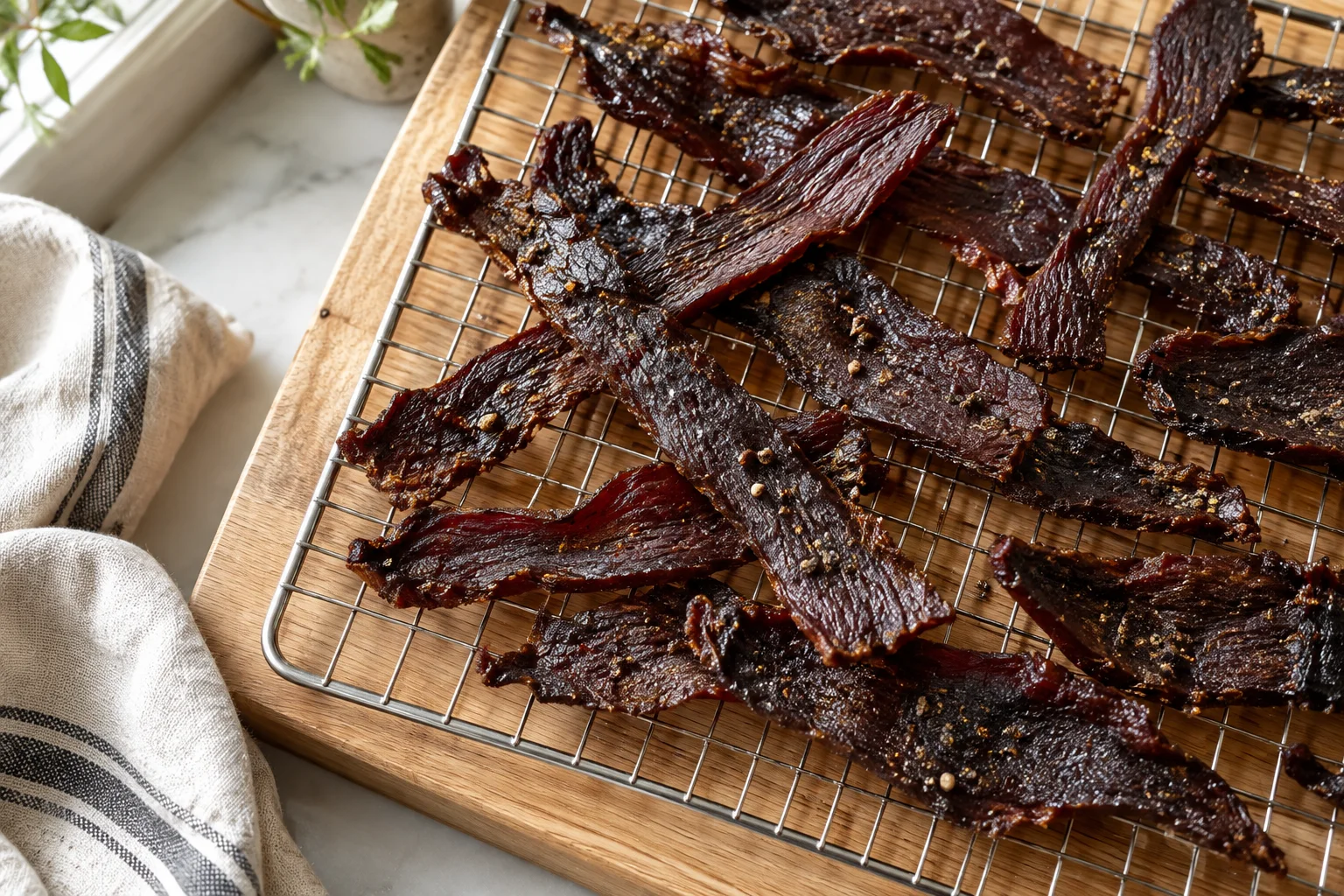
To make beef jerky at home in under 2 hours, slice lean beef 1/8 inch (3 mm) thin, simmer the strips in the marinade until they reach 160°F (71°C), then dry them at 190–200°F (88–93°C) in a convection oven. Classic oven jerky takes 4–8 hours. This express method gives up some marinade depth to finish in about 115 minutes.
Key takeaways
- Classic jerky takes 4–8 hours. The express method finishes in about 115 minutes because the slices are 1/8 inch (3 mm) thick and the oven runs at 190–200°F (88–93°C).
- USDA FSIS says to heat beef to 160°F (71°C), or poultry to 165°F (74°C), before or at the start of drying. Drying alone is not a kill step.
- Eye of round and top round are the best cuts. Trim every visible piece of fat, because fat goes rancid in days.
- Homemade jerky has about 12–16 g of protein per ounce (28 g) and costs roughly $1–$2 an ounce, against $2.50–$6 in the store.
- Jerky is done when a cooled strip bends 90 degrees and cracks without snapping. It keeps about 1 week at room temperature, 1–2 weeks in the fridge and 2–3 months in the freezer.
Can you really make beef jerky at home in 2 hours?
Beef jerky can be made at home in under 2 hours only with an express method: 1/8-inch (3 mm) slices, a simmer in the marinade to reach 160°F (71°C), and a 190–200°F (88–93°C) convection oven. Most guides put oven jerky at 4–8 hours because they use thicker slices and 130–175°F ovens. Classic thick-cut jerky does not dry in 2 hours.
Almost every jerky guide tells you to marinate overnight and dry for 4 to 8 hours. That advice is sound for a low-and-slow dehydrator at 130–145°F (54–63°C) with thick slices. The express method keeps what makes jerky safe and good and changes what only makes it slow, with four changes.
- Thin slices. Meat cut 1/8 inch (3 mm) thick loses water several times faster than 1/4-inch strips, which saves hours on its own.
- A short marinade with a simmer. Real marinade penetration takes many hours, so it cannot fit here. Instead you toss the slices in a concentrated marinade as you cut, then simmer them in it for 2–4 minutes. The simmer pre-heats the meat to a safe temperature and drives flavor into the surface.
- A hotter, drier oven. Instead of 135°F (57°C), you dry at 190–200°F (88–93°C) with the convection fan on and the door propped open about an inch.
- Wire racks. Hot air reaches both sides of every strip, so you never flip them.
The trade-offs are real. The flavor sits more on the surface than in the middle, the texture is a little drier and firmer than a slow-dried batch, and you need to hover over the oven for the last 20 minutes. If you have a free weekend, an overnight soak and a dehydrator still give the deepest flavor. If you want jerky by dinner, use this method.
How long does it take to make beef jerky in the oven?
Oven beef jerky takes 4–8 hours by the classic method and about 115 minutes by the express method used here. The classic route uses 1/4-inch strips, an overnight marinade and a 160–175°F (71–79°C) oven. The express route uses 1/8-inch (3 mm) strips, a simmer pre-heat and a 190–200°F (88–93°C) convection oven.
The partial freeze exists only to make thin slicing possible. A big roast barely takes up marinade, so the flavor work happens while you slice and simmer. Use the freezer time to mix the marinade, set up the pans and preheat the oven.
| Clock | Minutes | What you do |
|---|---|---|
| 0:00 to 0:05 | 5 | Trim fat and silver skin off the roast, wrap it, and put it in the freezer. |
| 0:05 to 0:35 | 30 | Freezer time. Meanwhile, whisk the marinade, set racks on pans, and start the oven preheating at about 0:20. |
| 0:35 to 0:47 | 12 | Slice across the grain, 1/8 inch (3 mm) thick. Drop strips into the marinade as you go. |
| 0:47 to 1:00 | 13 | Simmer strips in the marinade in 2–3 batches (2–4 minutes each), then lay them on the racks. |
| 1:00 to 1:55 | 55 | Dry at 190–200°F (88–93°C), convection fan on, door propped. Check the first strips at 40 minutes. |
| 1:55 | total 115 | Cool 5 minutes, bend-test, and return any under-dried strips to the oven for 5–10 more minutes. |
Thicker slices, a weak oven that will not hold 190°F, or a crowded rack will each add time. Treat the schedule as a plan you adjust by feel in the last half hour.
What is the best cut of beef for jerky?
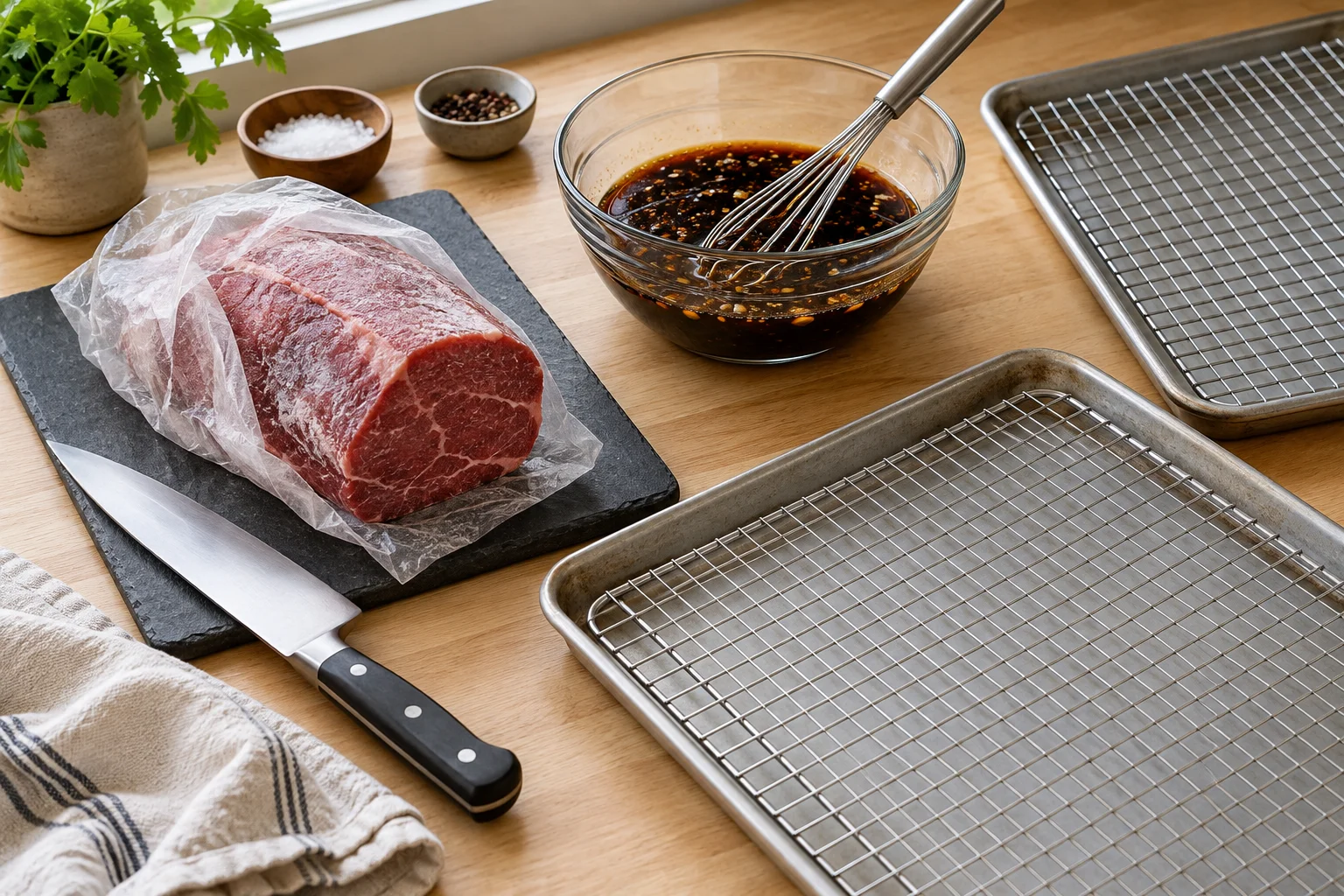
Beef eye of round is the best cut for jerky: it is very lean, uniform and usually the cheapest per pound. Top round, bottom round and sirloin tip also work, and flank steak works if you trim it hard. Skip brisket, chuck and ribeye, because fat does not dry out. It goes rancid within days and shortens shelf life.
Rancid fat gives jerky an off, paint-like flavor, which makes lean meat the biggest quality rule in jerky. The best choices all come from the round or the sirloin, the hard-working back leg:
- Eye of round is round, uniform and the easiest to slice evenly. Look for a beef eye of round roast (shop at Whole Foods, opens in a new tab) with little surface fat.
- Top round (often sold as London broil) is a little more tender and wider, so you get longer strips. A beef top round (shop at Whole Foods, opens in a new tab) is easy to find.
- Bottom round and sirloin tip are slightly tougher and have more connective tissue to trim, but both work well.
- Flank steak is lean with long, coarse fibers, so it gives chewier strips.
Skip anything labeled "stew meat" or "fajita" as well. Marbled cuts will not render their fat out of a thin strip.
Trimming
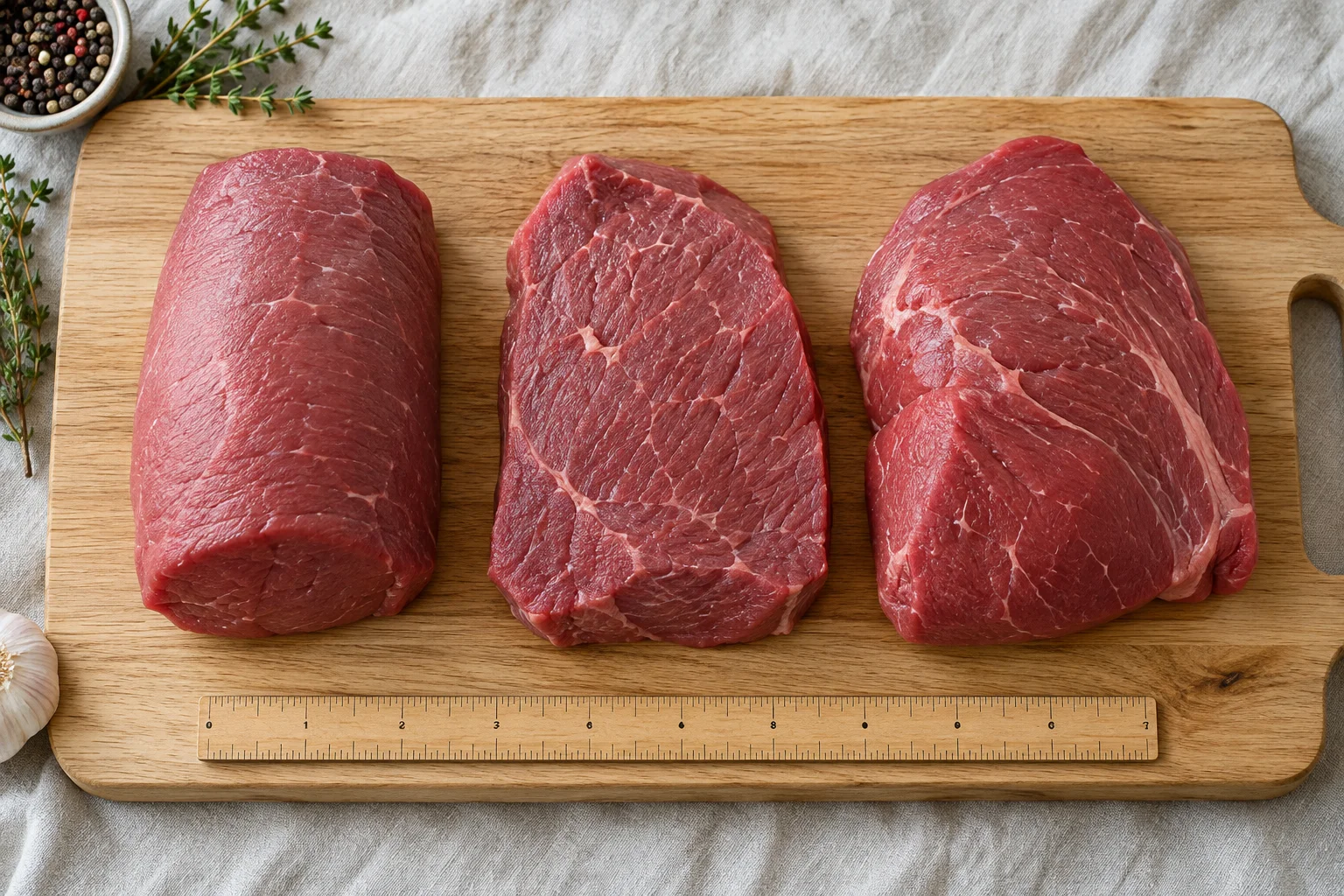
Fat and silver skin are the two things to remove. Work with a sharp knife on a cold roast.
- Cut off the outer fat cap and any thick fat seams. Leave nothing you can pinch between your fingers.
- Slide the knife under the silver skin (the shiny, tough membrane) and peel it away in long strokes. It does not soften during drying and makes chewy, stringy spots.
- Weigh the trimmed meat on a digital kitchen scale (shop at Amazon, opens in a new tab). The recipes here are written for trimmed weight.
How thin should you slice beef for jerky?
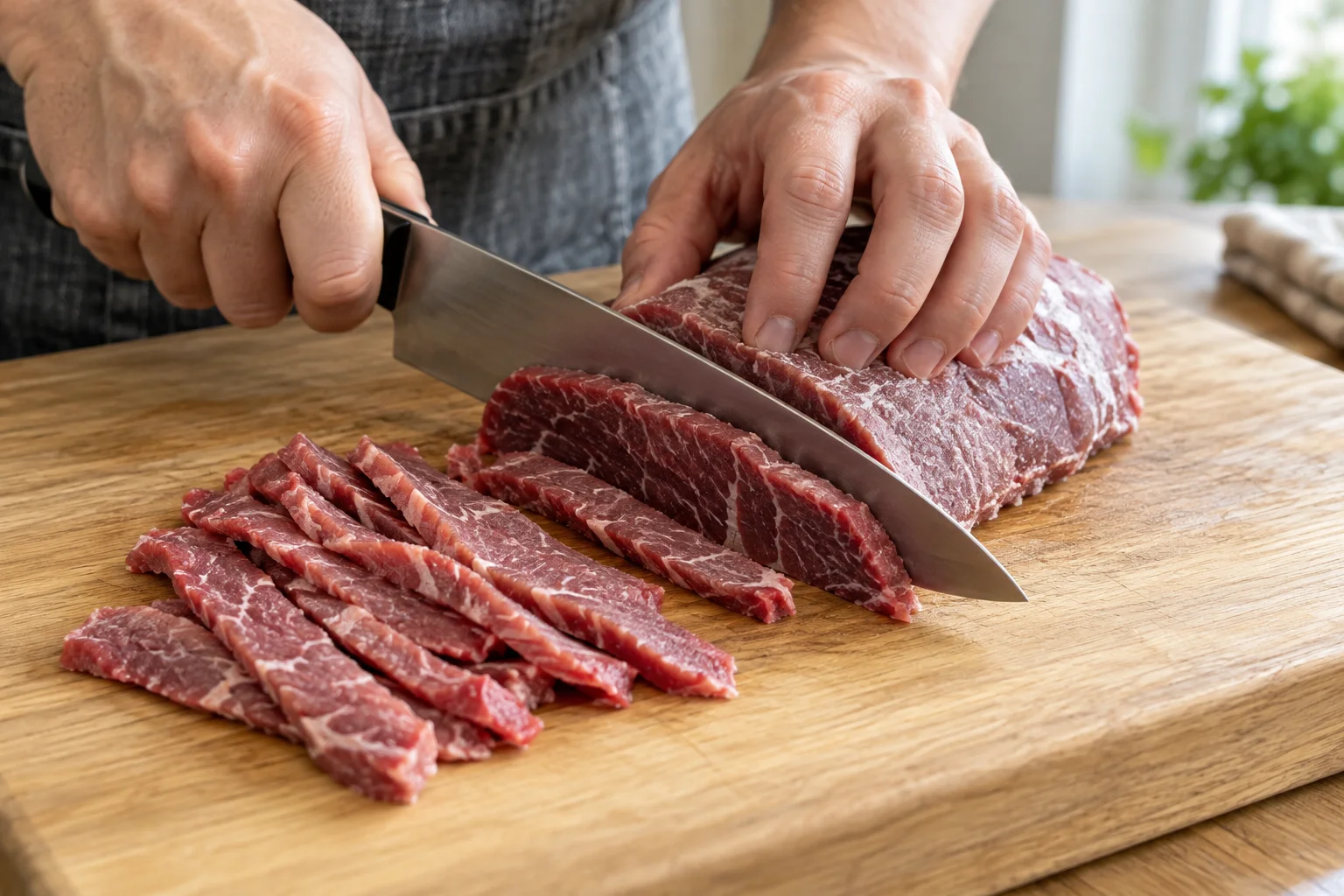
Beef jerky strips should be 1/8 inch (3 mm) thick for the express method, about the thickness of two stacked quarters, and about 1/4 inch (6 mm) for a classic low-temperature dehydrator batch. Thinner strips lose water several times faster, which is why 1/8-inch slices finish drying in under an hour in a 190°F (88°C) oven.
Cutting thinner than 1/8 inch makes brittle strips that can burn at 190°F. Look for the lines of muscle fiber running through the roast. These are the grain, and which way you cut changes the chew.
- Against the grain (across the fibers) gives jerky that tears easily and chews tender. It is the better default for beginners and for kids.
- With the grain (along the fibers) gives long, chewy, shreddable strips with the traditional jerky pull.
A partial freeze makes thin, even slices possible. After 25–30 minutes in a 0°F (−18°C) freezer, a 1.5-pound (680 g) roast is firm on the outside but still gives a little at the center, like cold cheese. Use a sharp chef's knife (shop at Amazon, opens in a new tab) and let the blade do the work. Do not leave the meat in much longer than 40 minutes, or slicing gets dangerous and the center stays icy.
If you would rather skip the knife work, ask the butcher. Many meat counters will slice a trimmed round roast to 1/8 inch on a deli slicer for free or a small fee. Tell them it is for jerky and ask for no fat. A home electric meat slicer (shop at Amazon, opens in a new tab) does the same job if you make jerky often.
What goes in a beef jerky marinade?
A beef jerky marinade needs salt (usually from soy sauce), a little acid such as Worcestershire sauce, a small amount of sugar, and surface seasonings like black pepper and garlic. For 1.5 pounds (680 g) of beef, about 1/3 cup (80 ml) of low-sodium soy sauce, 2 tablespoons of Worcestershire and 1 tablespoon of honey is enough.
Each ingredient has a job, and knowing the job helps you change a recipe without breaking it.
Salt and soy sauce pull water out of the meat, firm the surface, and lower the water activity. Water activity (aw) measures how much of the water in food is available to bacteria, and lower values make growth harder. A low-sodium soy sauce or tamari (shop at Amazon, opens in a new tab) is the base here because it adds savory depth along with the salt.
Acid from Worcestershire, vinegar or citrus brightens the flavor and slightly softens the surface. Strong acid for a long time makes the outside of the meat mushy, so in a short marinade a tablespoon or two of Worcestershire sauce (shop at Amazon, opens in a new tab) is plenty.
Sugar balances the salt and helps the strips brown and glaze. Honey (shop at Amazon, opens in a new tab), maple syrup or brown sugar also hold a little moisture, so a very sweet marinade needs a few more minutes of drying. About 1 tablespoon per pound is enough for classic jerky.
Coarse black pepper (shop at Amazon, opens in a new tab), garlic powder (shop at Amazon, opens in a new tab) and onion powder (shop at Amazon, opens in a new tab) go straight onto the strips, where they do the most good in a short marinade. About 1/2 teaspoon of liquid smoke (shop at Amazon, opens in a new tab) for 1.5 pounds gives a smoked flavor without a smoker. It is strong, so measure it.
Curing salt #1 (optional)
Curing salt #1 (shop at Amazon, opens in a new tab), also sold as Prague powder #1, contains 6.25% sodium nitrite. It gives jerky the classic pink-red color and cured flavor and adds some protection against spoilage bacteria. It is optional. The 160°F (71°C) heat step and thorough drying carry the safety load either way.
The standard dose is 1 level teaspoon per 5 pounds of meat. For a 1.5-pound (680 g) batch that is about 0.3 teaspoon, so use a scant 1/3 teaspoon (about 1.7 g). A scale that reads to 0.1 g is the safer way to measure such a small amount. Mix it into the liquid marinade until it dissolves, so it spreads evenly.
Never use curing salt #2 for jerky, never exceed the dose, and keep the container away from children. It is dyed pink so it is not mistaken for table salt.
Low-sodium and gluten-free versions
- For lower sodium, use low-sodium soy sauce, halve the Worcestershire, and replace some of the soy with water plus extra pepper and garlic. Drying concentrates salt, so jerky is naturally salty. Keep a lower-salt batch cold and eat it sooner.
- For gluten-free jerky, replace the soy sauce with tamari labeled gluten-free, or with coconut aminos (shop at Amazon, opens in a new tab), which are milder and sweeter, so use a little less honey. Check the Worcestershire label, because formulas vary.
What temperature should beef jerky be cooked to?
Beef jerky meat should reach an internal temperature of 160°F (71°C), and poultry jerky 165°F (74°C), before or at the start of drying, according to USDA FSIS. After that, the oven or dehydrator should hold at least 130–140°F (54–60°C). The express method then dries hotter, at 190–200°F (88–93°C), to finish in under an hour.
Sources disagree on drying temperature and time because they assume different slice thicknesses, different ovens, and whether the meat was heated first. This table reconciles them. Use an oven thermometer, since many oven dials are off by 25°F or more.
| Method | Drying temperature | Drying time | Batch size | Notes |
|---|---|---|---|---|
| Oven, express (this guide) | 190–200°F (88–93°C), convection, door propped | 45–60 min after pre-heat | 1.5–2 lb (680–900 g) on two pans | Fastest full batch. Strips must be 1/8 inch (3 mm) and simmered to 160°F (71°C) first. |
| Oven, classic | 160–175°F (71–79°C), door propped | 4–8 hours | 1.5–2 lb (680–900 g) | Common in other guides. Uses thicker strips and often a long marinade. |
| Food dehydrator (shop at Amazon, opens in a new tab) | 145–165°F (63–74°C) | 3–6 hours | 1–3 lb (450–1,360 g) depending on trays | Most even and hands-off. Pick a model with real temperature control up to 160°F, and still pre-heat the meat. |
| Air fryer | 170–200°F (77–93°C) | 25–35 min per batch | 5–10 oz (140–285 g) per batch | Small batches, and basket models dry unevenly. |
| Smoker or grill | 160–200°F (71–93°C) | 2–4 hours | Large | Real smoke flavor, but a steady temperature is hard to hold. Pre-heat the meat first. |
If you make jerky every week, a dehydrator pays off. For a one-off, same-day batch, the oven is the best tool you already own.
Is homemade beef jerky safe?
Homemade beef jerky is safe when the meat is heated to 160°F (71°C), or 165°F (74°C) for poultry, before or at the start of drying, and then dried until leathery. Drying alone is not a kill step, because low-temperature drying can leave Salmonella and E. coli O157:H7 alive. Oven jerky is as safe as dehydrator jerky when you follow these steps.
USDA FSIS recommends the heat step because raw meat can carry those bacteria, and they survive in a dehydrator running at 130–140°F (54–60°C). FSIS notes that outbreaks have been linked to jerky dried without a heat step. Slow, low-temperature drying dries the surface faster than it heats the interior, so the meat can sit in the danger zone, 40–140°F (4–60°C), for hours.
Heat the meat to 160°F (71°C) first, then dry. There are two ways to do the pre-heat, and this guide uses the first for whole-muscle strips.
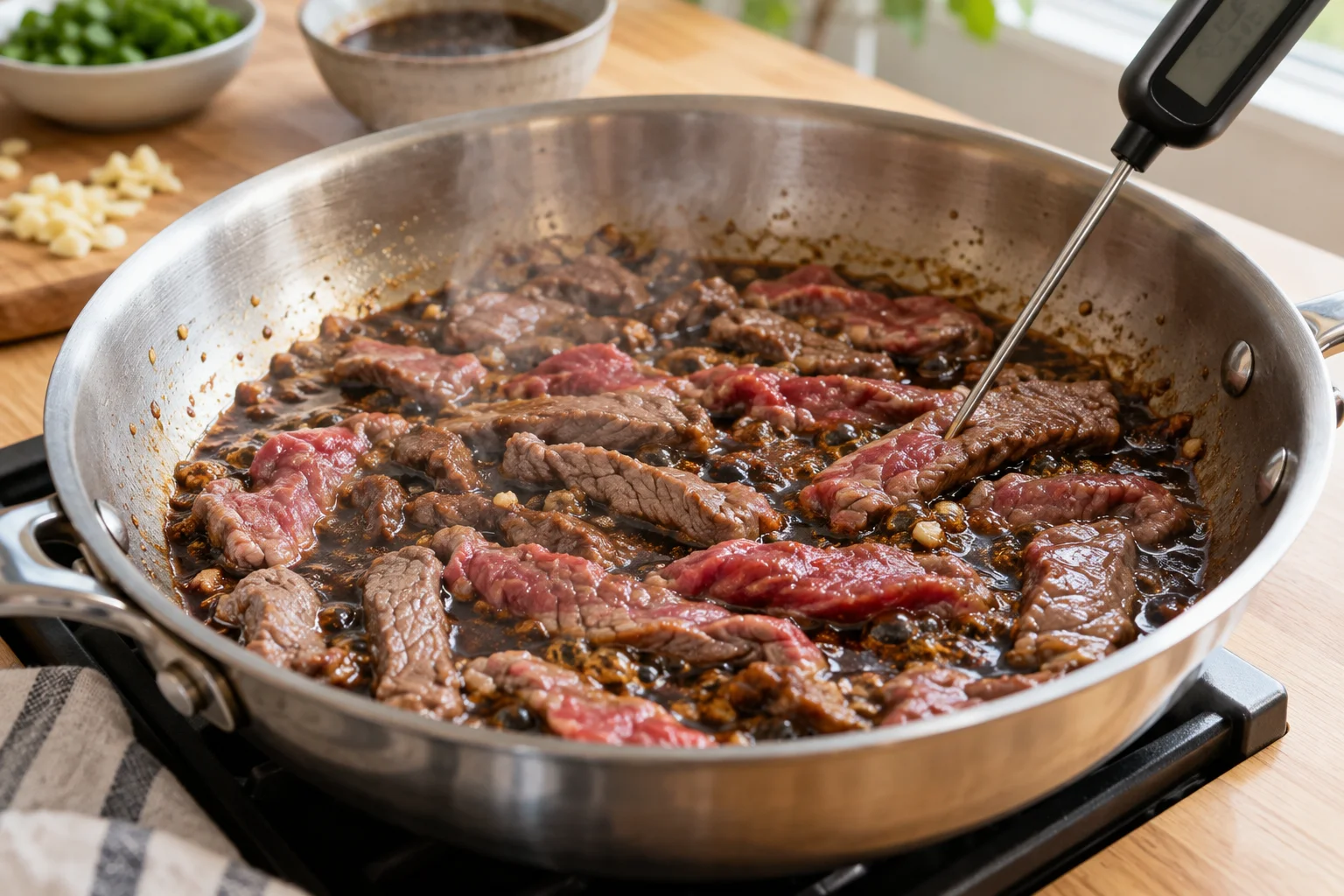
- Simmer in the marinade. Bring the marinade to a gentle simmer in a wide skillet, add the strips in a loose layer, and simmer 2–4 minutes until they turn gray-brown all the way through. Check the thickest strip with an instant-read thermometer (shop at Amazon, opens in a new tab). It should read 160°F (71°C) at the center.
- Hot oven start. Start the oven at 275°F (135°C) for the first 10 minutes, probe the thickest strips, then lower to the drying temperature. The ground-beef recipe works this way.
After the pre-heat, the oven must hold at least 130–140°F (54–60°C) for the dry. The express method runs far hotter, at 190–200°F, which is why it is fast. A thermometer in the oven tells you more than the dial.
Ground meat carries a bigger safety question than whole strips, because surface bacteria get mixed all the way through. That is why the pre-heat matters even more for ground jerky.
Venison, bear and pork can carry parasites such as Trichinella, which USDA guidance addresses with freezing and heating. Rules differ by species, so this article sticks to beef and turkey. To dry game, find a tested game-specific procedure and follow it exactly.
Keep these habits too:
- Keep raw meat at or below 40°F (4°C) until it goes in the freezer or the pan, and never leave it out more than 2 hours (1 hour above 90°F/32°C).
- Wash your hands, board, knife and tongs after handling raw strips.
- Discard any marinade that touched raw meat. Do not serve it as a dipping sauce.
- If the jerky smells sour, feels slimy or shows fuzzy mold, throw it out.
Homemade beef jerky recipes: five 2-hour methods
Every recipe below fits inside 120 minutes, including the freezer time. Recipe 1 is the baseline, and the others change the cut, the flavor or the equipment. Nutrition values are estimates calculated from USDA FoodData Central entries for the listed ingredients.
Recipe 1: 2-hour express oven beef jerky
This is the flagship method. It uses a classic soy, Worcestershire and black pepper marinade that suits most tastes. You need two half-sheet pans with wire racks that fit inside them, or one pan and two batches.
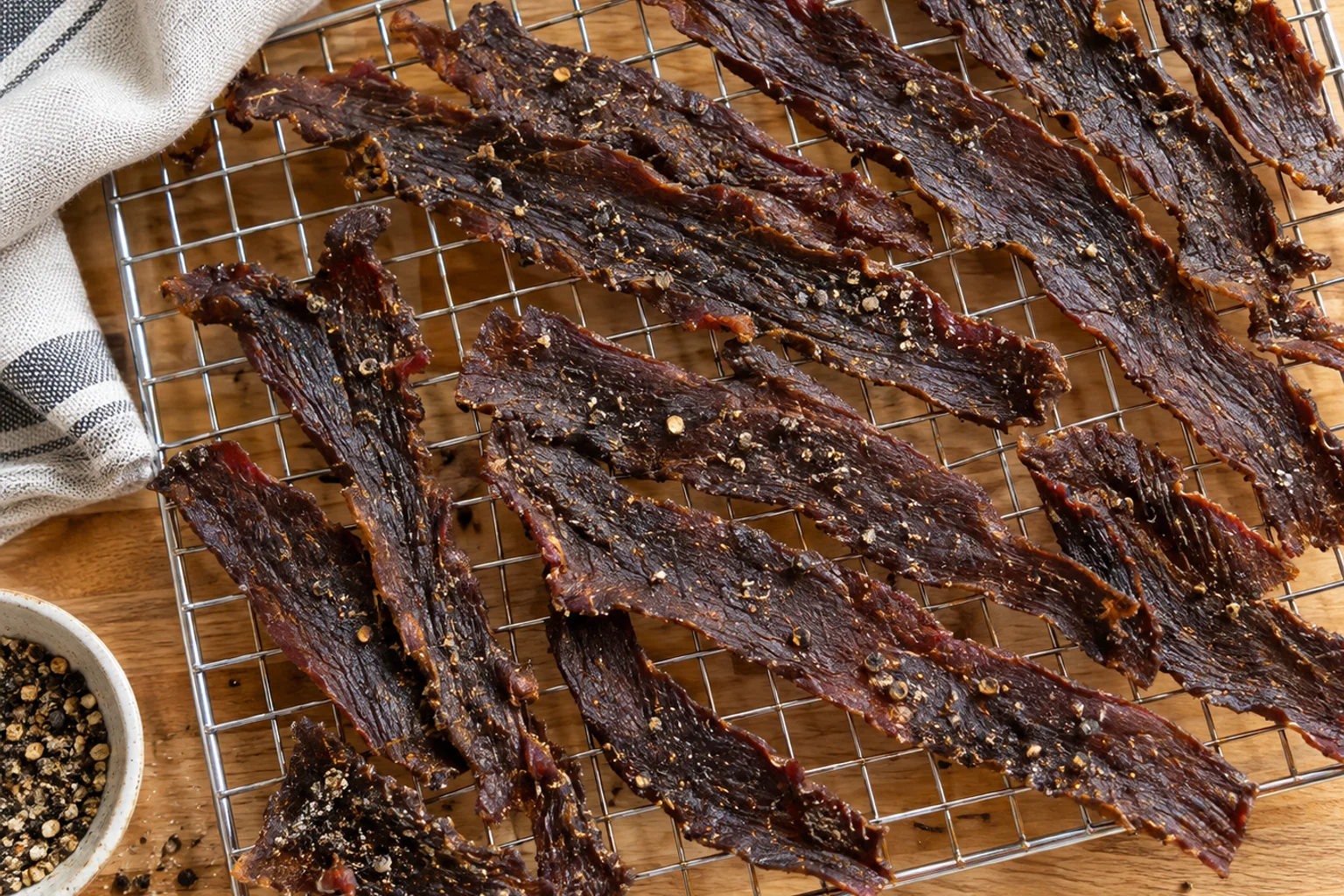
Recipe · Medium · dairy-free
2-Hour Express Oven Beef Jerky
Thin-sliced, simmered and oven-dried beef jerky with 14 g of protein per 1-ounce serving, done in 115 minutes.
- Prep
- 30 min
- Cook
- 55 min
- Chill/set
- 30 min
- Total
- 1 hr 55 min
- Makes
- 10 servings (about 1 oz / 28 g each)
- Protein
- 14g
- Calories
- 100
- Carbs
- 3g
- Fat
- 2g
- Fiber
- 0g
- Sodium
- 370mg
Per serving, approximate.
Ingredients
- 1.5 lb (680 g) beef eye of round, trimmed of all visible fat and silver skin (shop at Whole Foods, opens in a new tab)
- 1/3 cup (80 ml) low-sodium soy sauce (shop at Amazon, opens in a new tab)
- 2 tbsp (30 ml) Worcestershire sauce (shop at Amazon, opens in a new tab)
- 1 tbsp (21 g) honey (shop at Amazon, opens in a new tab)
- 2 tsp coarse-ground black pepper (shop at Amazon, opens in a new tab)
- 1 tsp garlic powder (shop at Amazon, opens in a new tab)
- 1 tsp onion powder (shop at Amazon, opens in a new tab)
- 1/2 tsp liquid smoke (shop at Amazon, opens in a new tab)
- 1/4 cup (60 ml) water
- a scant 1/3 tsp (about 1.7 g) curing salt #1 (optional, weigh it) (shop at Amazon, opens in a new tab)
Equipment
- Rimmed half-sheet pans (shop at Amazon, opens in a new tab)
- Oven-safe wire cooling racks (fit half-sheet) (shop at Amazon, opens in a new tab)
- Instant-read meat thermometer (shop at Amazon, opens in a new tab)
- Sharp chef's knife or slicing knife (shop at Amazon, opens in a new tab)
- Digital kitchen scale (grams) (shop at Amazon, opens in a new tab)
Steps
- Minute 0: Trim every bit of visible fat and silver skin from the roast, wrap it tightly, and put it in the freezer for 30 minutes.
- While it freezes, whisk the soy sauce, Worcestershire, honey, pepper, garlic powder, onion powder, liquid smoke, water and the curing salt, if using, in a wide bowl until the honey and cure dissolve.
- Set wire racks inside two half-sheet pans. Move an oven rack to the middle and start preheating to 200°F (93°C) with the convection fan on, if you have one, about 15 minutes before the freeze ends.
- Minute 35: Unwrap the roast and slice it across the grain into 1/8-inch (3 mm) strips with a sharp knife. Drop the strips into the marinade as you go, and stir every few minutes so each one is coated.
- Minute 47: Pour the marinade and strips into a wide skillet and bring to a gentle simmer over medium heat. Simmer in 2 or 3 batches for 2 to 4 minutes, turning once, until the strips are gray-brown with no pink and the thickest strip reads 160°F (71°C) on an instant-read thermometer.
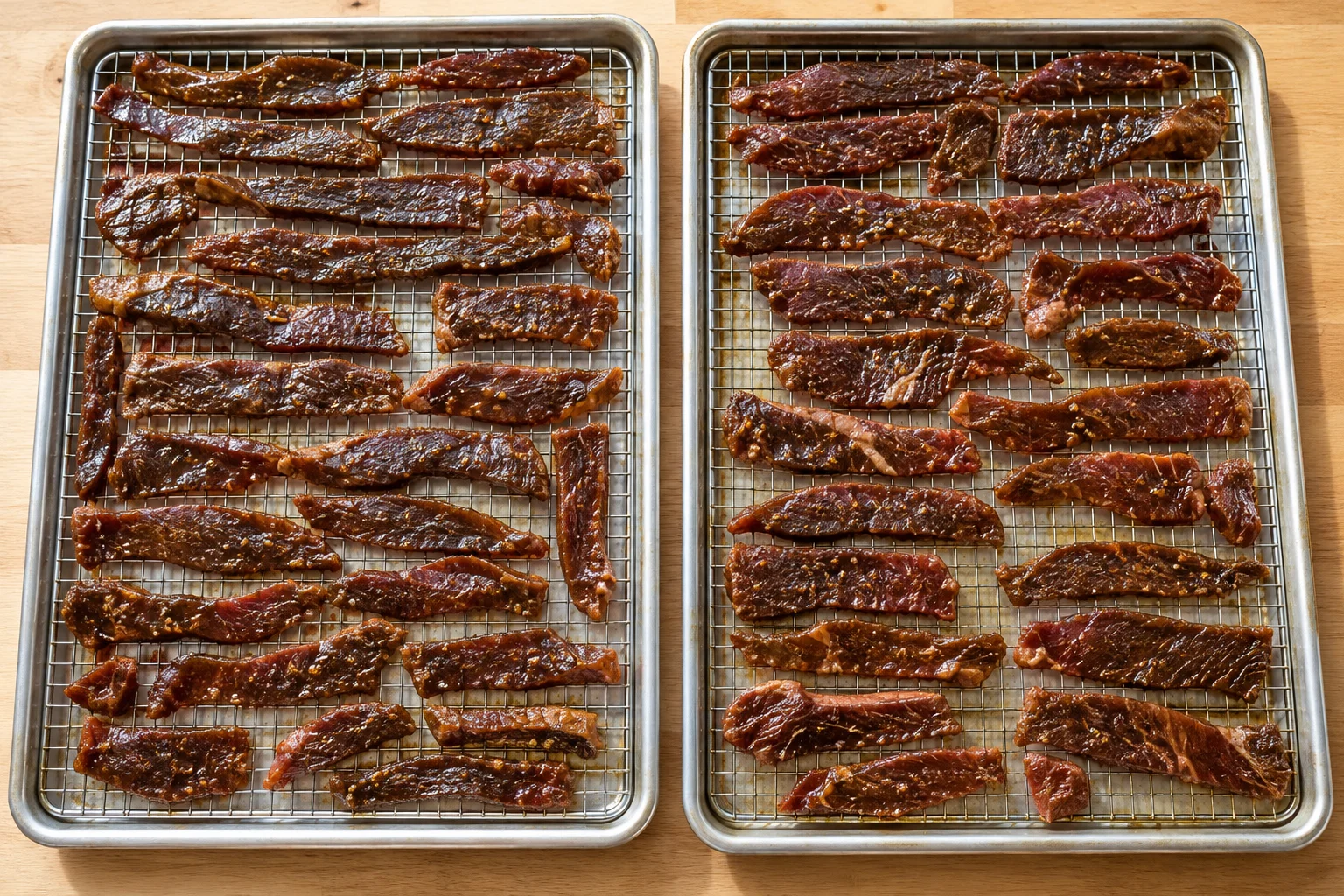
- Lift each strip out with tongs, shake off drips, and lay it on a wire rack in a single layer with a little space between strips. Discard the remaining marinade and wash the tongs and board.
- Minute 60: Put the pans in the oven and prop the door open about 1 inch (2.5 cm) with a wooden spoon so moisture can escape. Dry for 40 minutes without opening it.
- Check a thick strip: let it cool for 1 minute and bend it. It should crack but not snap and have no wet spots. Keep drying in 5-minute steps, swapping pan positions once, until every strip passes, about 55 minutes total.
- Cool the finished strips on the racks for 15 minutes, blot any beads of fat with a paper towel, then store.
Storage: Airtight jar at room temperature about 1 week; fridge 1 to 2 weeks; freezer 2 to 3 months.
Tips for this recipe:
- Slice the whole roast first and marinate the strips together. Strips that sit for 10 minutes before they hit the skillet taste noticeably stronger than the first ones in.
- If your oven does not go as low as 200°F, or the convection fan runs hot, start with the lower setting and watch the strips at 35 minutes.
- Lay the strips so they do not touch. Overlapping strips dry unevenly and stick together.
Recipe 2: sweet and spicy sriracha jerky
This variation swaps the black pepper profile for heat and sweetness. Sriracha (shop at Amazon, opens in a new tab) brings salt, garlic and chili, so the marinade needs less soy sauce. Use top round for a slightly wider, more tender strip.
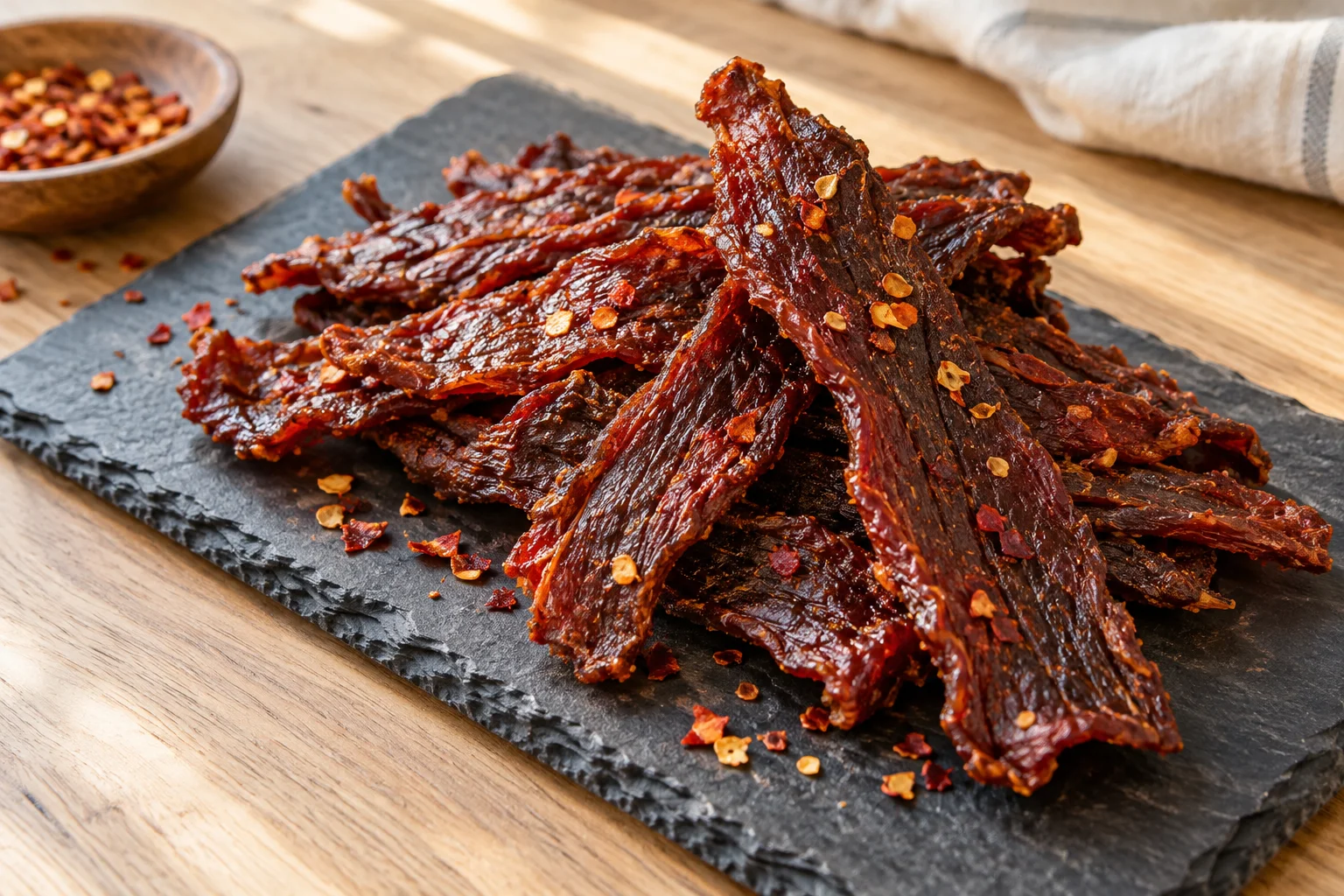
Recipe · Medium · dairy-free
Sweet and Spicy Sriracha Beef Jerky
Glossy, lightly sticky top-round beef jerky with sriracha heat and 14 g of protein per 1-ounce serving.
- Prep
- 30 min
- Cook
- 50 min
- Chill/set
- 30 min
- Total
- 1 hr 50 min
- Makes
- 10 servings (about 1 oz / 28 g each)
- Protein
- 14g
- Calories
- 105
- Carbs
- 5g
- Fat
- 2g
- Fiber
- 0g
- Sodium
- 360mg
Per serving, approximate.
Ingredients
- 1.5 lb (680 g) beef top round, trimmed of all visible fat (shop at Whole Foods, opens in a new tab)
- 1/4 cup (60 ml) low-sodium soy sauce (shop at Amazon, opens in a new tab)
- 3 tbsp (45 ml) sriracha (shop at Amazon, opens in a new tab)
- 2 tbsp (42 g) honey (shop at Amazon, opens in a new tab)
- 1 tbsp (15 ml) Worcestershire sauce (shop at Amazon, opens in a new tab)
- 1 tbsp (15 ml) apple cider vinegar
- 1 tsp smoked paprika (shop at Amazon, opens in a new tab)
- 1 tsp garlic powder (shop at Amazon, opens in a new tab)
- 1/2 tsp crushed red pepper flakes (optional, for more heat) (shop at Amazon, opens in a new tab)
- 1/4 cup (60 ml) water
Equipment
Steps
- Trim the top round, wrap it, and freeze it for 30 minutes.
- Whisk the soy sauce, sriracha, honey, Worcestershire, vinegar, smoked paprika, garlic powder, pepper flakes and water in a wide bowl. Set racks in two half-sheet pans and preheat the oven to 195°F (91°C), convection if available.
- Slice the partly frozen beef across the grain into 1/8-inch (3 mm) strips, adding them to the marinade as you cut.
- Simmer the strips and marinade in a wide skillet in 2 or 3 batches for 2 to 4 minutes each, until no pink remains and the thickest strip reads 160°F (71°C).
- Lay the strips on the racks in a single layer. Honey glazes the surface, so leave a little gap between them.
- Dry in the oven with the door propped open 1 inch (2.5 cm) for 45 to 50 minutes, rotating the pans once. Expect a slightly tackier surface than Recipe 1 because of the honey.
- Bend-test a strip after a 1-minute cool. It should crack without snapping. Dry in 5-minute steps if needed, then blot and cool 15 minutes.
Storage: Airtight jar at room temperature about 1 week; fridge 1 to 2 weeks; freezer 2 to 3 months.
For a teriyaki version, replace the sriracha with 2 tablespoons of low-sodium soy, 1 tablespoon of honey, 1 teaspoon of ground ginger and a pinch of garlic, and skip the vinegar. Everything else stays the same.
Recipe 3: ground-beef jerky with a jerky gun or rolling pin
Ground-beef jerky is the fastest and most forgiving version. There is no slicing and no freezing, the seasoning mixes through the meat, and the strips come out uniform. The texture is closer to a snack stick than to classic jerky.
Use 93% lean ground beef or leaner, because fattier meat makes greasy strips that spoil quickly. Mix the seasoning into the cold meat until it feels tacky, then shape the strips one of two ways:
- With a jerky gun (shop at Amazon, opens in a new tab), press strips about 1/8 to 3/16 inch (3 to 5 mm) thick onto parchment-lined sheet pans.
- With a rolling pin, sandwich the meat between two sheets of parchment paper (shop at Amazon, opens in a new tab), roll it to an even 1/8 inch (3 mm), freeze it 10 minutes if you like, peel off the top sheet, and cut strips with a pizza wheel or knife.
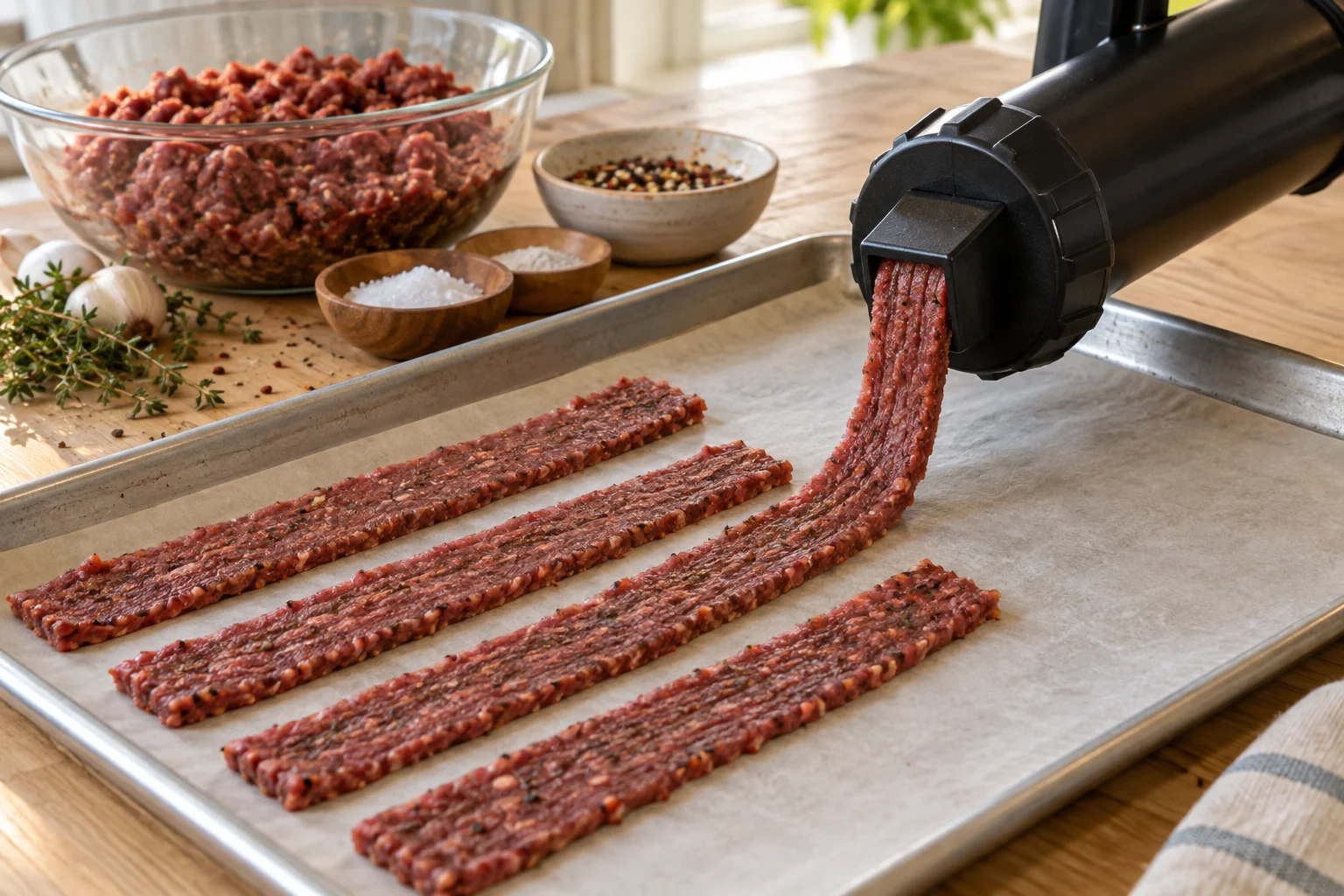
The recipe starts the oven at 275°F (135°C) for the first 10 minutes and has you probe a thick strip for 160°F (71°C) before you lower the temperature.
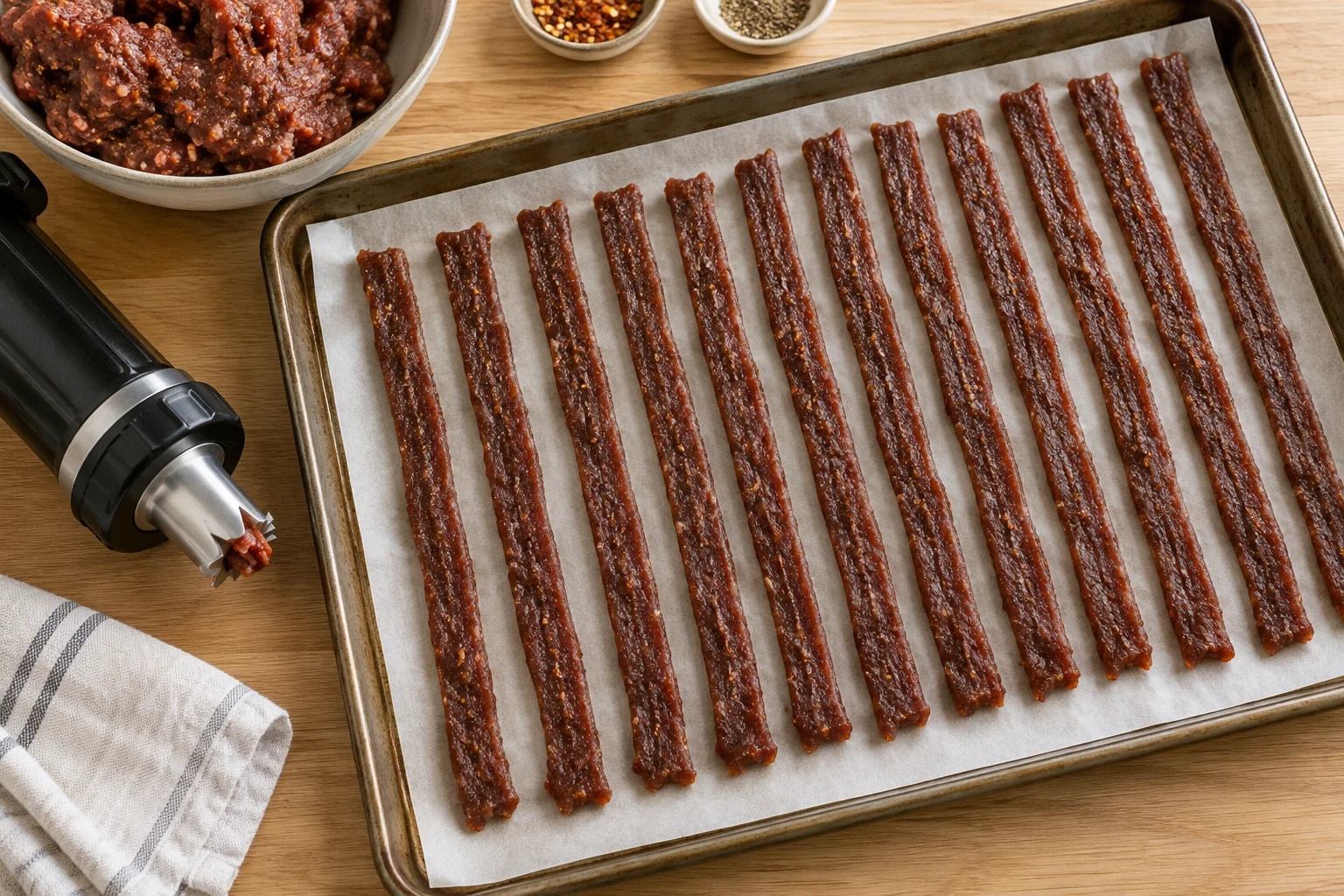
Recipe · Easy · dairy-free
Ground-Beef Jerky (Jerky Gun or Rolling Pin)
Fast, uniform 93% lean ground-beef jerky with 13 g of protein per 1-ounce serving, from bowl to oven in 25 minutes.
- Prep
- 25 min
- Cook
- 1 hr 10 min
- Total
- 1 hr 35 min
- Makes
- 7 servings (about 1 oz / 28 g each)
- Protein
- 13g
- Calories
- 100
- Carbs
- 2g
- Fat
- 4.5g
- Fiber
- 0g
- Sodium
- 380mg
Per serving, approximate.
Ingredients
- 1 lb (454 g) 93% lean ground beef, cold (shop at Whole Foods, opens in a new tab)
- 2 tbsp (30 ml) low-sodium soy sauce (shop at Amazon, opens in a new tab)
- 1 tbsp (15 ml) Worcestershire sauce (shop at Amazon, opens in a new tab)
- 1 tsp coarse-ground black pepper (shop at Amazon, opens in a new tab)
- 1/2 tsp garlic powder (shop at Amazon, opens in a new tab)
- 1/2 tsp onion powder (shop at Amazon, opens in a new tab)
- 1/2 tsp smoked paprika (shop at Amazon, opens in a new tab)
- 1/4 tsp liquid smoke (shop at Amazon, opens in a new tab)
Equipment
Steps
- Line two half-sheet pans with parchment paper and preheat the oven to 275°F (135°C), convection if available.
- In a bowl, mix the cold ground beef with the soy sauce, Worcestershire, pepper, garlic powder, onion powder, paprika and liquid smoke for about 1 minute, until the mixture feels sticky and evenly seasoned.
- Load the meat into a jerky gun and press strips 1/8 to 3/16 inch (3 to 5 mm) thick onto the pans, or roll the meat between two sheets of parchment to 1/8 inch (3 mm) and cut it into 1-inch (2.5 cm) strips.
- Bake at 275°F (135°C) for 10 to 12 minutes, until the thickest strip reads 160°F (71°C) on an instant-read thermometer.
- Lower the oven to 190°F (88°C), prop the door open about 1 inch (2.5 cm), and keep drying for 30 minutes.
- Flip every strip, blot the surface fat with a paper towel, and dry another 20 to 30 minutes, until the strips bend and crack without snapping.
- Blot again and cool on a rack for 15 minutes.
Storage: Fridge 1 week in an airtight container; freezer 2 months. Ground meat carries more fat, so do not keep it at room temperature more than 2 to 3 days.
Expect more fat spots on the surface than with whole-muscle jerky. Blot them while the strips are warm.
Recipe 4: air-fryer beef jerky
An air fryer (shop at Amazon, opens in a new tab) with a dehydrate or low-temperature setting makes good jerky in small batches. Basket models are small and move air hard, so strips can dry at the edges and stay damp in the middle. Oven-style air fryers with removable racks do better. Cut the batch down, keep strips in a single layer, and run two rounds if needed.
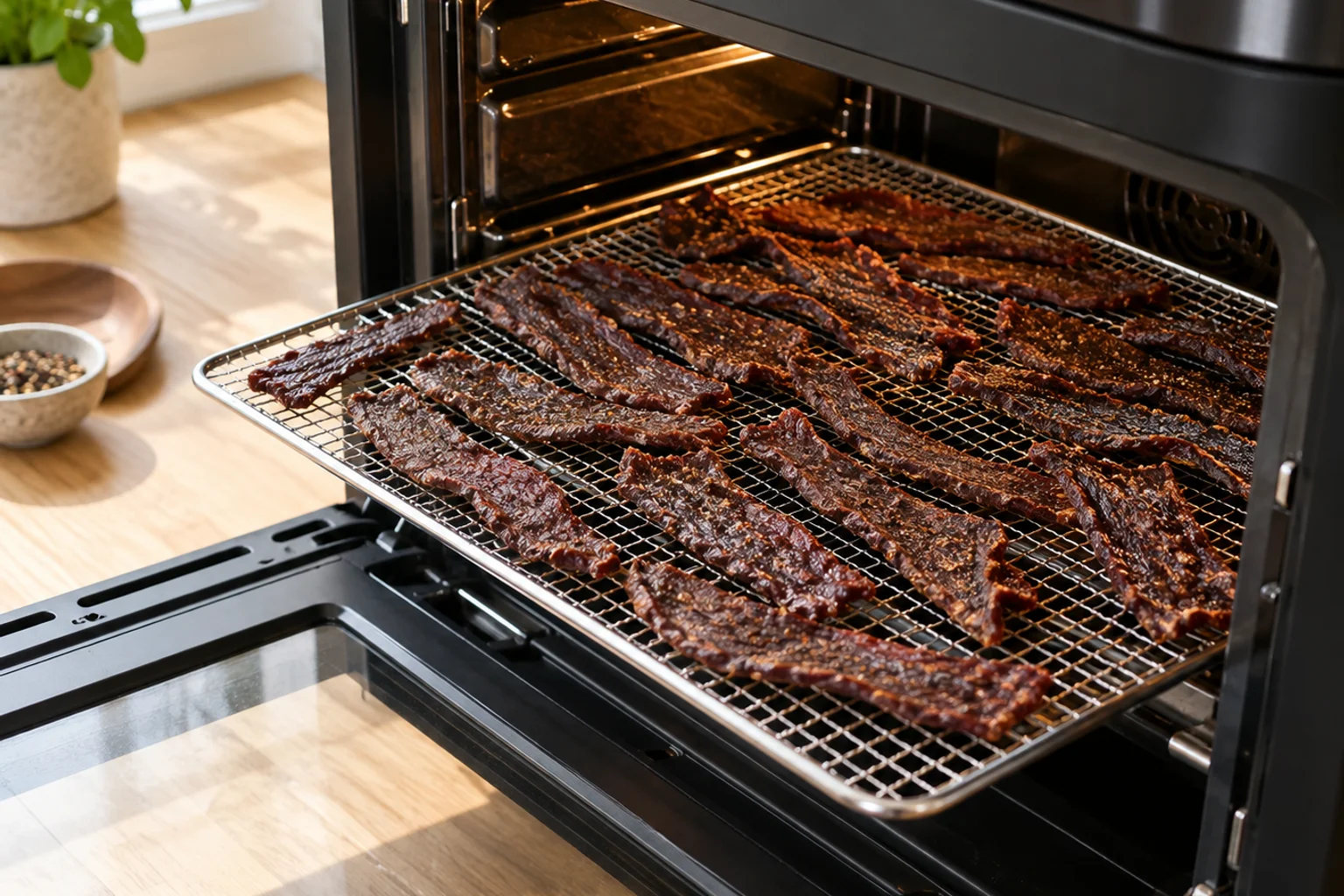
Recipe · Easy · dairy-free
Air-Fryer Beef Jerky
A small batch of 1/8-inch eye-of-round jerky with 15 g of protein per 1-ounce serving, dried in an air fryer in under 2 hours.
- Prep
- 25 min
- Cook
- 55 min
- Chill/set
- 30 min
- Total
- 1 hr 50 min
- Makes
- 4 servings (about 1 oz / 28 g each)
- Protein
- 15g
- Calories
- 100
- Carbs
- 2g
- Fat
- 2.5g
- Fiber
- 0g
- Sodium
- 360mg
Per serving, approximate.
Ingredients
- 10 oz (285 g) beef eye of round, trimmed (shop at Whole Foods, opens in a new tab)
- 3 tbsp (45 ml) low-sodium soy sauce (shop at Amazon, opens in a new tab)
- 1 tbsp (15 ml) Worcestershire sauce (shop at Amazon, opens in a new tab)
- 2 tsp honey (shop at Amazon, opens in a new tab)
- 1 tsp coarse-ground black pepper (shop at Amazon, opens in a new tab)
- 1/2 tsp garlic powder (shop at Amazon, opens in a new tab)
- 1/4 tsp liquid smoke (shop at Amazon, opens in a new tab)
- 2 tbsp (30 ml) water
Equipment
Steps
- Trim the beef, wrap it, and freeze it for 30 minutes.
- Whisk the soy sauce, Worcestershire, honey, pepper, garlic powder, liquid smoke and water in a bowl.
- Slice the beef across the grain into 1/8-inch (3 mm) strips and stir them into the marinade.
- Simmer the strips and marinade in a skillet for 2 to 4 minutes, until no pink remains and the thickest strip reads 160°F (71°C).
- Drain the strips, shake off drips, and lay them in a single layer in the air-fryer basket or on the racks, with a little space between each strip. Work in two batches if the strips would overlap.
- Set the air fryer to the dehydrate setting, or to its lowest temperature of 170–200°F (77–93°C). Dry for 20 minutes.
- Rearrange the strips and swap rack positions. Continue drying 5 to 10 minutes at a time, bend-testing a strip after each check, until it cracks but does not snap. Expect 25 to 30 minutes per batch.
- Cool 15 minutes on a plate or rack and blot any fat.
Storage: Airtight jar at room temperature about 1 week; fridge 1 to 2 weeks; freezer 2 to 3 months.
If your air fryer's lowest setting is 250–300°F (120–150°C), cook for a shorter time and check at 12 minutes. The jerky will cook more than dry and turn out crisper. That is a taste choice and not a safety problem, since the meat is already pre-heated.
Recipe 5: turkey jerky
Turkey breast makes a very lean, mild jerky. Poultry must reach 165°F (74°C) before drying, which the simmer step handles. Turkey has almost no fat, so it dries faster than beef and can turn brittle. Check it earlier. Buy turkey breast cutlets (shop at Whole Foods, opens in a new tab) and slice them into strips.
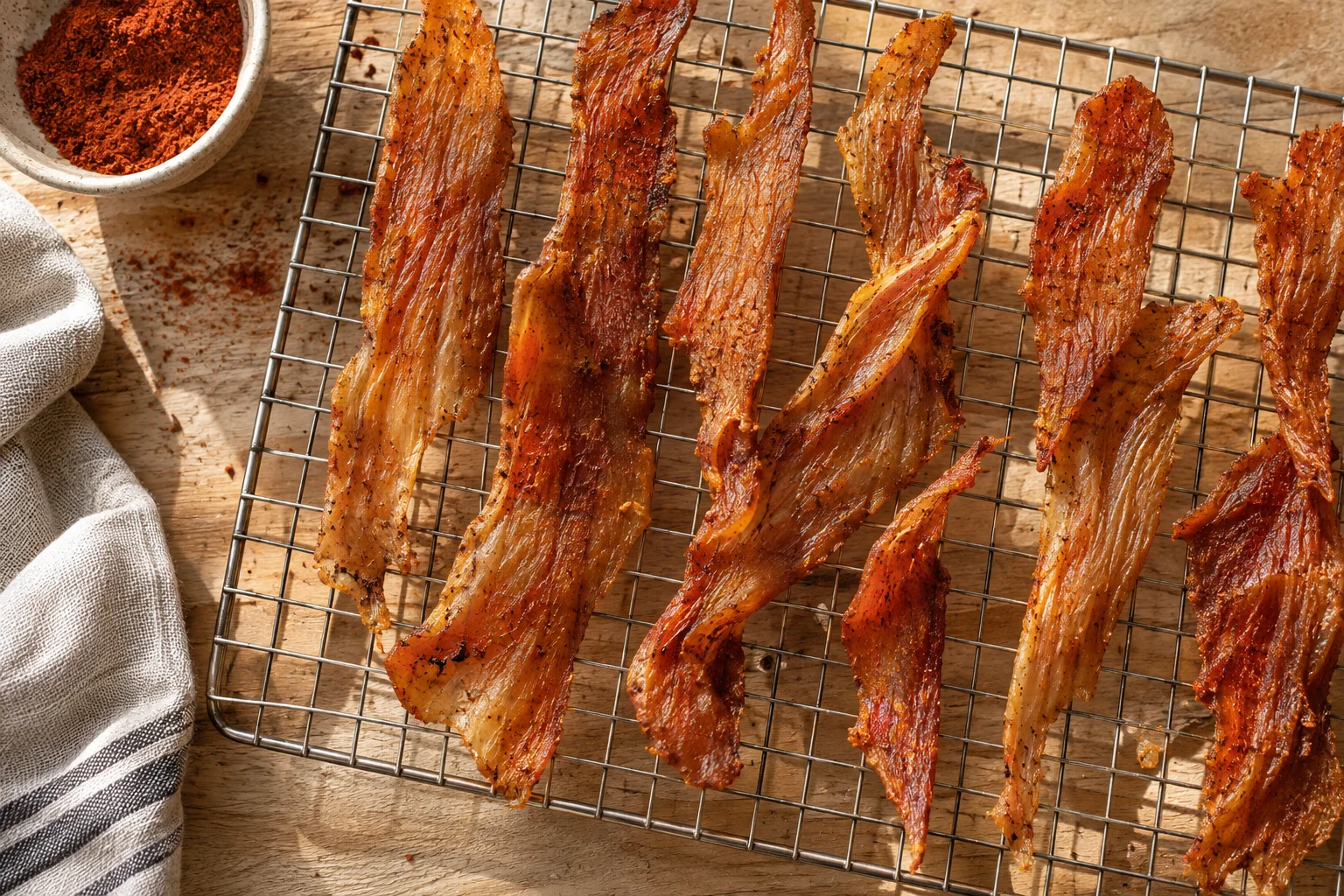
Recipe · Medium · dairy-free
Turkey Jerky
Mild, very lean turkey-breast jerky with 17 g of protein per 1-ounce serving, simmered to 165°F and oven-dried.
- Prep
- 30 min
- Cook
- 45 min
- Chill/set
- 25 min
- Total
- 1 hr 40 min
- Makes
- 6 servings (about 1 oz / 28 g each)
- Protein
- 17g
- Calories
- 85
- Carbs
- 2g
- Fat
- 1g
- Fiber
- 0g
- Sodium
- 400mg
Per serving, approximate.
Ingredients
- 1 lb (454 g) turkey breast cutlets, trimmed (shop at Whole Foods, opens in a new tab)
- 1/4 cup (60 ml) low-sodium soy sauce (shop at Amazon, opens in a new tab)
- 1 tbsp (21 g) honey (shop at Amazon, opens in a new tab)
- 1 tbsp (15 ml) apple cider vinegar
- 1 tsp smoked paprika (shop at Amazon, opens in a new tab)
- 1 tsp garlic powder (shop at Amazon, opens in a new tab)
- 1/2 tsp coarse-ground black pepper (shop at Amazon, opens in a new tab)
- 1/4 tsp crushed red pepper flakes (optional) (shop at Amazon, opens in a new tab)
- 1/4 cup (60 ml) water
Equipment
Steps
- Trim any fat and sinew from the turkey cutlets, lay them flat on a plate, and freeze them for 25 minutes.
- Whisk the soy sauce, honey, vinegar, paprika, garlic powder, pepper, pepper flakes and water in a wide bowl. Set wire racks in two half-sheet pans and preheat the oven to 190°F (88°C), convection if available.
- Slice the cutlets with the grain into strips 1/8 to 1/4 inch (3 to 6 mm) thick and about 1 inch (2.5 cm) wide. Stir them into the marinade.
- Simmer in a wide skillet for 3 to 4 minutes per batch, until no pink remains and the thickest strip reads 165°F (74°C) on an instant-read thermometer.
- Lay the strips on the racks in a single layer, prop the oven door open 1 inch (2.5 cm), and dry for 30 minutes.
- Bend-test a strip after a 1-minute cool, then keep drying in 5-minute steps until it cracks without snapping, usually 40 to 45 minutes total.
- Cool for 15 minutes on the racks, then store.
Storage: Fridge 1 week in an airtight container; freezer 2 months. Turkey jerky has little fat, so freeze it earlier than beef if you will not eat it within a few days.
Turkey jerky tastes dry if over-dried. Pull it as soon as it cracks without snapping, and let the conditioning step below finish the job.
How do you know when beef jerky is done?
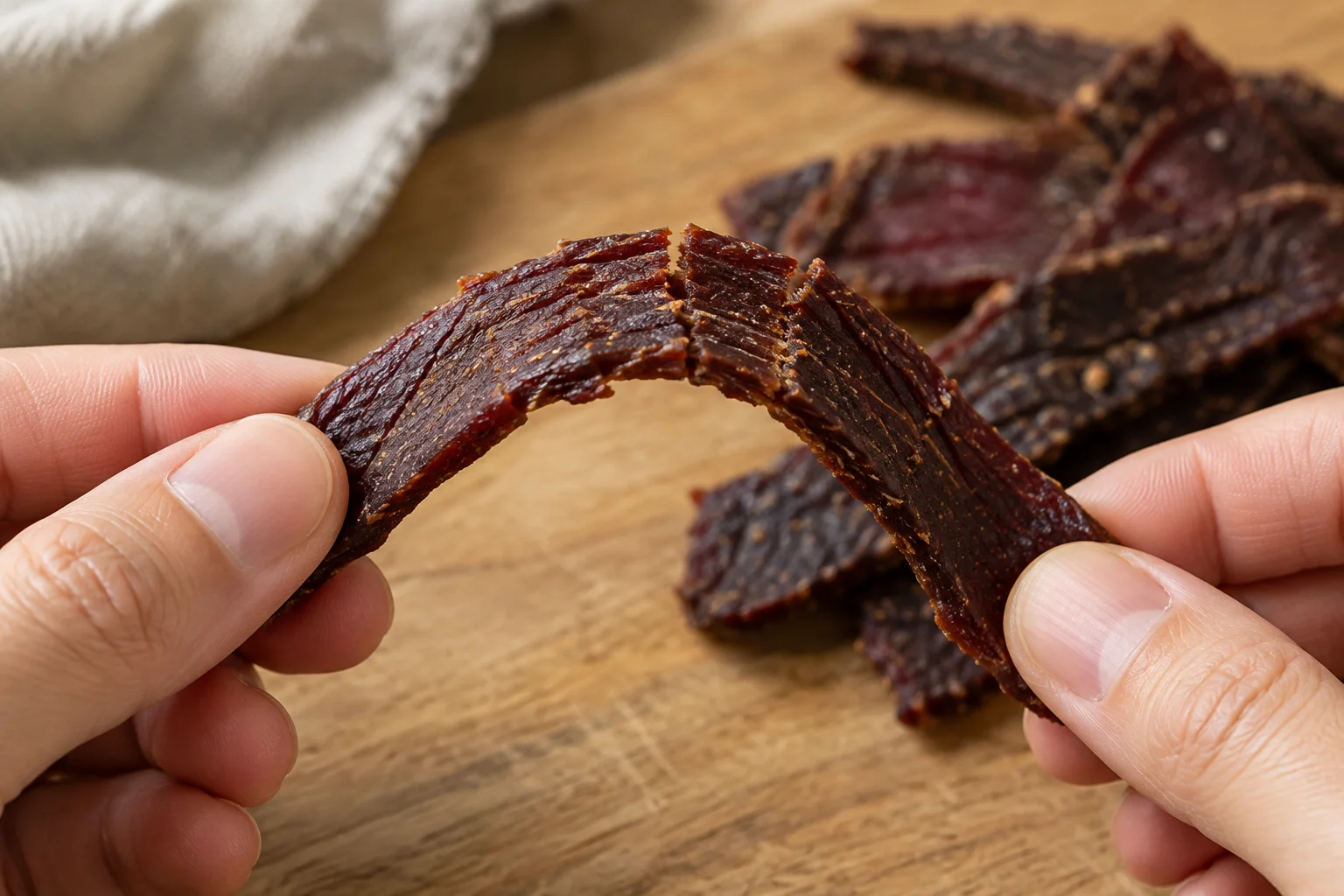
Beef jerky is done when a strip, cooled for 1 minute, bends 90 degrees and shows fine white cracks on the outer curve without snapping. The surface should be dry, dark and leathery, with no wet or soft spot in the center. If the strip breaks, it is over-dried. If it folds without cracking, dry it 5–10 minutes more.
Doneness is about texture and moisture, not the clock. These checks work in order.
- Bend test: take a thick strip out, let it cool for 1 minute, and bend it 90 degrees. It should crack on the outside but not break in two.
- Look and feel: the surface should be dry, leathery and dark brown. Tear one open, and the middle should not look raw.
- Blot the fat: small beads of fat on top are normal. Blot them with a paper towel while the strips are warm.
- Thermometer check, if you want one: the safety check is the 160°F (71°C) pre-heat, so you do not need to probe finished jerky.
Condition before you store
Warm jerky holds uneven moisture. Let the strips cool completely, then seal them loosely in a zip-top bag or jar for about an hour so moisture evens out between drier and moister strips. If you see condensation inside, the batch is under-dried, and it should go back in the oven for 10–15 minutes. This hour is optional and happens after the 2-hour window.
Troubleshooting
| Problem | Likely cause | Fix |
|---|---|---|
| Too brittle | Sliced too thin, or over-dried at high temperature | Pull sooner next time and check from minute 35. Slice closer to 1/8 inch (3 mm), not 1/16. Brittle jerky is still safe, and it crumbles well into soup or trail mix. |
| Too chewy or leathery | Sliced with the grain, or too thick | Slice across the grain. If thick strips are tough, add 5–10 minutes at the end instead of raising the temperature. |
| Case hardening (dry crust, damp inside) | Heat too high at the start, or strips too thick, so the outside seals | Keep slices at 1/8 inch (3 mm), prop the door for airflow, and dry in 5-minute steps. If strips bend with a damp center, keep drying. |
| Uneven drying | Overlapping strips, crowded racks, oven hot spots | Use a single layer with gaps, rotate and swap pans at the halfway mark, and pull finished strips out as they are ready. |
| Too salty | Heavy soy, or a very concentrated marinade; drying concentrates salt | Use low-sodium soy, cut the Worcestershire, add water, and rinse strips briefly before laying them on racks. |
| White spots on the surface | Usually salt or fat bloom. Mold is rare but possible after storage. | See below. |
A fine white or gray film or dots on freshly dried jerky are most often rendered fat or salt crystals. Rub it with a clean finger: fat smears and melts a little, and salt feels gritty.
Mold is fuzzy or hairy and sits raised on the surface, in white, green, black or blue, and usually shows up after days of storage somewhere humid or warm. If you see fuzzy growth, throw the whole batch away. Do not cut off the mold and eat the rest. If you are unsure, discard it.
How long does homemade beef jerky last?
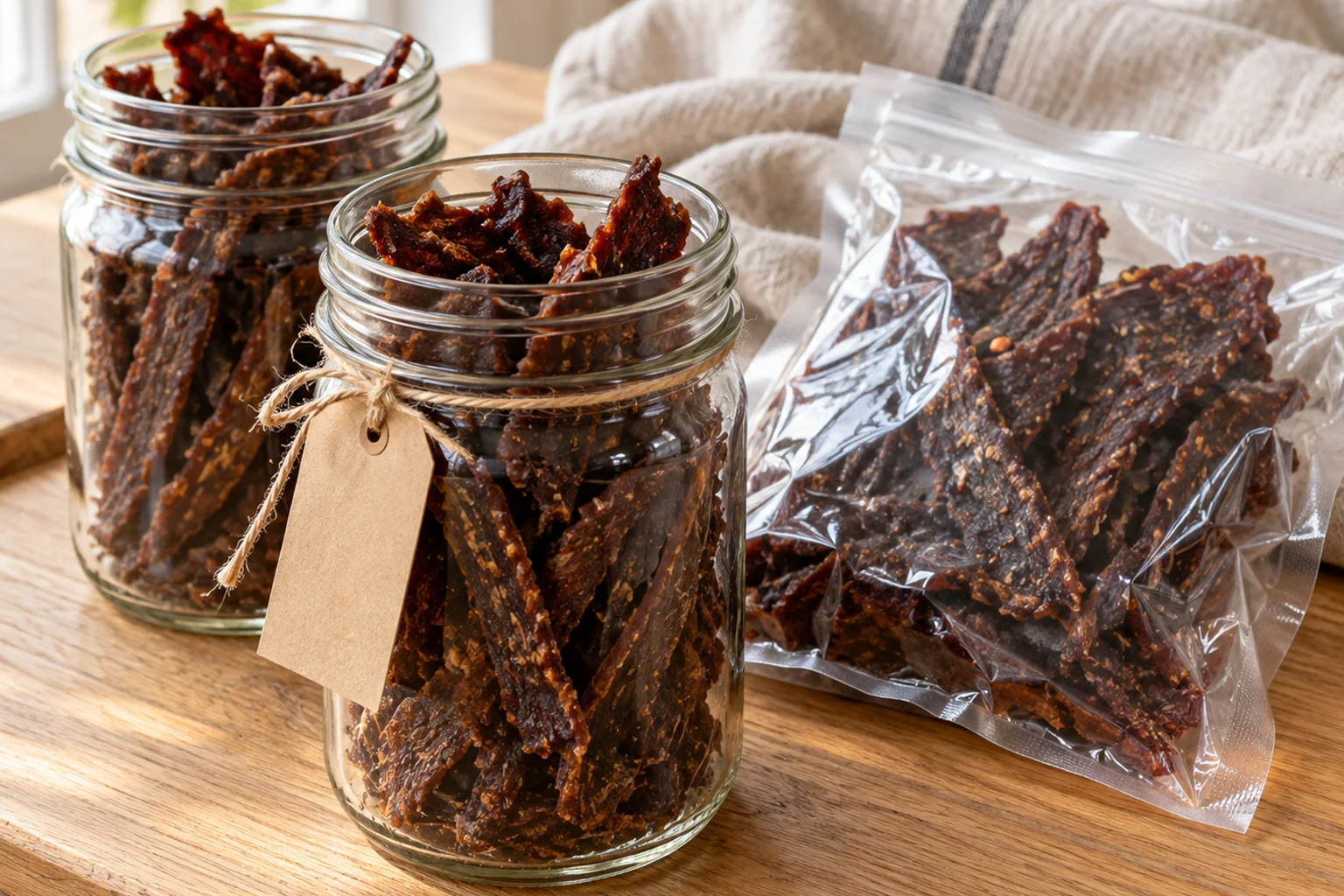
Homemade beef jerky lasts about 1 week at room temperature in an airtight container, 1–2 weeks in the fridge, and 2–3 months in the freezer for best quality. These are conservative times for jerky made without curing salt or commercial packaging. Ground-beef jerky lasts only 2–3 days at room temperature.
You will find claims that range from 1–2 weeks to 6 months. The longer figures usually describe store-bought jerky, which has cure, preservatives and sealed packaging. For homemade jerky, count one week in the pantry, freeze the rest, and judge by smell and appearance.
| Where | Typical time | Notes |
|---|---|---|
| Room temperature | About 1 week | Airtight jar or bag, away from light and heat. Use only well-dried, lean jerky. Ground-beef jerky: 2–3 days. |
| Fridge | 1–2 weeks | Best choice if your kitchen is warm or humid. |
| Freezer | 2–3 months for best quality | At 0°F (−18°C), food stays safe indefinitely. The time limit is about flavor and texture. |
| Vacuum sealed with oxygen absorber | Several weeks at room temperature, longer cold | Slows fat oxidation. Keep it cool, and do not treat it as a canning step. |
Pack jerky in snack-size portions so you open only what you will eat, and put a dated label on each bag. For fridge and freezer details, see fridge and freezer storage for protein snacks. For drying science, water activity and oxygen absorbers, see how to preserve homemade protein snacks.
A vacuum sealer (shop at Amazon, opens in a new tab) with oxygen absorbers (shop at Amazon, opens in a new tab) is the most useful upgrade for large batches. For everyday use, wide-mouth mason jars (shop at Amazon, opens in a new tab) hold the week's supply.
How much does homemade jerky cost, and how much protein does it have?
Homemade beef jerky costs roughly $1–$2 per ounce, compared with $2.50–$6 for store-bought, and has about 12–16 g of protein per 1-ounce (28 g) serving. Eye of round or top round often runs $6–$9 per pound raw and dries to about 40–45% of its weight, so a 1.5-pound (680 g) roast yields about 10 ounces.
Prices vary by store and season, so treat these as rough ranges for a U.S. supermarket. Mass-market jerky usually costs $2.50–$4 per ounce on sale, and $4–$6 or more for premium or grass-fed brands. Homemade is cheapest when you buy roasts on sale and freeze them, and you control the sodium and sugar. Store-bought wins on convenience and shelf life.
Commercial jerky is often 9–13 g of protein per ounce, because added sugar and moisture dilute the protein. The beef recipes here land at about 13–15 g of protein per 100 calories. Nutrition values are estimates from USDA FoodData Central entries, so they are not exact. The site's healthy protein snack method asks for 10 g or more of protein, under 200 calories, 5 g or less of sugar and under 400 mg of sodium per serving, plus at least 3 g of fiber. The beef recipes meet the first four and have no fiber, so pair it with fruit or nuts. For how this fits into a day, see how much protein a snack should have.
Jerky is high in sodium, at about 350–400 mg per ounce in these recipes. If you have kidney disease or a doctor-advised sodium limit, check with your doctor before making it a daily snack.
For more savory ideas to pair with a jar of jerky, see savory meat, fish and egg snacks and the combination formulas in build your own high-protein snacks.
Shop this article
29 ingredients and tools. Add them to your list, then send it to Amazon, Whole Foods or Instacart.
Meat & fish
- Beef eye of round roastWhole Foods (opens in a new tab)Instacart (opens in a new tab)
- Beef top round (London broil)Whole Foods (opens in a new tab)Instacart (opens in a new tab)
- 93% lean ground beefWhole Foods (opens in a new tab)Instacart (opens in a new tab)
- Turkey breast cutletsWhole Foods (opens in a new tab)Instacart (opens in a new tab)
Sweeteners & chocolate
Sauces, spices & flavor
- Low-sodium soy sauce or tamariAmazon (opens in a new tab)Whole Foods (opens in a new tab)Instacart (opens in a new tab)
- Worcestershire sauceAmazon (opens in a new tab)Whole Foods (opens in a new tab)Instacart (opens in a new tab)
- Coarse-ground black pepperAmazon (opens in a new tab)Whole Foods (opens in a new tab)Instacart (opens in a new tab)
- Garlic powderAmazon (opens in a new tab)Whole Foods (opens in a new tab)Instacart (opens in a new tab)
- Onion powderAmazon (opens in a new tab)Whole Foods (opens in a new tab)Instacart (opens in a new tab)
- Liquid smokeAmazon (opens in a new tab)Whole Foods (opens in a new tab)Instacart (opens in a new tab)
- Curing salt #1 (Prague powder #1, 6.25% sodium nitrite)Amazon (opens in a new tab)Instacart (opens in a new tab)
- Coconut aminosAmazon (opens in a new tab)Whole Foods (opens in a new tab)Instacart (opens in a new tab)
- SrirachaAmazon (opens in a new tab)Whole Foods (opens in a new tab)Instacart (opens in a new tab)
- Smoked paprikaAmazon (opens in a new tab)Whole Foods (opens in a new tab)Instacart (opens in a new tab)
- Crushed red pepper flakesAmazon (opens in a new tab)Whole Foods (opens in a new tab)Instacart (opens in a new tab)
Kitchen tools
- Digital kitchen scale (grams)Amazon (opens in a new tab)Instacart (opens in a new tab)
- Sharp chef's knife or slicing knifeAmazon (opens in a new tab)Instacart (opens in a new tab)
- Electric meat slicer (optional)Amazon (opens in a new tab)Instacart (opens in a new tab)
- Food dehydrator with temperature control (to 160°F+)Amazon (opens in a new tab)Instacart (opens in a new tab)
- Instant-read meat thermometerAmazon (opens in a new tab)Instacart (opens in a new tab)
- Rimmed half-sheet pansAmazon (opens in a new tab)Instacart (opens in a new tab)
- Oven-safe wire cooling racks (fit half-sheet)Amazon (opens in a new tab)Instacart (opens in a new tab)
- Jerky gun (for ground-meat jerky)Amazon (opens in a new tab)Instacart (opens in a new tab)
- Parchment paperAmazon (opens in a new tab)Whole Foods (opens in a new tab)Instacart (opens in a new tab)
- Air fryer (with dehydrate setting)Amazon (opens in a new tab)Instacart (opens in a new tab)
Storage & preserving supplies
- Vacuum sealerAmazon (opens in a new tab)Instacart (opens in a new tab)
- Oxygen absorbers (100–300 cc)Amazon (opens in a new tab)Instacart (opens in a new tab)
- Wide-mouth mason jarsAmazon (opens in a new tab)Instacart (opens in a new tab)
Frequently asked questions
Can you make beef jerky in an air fryer?
Yes, in small batches. Use the dehydrate setting or the lowest temperature, usually 170–200°F (77–93°C), and lay 1/8-inch strips in a single layer after simmering them to 160°F (71°C). Check at 20 minutes, rotate the strips, and expect 25–30 minutes per batch of about 10 ounces (285 g) of beef.
Can you make jerky with ground beef?
Yes, with 93% lean ground beef and a jerky gun or a rolling pin. Shape strips 1/8 inch (3 mm) thick, bake at 275°F (135°C) until a thick strip reads 160°F (71°C), then dry at 190°F (88°C). The batch takes about 95 minutes, and the jerky keeps only 2–3 days at room temperature.
Does homemade beef jerky need to be refrigerated?
Not always. Well-dried lean jerky keeps about 1 week in an airtight jar at room temperature, but the fridge stretches that to 1–2 weeks and is safer in a warm or humid kitchen. Ground-beef jerky and low-salt batches belong in the fridge. Freeze whatever you will not eat within a week.
How long should beef jerky marinate?
For the express method, the strips marinate only while you slice them (about 12 minutes) and simmer them (2–4 minutes), because 1/8-inch slices pick up surface flavor quickly. For deeper flavor in a dehydrator batch, marinate 8–24 hours in the fridge, then heat the strips to 160°F (71°C) before drying.
What temperature should a dehydrator be for jerky?
Set a dehydrator to 145–165°F (63–74°C), after heating the meat to 160°F (71°C) for beef or 165°F (74°C) for poultry. USDA FSIS says to keep the drying temperature at 130–140°F (54–60°C) at minimum. Expect 3–6 hours, and start bend-testing strips around hour 3.
Do I need curing salt for homemade jerky?
No. Curing salt #1 is optional. It adds the classic pink color and cured flavor and some extra protection against bacteria, but safe jerky depends mostly on heating the meat to 160°F (71°C) and drying it well. If you use it, the dose is 1 level teaspoon per 5 pounds of meat. Never use curing salt #2.
Is it safe to make jerky from venison or other wild game?
It can be, but this method is written for beef and turkey. Game and pork can carry parasites such as Trichinella, and USDA guidance covers freezing and heating steps for them. Use the same 160°F (71°C) pre-heat for red meat, and find a tested game-specific procedure before you try it.
Sources
- USDA FSIS: Jerky and Food Safety (opens in a new tab)
- USDA FSIS: Food Safety (opens in a new tab)
- National Center for Home Food Preservation: Drying Foods (opens in a new tab)
- FoodSafety.gov: Safe Minimum Internal Temperatures (opens in a new tab)
- Penn State Extension: Food Safety (opens in a new tab)
- USDA FoodData Central (opens in a new tab)
More reading on protein, sugar and snack labels is collected on our resources page.