Store
How to Store Protein Snacks in the Fridge and Freezer (Storage Chart and Weekly Plan)
By Editorial Team. Updated . 19 min read.
Store links may be affiliate links. We may earn a commission; it never changes what we recommend.
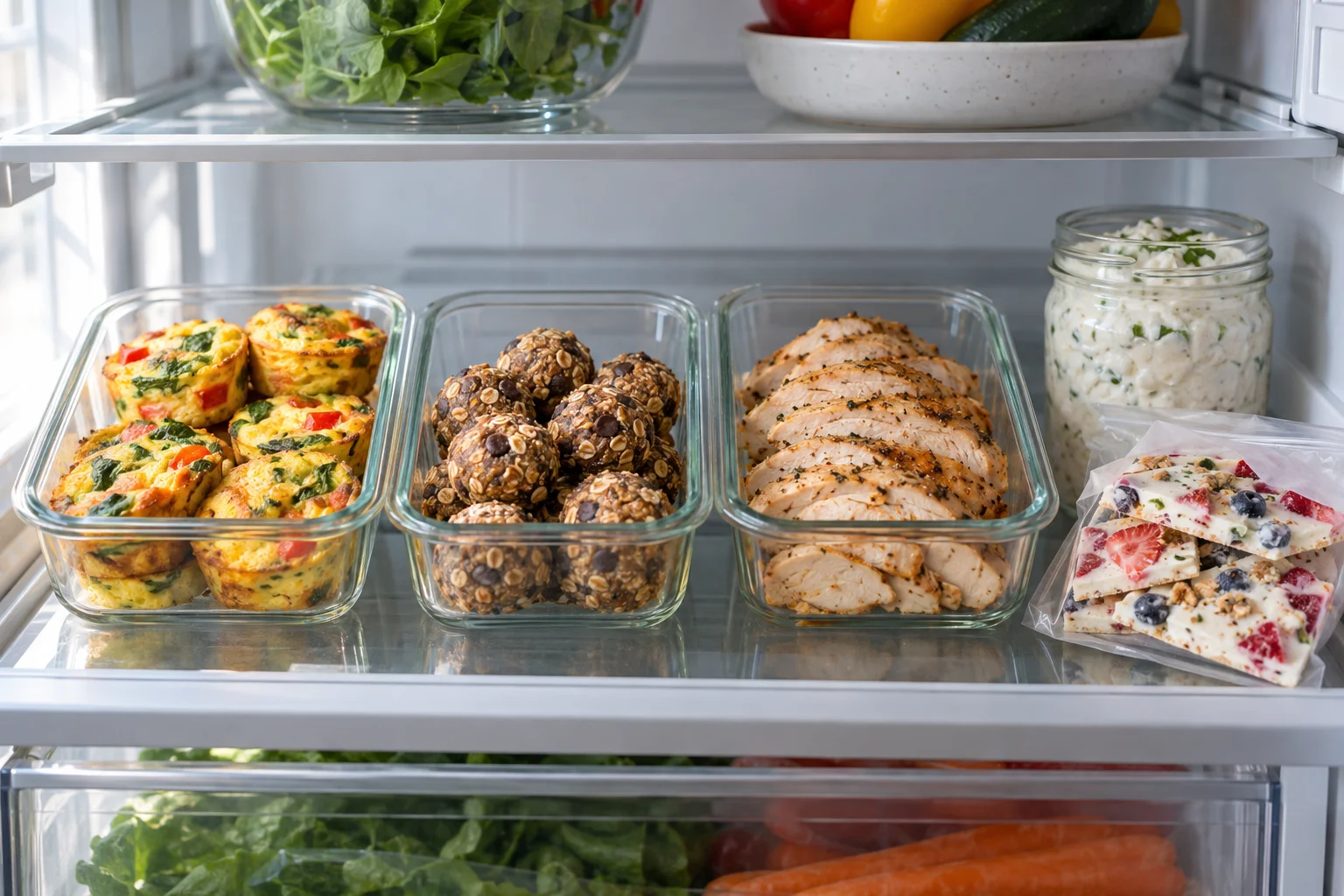
To store protein snacks in the fridge and freezer, cool cooked food within 2 hours, pack it in shallow airtight containers and write the date on each one. Most homemade snacks keep 3 to 4 days at or below 40°F (4°C) and 2 to 3 months at 0°F (-18°C). The chart below lists every snack in this section.
Key takeaways
- Baked egg bites last 3 to 4 days in the fridge and 2 to 3 months in the freezer. Hard-boiled eggs last 1 week.
- No-bake protein balls and bars last 7 to 14 days in the fridge and about 3 months in the freezer.
- Check temperatures with a thermometer: 40°F (4°C) or below in the fridge, 0°F (-18°C) in the freezer. The built-in dial is often off.
- Get cooked food into the fridge within 2 hours (1 hour if the room is above 90°F / 32°C). Warm food in the fridge is fine in containers no deeper than 2 inches (5 cm).
- Freeze single portions on a sheet pan for 1 to 2 hours first, then bag them. Thaw in the fridge and reheat cooked meat and egg items to 165°F (74°C).
How long do protein snacks last in the fridge and freezer?
Most cooked protein snacks last 3 to 4 days in the fridge, and most no-bake snacks last 7 to 14 days. In the freezer, quality holds for 1 to 3 months for most items, while food held at 0°F (-18°C) stays safe indefinitely. The chart gives the number for each snack.
| Snack | Fridge (days) | Freezer (months) | Freezes well? | How to thaw and reheat |
|---|---|---|---|---|
| Egg bites (baked) | 3 to 4 | 2 to 3 | Yes | Thaw in fridge overnight, or microwave from frozen 60 to 90 seconds; heat to 165°F (74°C) |
| Hard-boiled eggs, in shell | 7 | Do not freeze | No | Eat cold |
| Hard-boiled eggs, peeled | 5 to 7 (covered, with a damp paper towel) | Do not freeze | No (whites go rubbery) | Eat cold |
| Deviled eggs | 2 | Do not freeze | No | Eat cold; keep chilled until serving |
| Chicken chips (baked or air-fried) | 3 to 4 | 2 to 3 | Yes, but they soften | Re-crisp in a 375°F (190°C) oven 3 to 5 minutes; heat to 165°F (74°C) |
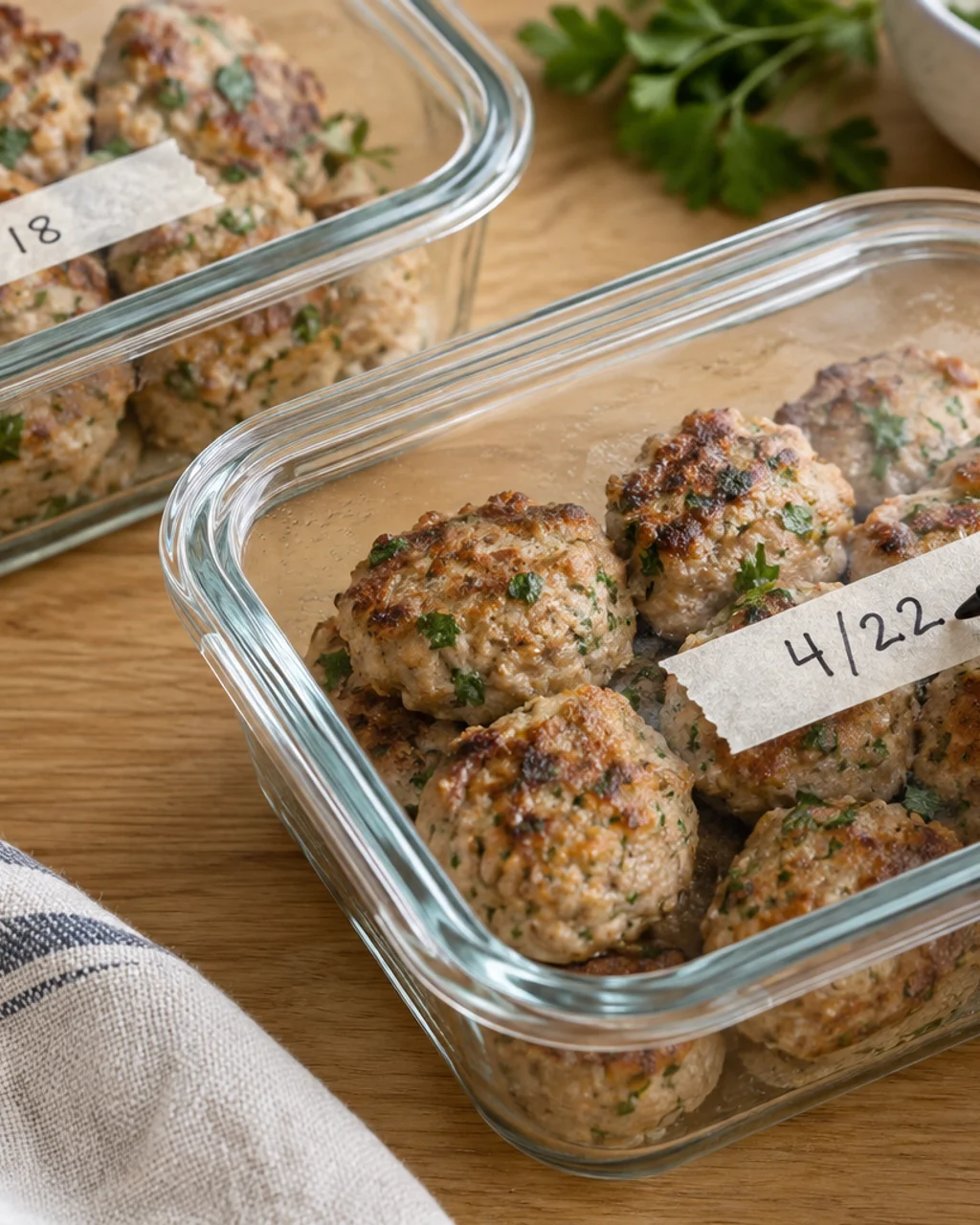
| Meatballs (beef, turkey) | 3 to 4 | 2 to 3 | Yes | Thaw in fridge or microwave; heat to 165°F (74°C) |
| Tuna or chicken salad (mayo-based) | 3 to 5 | Do not freeze | No (mayo separates) | Eat cold |
| Deli roll-ups (turkey, cheese) | 3 | 1 | Poorly (cheese texture) | Eat cold; freeze meat and cheese separately |
| Cottage cheese dips | 5 to 7 | Do not freeze | No (curds go watery) | Eat cold |
| Yogurt bark | 5 to 7 (keep cold) | 2 | Yes | Eat straight from the freezer |
| Protein puddings (Greek yogurt, casein) | 3 to 5 | 1 | Fair | Thaw in fridge; stir well |
| Chia pudding | 5 | 2 | Fair (thaws a bit watery) | Thaw in fridge overnight; stir |
| Protein muffins | 4 to 5 | 3 | Yes | Microwave from frozen 30 to 45 seconds, or thaw on a rack |
| Protein balls (no-bake) | 7 to 14 | 3 | Yes | Eat frozen, or thaw 10 to 15 minutes |
| Protein bars (no-bake, cut) | 7 to 14 | 3 | Yes | Eat frozen or thaw 15 minutes |
| Roasted chickpeas | Not needed (airtight, room temp 3 to 4 days); fridge 7 | Do not freeze | No (lose crunch) | Re-crisp in a 375°F (190°C) oven 5 minutes |
| Beef or turkey jerky (homemade) | 14 to 30 (airtight) | 2 to 3 | Yes | Thaw at room temperature in the bag |
| Cheese crisps | 5 to 7 (airtight) | 2 | Fair (can soften) | Re-crisp in a 350°F (175°C) oven 2 minutes |
| Hummus (homemade or opened) | 4 to 7 | 2 to 4 | Yes (stir after thawing) | Thaw in fridge; stir in a spoon of olive oil |
| Yogurt, opened | 5 to 7 | 1 to 2 | Texture changes (fine for smoothies) | Thaw in fridge; stir |
| Cottage cheese, opened | 5 to 7 | Do not freeze | No | Not applicable |
Fridge times assume food that was cooled within 2 hours. Freezer times are quality guidelines, because anything held at 0°F (-18°C) stays safe indefinitely. Cooked egg dishes, cooked poultry and meatballs match the FoodSafety.gov cold storage chart (3 to 4 days), and where that chart gives a range this one uses the lower end. Deviled eggs and roll-ups get shorter windows because they are handled more and often sit out at parties and desks. The USDA FoodKeeper tool lists many more foods by name if your snack is not here.
When a snack combines items, such as a bento box with egg, cheese and berries, use the shortest shelf life in the box. Dry jerky lasts longer than the chart shows at room temperature; the preserve guide covers pantry storage.
How long do egg bites last in the fridge and freezer?
Baked egg bites last 3 to 4 days in the fridge in an airtight container, as long as they were cooled within 2 hours and the fridge is at or below 40°F (4°C). In the freezer they keep their best texture for 2 to 3 months. Cooked egg dishes sit in the same 3 to 4 day group as other leftovers on the FoodSafety.gov chart.
For meal prep, bake a batch, cool it in a single layer, and put half in the fridge for the week. Flash freeze the other half. To reheat, microwave frozen egg bites 60 to 90 seconds, or warm thawed ones in a 350°F (175°C) air fryer or oven for about 5 minutes, until the center reaches 165°F (74°C). Recipes are in savory meat, fish and egg snacks.
How long do hard-boiled eggs last in the fridge?
Hard-boiled eggs last about 1 week in the fridge, in the shell or peeled, according to USDA and FoodSafety.gov. Refrigerate them within 2 hours of cooking. Peeled eggs dry out and pick up fridge odors, so keep them in a covered container with a damp paper towel and plan to eat them within 5 to 7 days.
Do not freeze them. Cooked whites turn rubbery, so freeze egg bites instead. If you are not sure when an egg was boiled, write the cooking date on the shell with a pencil.
How long do protein balls last in the fridge, and can you freeze them?
No-bake protein balls last 7 to 14 days in the fridge in an airtight container and about 3 months in the freezer. Yes, they freeze well. Roll them, freeze them on a lined sheet pan for an hour, and bag them in portions of three.
To thaw protein balls, eat them straight from the freezer for a fudgy, chewy bite, or let them sit on the counter 10 to 15 minutes. Balls made with yogurt, cream cheese or fresh fruit should stay in the fridge until you eat them. Recipes and variations are in no-bake protein balls and bars.
How long do cottage cheese dip and protein muffins last?
Cottage cheese dip lasts 5 to 7 days in a sealed fridge container, and protein muffins last 4 to 5 days in the fridge. Muffins freeze well for about 3 months, while dip does not, because the curds turn watery after thawing. Use the open date of the cottage cheese as your clock.
Wrap muffins one at a time, flash freeze them, and microwave from frozen for 30 to 45 seconds. Recipes for both are in Greek yogurt, cottage cheese and baked protein snacks.
Set up your fridge, freezer and containers
Good storage starts with the appliance. A fridge that runs at 45°F (7°C) looks fine and feels cold, yet it lets bacteria multiply several times faster than one at 38°F (3°C). The FDA recommends an appliance thermometer in both compartments, because dial settings are only rough guides.
Put a fridge and freezer thermometer (shop at Amazon, opens in a new tab) on the middle shelf of the fridge and in the front of the freezer, and read it after the door has been closed for a few hours. Aim for 40°F (4°C) or lower in the fridge (35 to 38°F / 2 to 3°C is a comfortable target) and 0°F (-18°C) or lower in the freezer. If you are off by more than a couple of degrees, adjust the dial one notch and check again the next day.
Where things go
Cold air sinks and the door swings open constantly, so the door is the warmest spot.
- Bottom shelf: raw meat, poultry and fish, in a rimmed container so juices cannot drip onto ready-to-eat snacks.
- Middle shelves: cooked egg bites, meatballs, chicken chips, tuna salad, roll-ups and dips. This is the steadiest zone.
- Top shelf: grab-and-go items such as protein balls, bars and yogurt cups.
- Door: condiments and jams only. Do not keep eggs or open dairy there.
- Away from the back wall: on some fridges, items pressed against it can freeze, which ruins yogurt and cottage cheese texture.
In the freezer, keep a flat shelf or bin free for sheet pans and bags of flash-frozen snacks, with the oldest bags in front. Cold air has to circulate in the fridge, so leave a finger-width gap around containers. The freezer works the other way: a full one stays cold longer when the door opens, so fill empty space with bags of ice or water bottles.
How to cool cooked food fast
Cooked food is most at risk while it passes through the 40 to 140°F (4 to 60°C) danger zone. The goal is to get from hot to under 40°F (4°C) within 2 hours.
- Divide it up. A full pot of meatballs can stay warm at the center for hours, so spread food into containers no more than 2 inches (5 cm) deep.
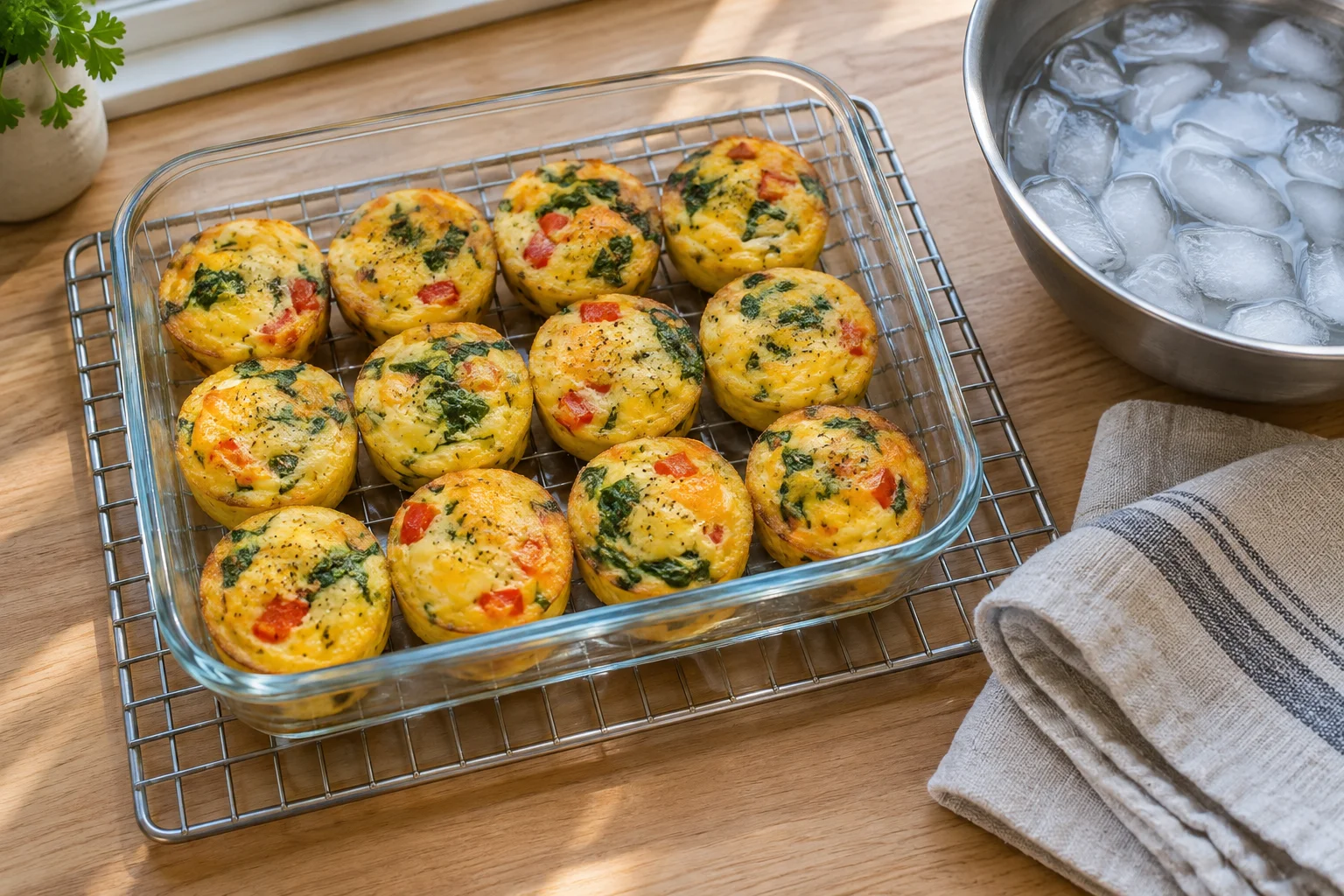
- Use an ice bath for liquids and dense mixtures. Set the container in a sink of ice and water for 10 to 15 minutes, stirring now and then.
- Skip the wait. USDA says it is fine to put hot food in the fridge. Leave lids slightly ajar for the first 30 minutes, then seal.
- Set a timer. In a kitchen above 90°F (32°C), the limit is 1 hour.
Which meal prep containers work for the freezer?
The container affects how long snacks stay fresh, how well they freeze and how easily you can grab them. No single one is best for everything.
| Container | Best for | Pros | Cons |
|---|---|---|---|
| Glass meal-prep containers (shop at Amazon, opens in a new tab) | Egg bites, meatballs, chicken chips, cooked portions | Does not stain or hold odors, oven and microwave safe, easy to see contents | Heavy, can crack if moved from freezer to hot oven, space-hungry |
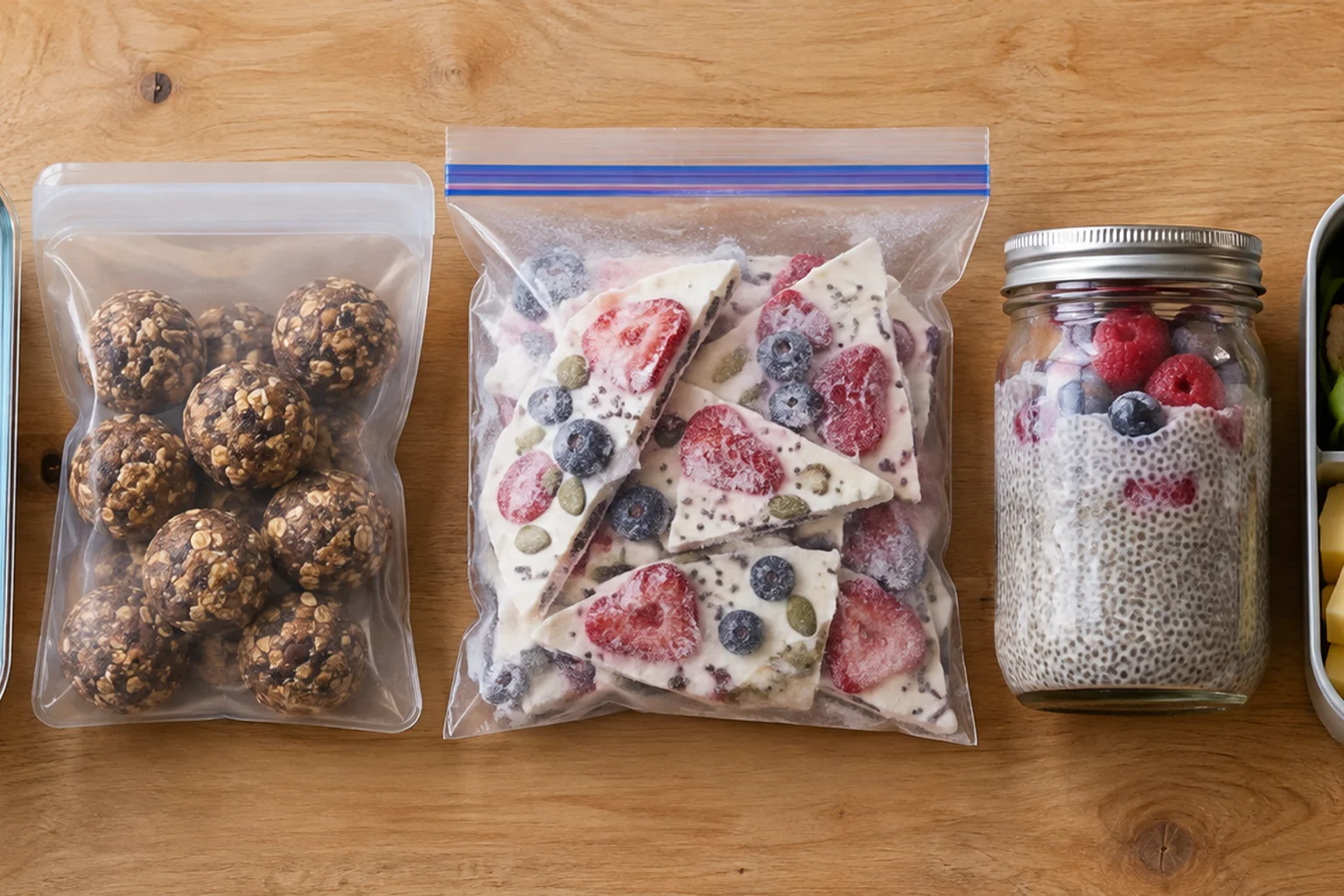
| Reusable silicone storage bags (shop at Amazon, opens in a new tab) | Yogurt bark pieces, protein balls, freezing flat | Reusable, stand up in the freezer, microwave safe | Can hold odors, harder to get fully airless, pricey up front |
| Zip-top freezer bags (shop at Amazon, opens in a new tab) | Flash-frozen snacks, muffins, bars | Cheap, flat-freezing saves space, thicker than sandwich bags | Single use for raw meat, air removal takes technique |
| Vacuum sealer (shop at Amazon, opens in a new tab) bags | Long freezer storage of meatballs, chicken, jerky | Removes nearly all air, best freezer-burn defense, 2x to 3x the quality life | Machine cost, ongoing bag expense, soft snacks get squashed unless pre-frozen |
| Wide-mouth mason jars (shop at Amazon, opens in a new tab) | Chia pudding, cottage cheese dips, yogurt parfaits, roasted chickpeas | Airtight, stackable, cheap, good for layered portions | Glass can crack when filled and frozen unless you leave 1 inch of headspace |
| Bento snack boxes (shop at Amazon, opens in a new tab) | Lunchbox packing, separating dry and wet items | Compartments keep wet away from crisp, leak-proof lids | Not for long storage, usually not freezer safe |
Choose airtight lids, since air dries and stales food. Leave 1 inch (2.5 cm) of headspace in jars and rigid containers when freezing anything wet, because liquids expand. Do not reuse bags that held raw meat for ready-to-eat snacks. For air-free storage and oxygen absorbers for dry, shelf-stable snacks, see how to preserve homemade protein snacks. This page stays on the cold side.
How to freeze protein snacks without freezer burn
Freezer burn is not a safety problem. It is dehydration and oxidation on the surface of food, which leaves gray-white dry patches and a stale flavor. Good technique prevents it and stops snacks from freezing into one brick.
Flash freeze, then bag
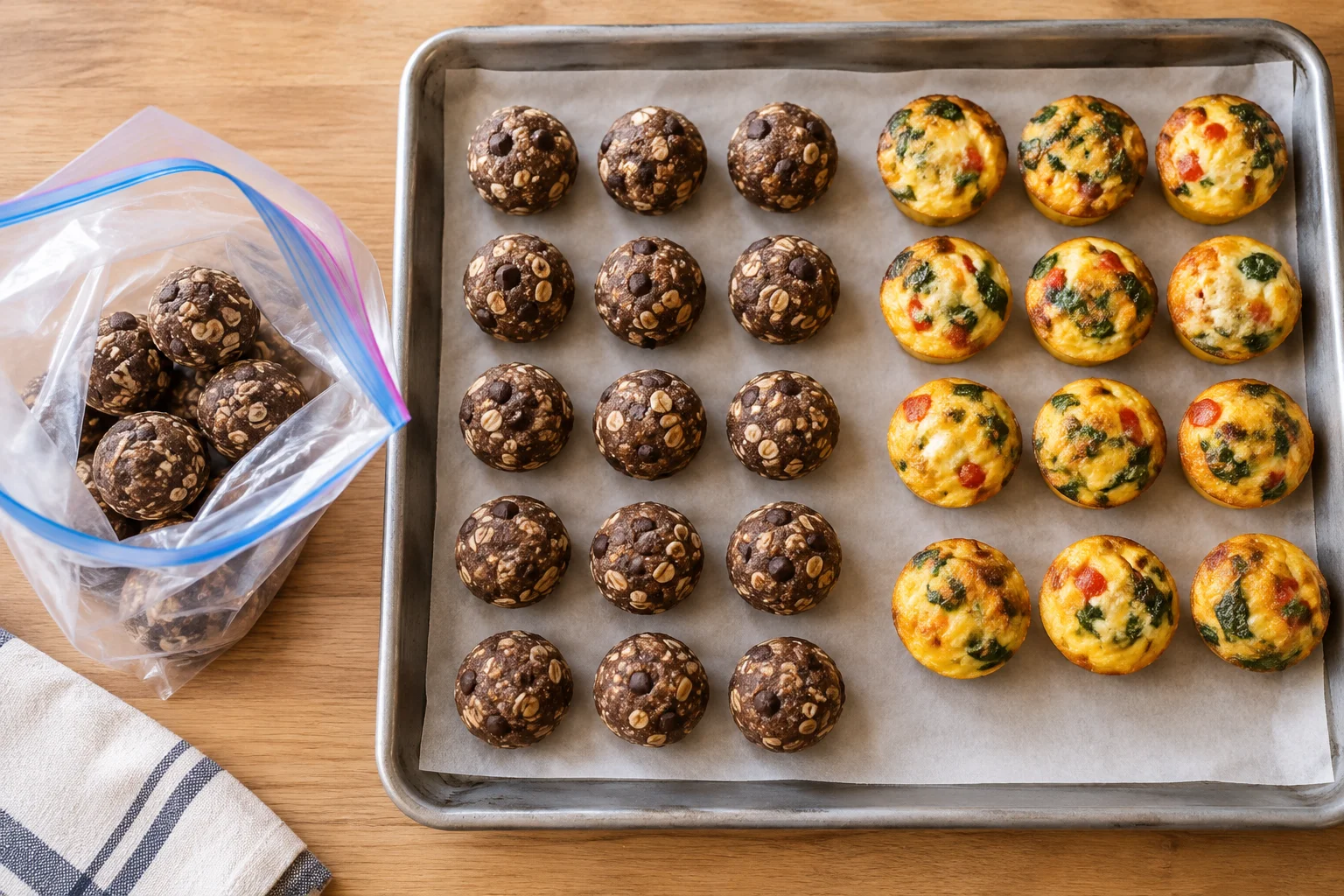
- Line a rimmed sheet pan (shop at Amazon, opens in a new tab) with parchment paper (shop at Amazon, opens in a new tab).
- Cool the snacks completely, because warm food makes steam and ice crystals.
- Arrange egg bites, meatballs, protein balls, bark pieces, cut bars or muffins in a single layer without touching.
- Freeze 1 to 2 hours, until solid.
- Pour them into a freezer bag or silicone bag and press out as much air as you can. For zip-top bags, close the zipper almost all the way, press the bag flat from the bottom up, and seal at the last moment. A drinking straw pulls out the last air.
- Lay bags flat so they stack like books. Once solid, they can stand up.
A vacuum sealer does step 5 better than any hand method. For soft snacks such as bars and muffins, flash freeze first, or the machine squashes them.
Portion and label
Freeze the amount you eat: two egg bites per bag, three protein balls per bag, one muffin each. Thaw only what you need, because refreezing costs quality. Do not refreeze raw meat or poultry that thawed on the counter. Food thawed safely in the fridge can be refrozen, with some quality loss.
Use freezer labels and a marker (shop at Amazon, opens in a new tab) to write the snack name, the freezer date and the reheat instruction, for example "Egg bites. 10/15. Microwave 75 sec." Every white bag looks the same after a week.
Prevent freezer burn
- Use freezer bags, which are thicker than storage bags.
- Remove air, and leave minimal headspace in rigid containers.
- Double-wrap fatty items (meatballs, jerky) when freezing longer than 2 months.
- Keep the freezer at 0°F (-18°C) and keep the door shut.
- Store bags in the body of the freezer, not the door shelf, where temperatures swing most.
What does not freeze well
Some textures cannot survive ice crystals.
- Hard-boiled egg whites and cooked egg whites alone turn rubbery and watery. Freeze egg bites or scrambled egg instead.
- Deviled eggs: the whites suffer and the filling separates.
- Mayo-based salads (tuna, chicken, egg): mayonnaise breaks into oil and water. Freeze the base plain and add mayo or Greek yogurt after thawing.
- Cucumber, celery and other crisp raw vegetables go limp from their high water content.
- Roasted chickpeas and cheese crisps absorb moisture on thawing and lose crunch. Keep them dry in an airtight jar and re-crisp in the oven.
- Cottage cheese and cream cheese-style dips: the curds weep.
How do you thaw frozen protein snacks safely?
Thaw frozen protein snacks in the fridge overnight, in a bowl of cold water, or in the microwave. The counter is not a safe option, because the outer layer warms into the danger zone while the center is still frozen. Cook or eat food thawed in water or the microwave right away.
- Fridge (best): move the bag to the fridge the night before. Small snacks thaw in 4 to 8 hours and a dozen meatballs take 12 to 24. Food stays under 40°F (4°C) and keeps 3 to 4 days after thawing.
- Cold water (faster): seal the snacks in a leakproof bag, submerge in cold tap water, and change the water every 30 minutes. A small bag thaws in 30 to 60 minutes.
- Microwave (fastest): use the defrost setting or 50% power in 30-second bursts, flipping or stirring in between. Eat immediately, since parts may start to cook.
- Reheat cooked meat, poultry, egg bites, meatballs and chicken chips to 165°F (74°C) in the center. An instant-read thermometer (shop at Amazon, opens in a new tab) confirms it. Egg bites take 60 to 90 seconds from frozen in a 1000-watt microwave; check the center. In an air fryer or oven at 350°F (175°C), allow about 5 minutes for thawed bites.
Some snacks need no thawing. Yogurt bark is better frozen and snaps like a candy bar. Protein balls are chewy and cold, and bars soften after 15 minutes at room temperature. Edamame needs a quick steam or microwave, while frozen berries are fine as they are. A dessert-style snack thawed in the fridge should be eaten within 2 to 3 days.
How long can protein snacks sit out, and how do you keep them fresh on the go?
Perishable protein snacks can sit at room temperature for 2 hours total, and for 1 hour when the air is above 90°F (32°C), such as in a parked car or at a picnic. The clock is cumulative: 40 minutes on the counter at breakfast plus 90 minutes in a gym bag is already over the limit.
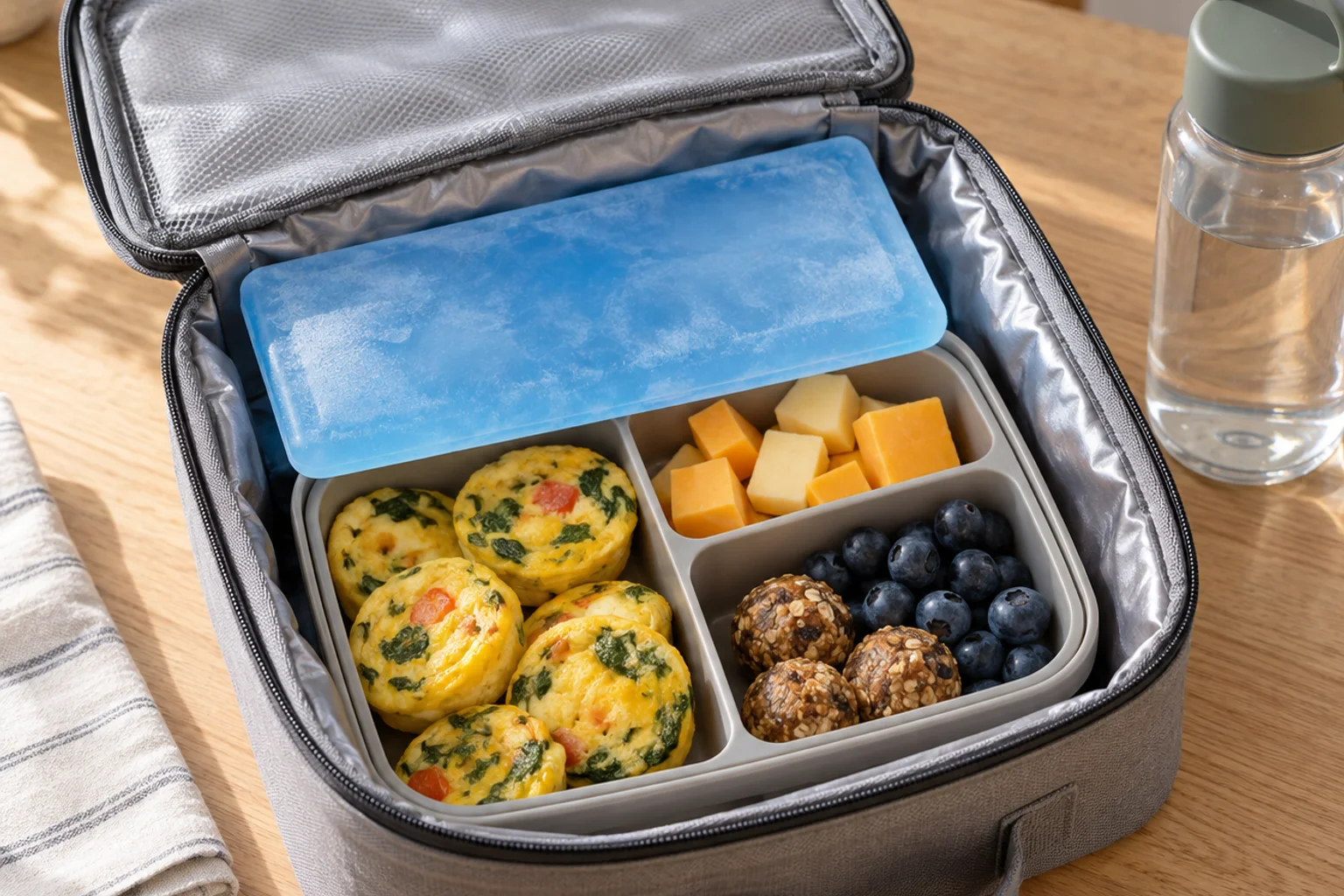
An insulated lunch bag with an ice pack (shop at Amazon, opens in a new tab) keeps contents at or below 40°F (4°C) for around 4 hours in most conditions. Pre-chill the bag, and pack snacks cold from the fridge, because a bag only slows warming. Use two ice packs for a full day, one above and one beneath, and keep the bag out of direct sun and the trunk. A frozen water bottle works as a second ice pack.
At an office fridge, label items with your name and the date, use a shelf instead of the door, and take home anything left over the weekend. Leave nothing perishable beyond 3 to 4 days. For kids, pack a leak-proof bento box next to a frozen gel pack or frozen yogurt tube. Frozen protein balls or bark thaw by lunchtime and work as cold packs. For more ideas see high-protein snacks for kids. Discard uneaten perishables that come home.
A weekly snack-prep plan
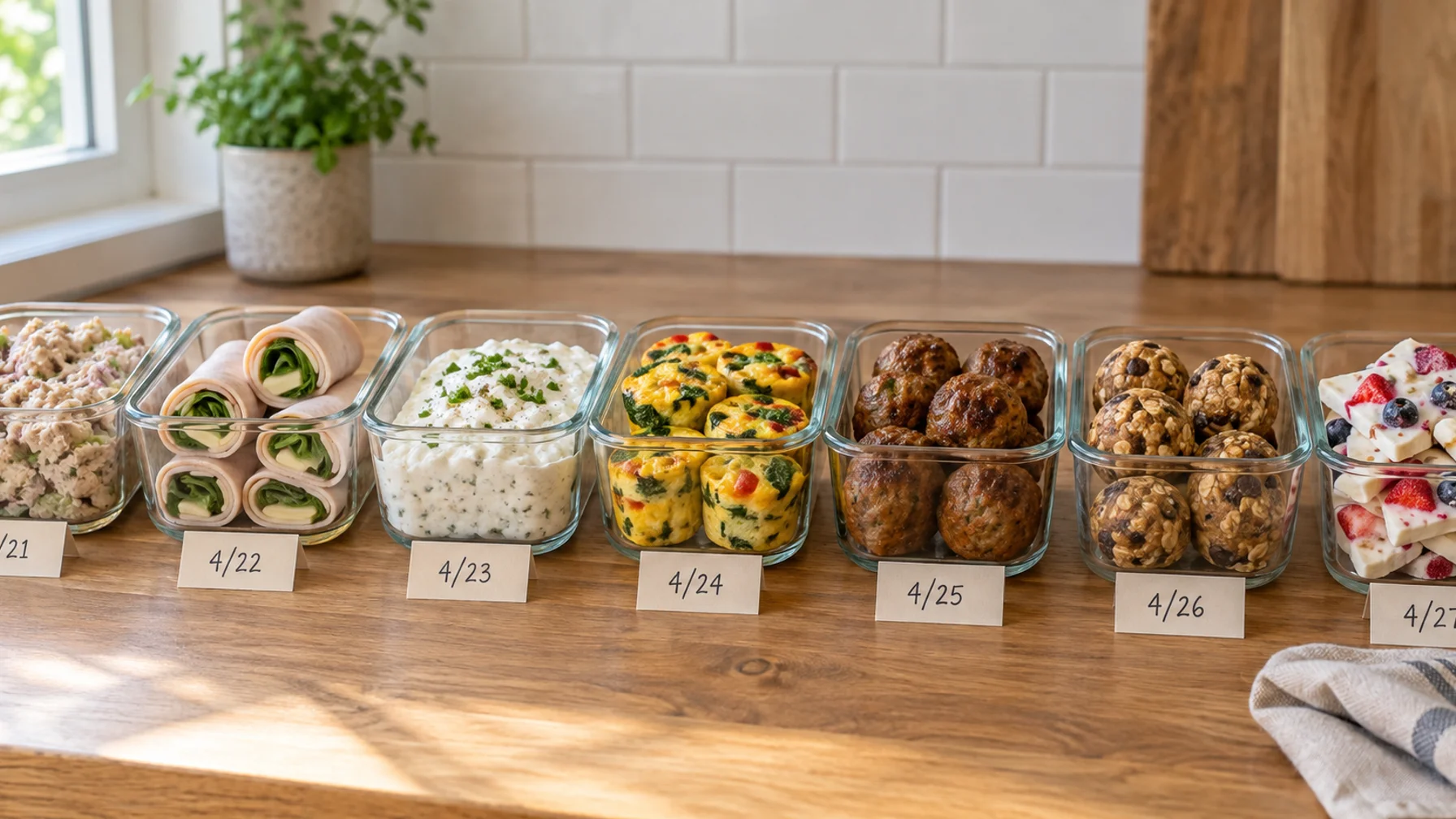
Batch prep works when you eat the most perishable snacks first and push the freezer-friendly ones to the end of the week. Cooking once beats cooking daily only if the storage holds up.
The Sunday session (90 to 120 minutes)
- Minutes 0 to 10: preheat the oven to 375°F (190°C), set out containers and labels, and start the eggs boiling.
- Minutes 10 to 35: mix and bake egg bites and meatballs on sheet pans (about 20 to 25 minutes), using the recipes in savory meat, fish and egg snacks.
- Minutes 35 to 60: while the oven works, make protein balls or bars and stir together cottage cheese or Greek yogurt dips and puddings. For ideas on combining them, see build-your-own high-protein snacks.
- Minutes 60 to 80: cool cooked items in shallow containers or on racks, and peel the hard-boiled eggs after an ice bath.
- Minutes 80 to 100: portion, then flash freeze half the egg bites, meatballs and balls on lined sheet pans.
- Minutes 100 to 120: bag, label, wipe down and put everything away. Cooked items must be in the fridge or freezer within 2 hours of leaving the oven.
Make delicate items (tuna salad, roll-ups, cut fruit) the day you eat them, or at most the night before.
What to eat first
Treat the fridge as a countdown clock.
- Days 1 to 2: roll-ups, deviled eggs, tuna salad, fresh dips and puddings. They are the most perishable and none freeze well.
- Days 3 to 4: egg bites, meatballs and chicken chips from the fridge batch. The USDA window of 3 to 4 days for cooked items ends here.
- Days 5 to 7: hard-boiled eggs, protein balls, bars, muffins and bark.
- Past day 4, cooked meat or egg comes from the freezer stash.
Sample week
| Day | Fridge snack to eat | Pull from freezer | Notes |
|---|---|---|---|
| Sunday | Fresh egg bites after cooling | Nothing | Prep day; bag and label |
| Monday | Tuna salad on rice cakes, cottage cheese dip | Move 6 egg bites to the fridge to thaw | Eat the dip first |
| Tuesday | Turkey and cheese roll-ups, yogurt pudding | Move meatballs to the fridge | Last day for roll-ups |
| Wednesday | Egg bites (fridge batch), 2 hard-boiled eggs | Protein balls for the gym bag | Cooked fridge items on day 3 |
| Thursday | Meatballs with hummus | Yogurt bark | Day 4: last of the cooked fridge batch |
| Friday | Protein muffin, 2 hard-boiled eggs | Bar or ball | Muffins keep 4 to 5 days |
| Saturday | Whatever is left, or a freezer snack | Eat from the frozen stash | Restock the list for Sunday |
If you know you will not want something by Thursday, freeze it Wednesday. Food frozen on day 3 tastes fresher than food frozen on day 5.
Rotating the freezer stash
Use first in, first out. Put new bags at the back and older ones at the front, and once a month pull anything older than 3 months and eat it that week. A sticky note on the freezer door ("6 egg bites, Oct 15; 12 meatballs, Oct 8") works as an inventory. A freezer that has crept up to 10°F (-12°C) still keeps food safe, but quality drops faster.
How long does food last in the freezer during a power outage?
A full freezer keeps food safe for about 48 hours during a power outage if the door stays closed, and a half-full freezer for about 24 hours. A closed refrigerator holds food safe for about 4 hours. These are the limits USDA FSIS gives for emergencies (opens in a new tab).
| Appliance | Safe hold time (hours) | After that |
|---|---|---|
| Refrigerator | About 4 | Discard perishables unless a thermometer shows 40°F (4°C) or below |
| Full freezer | About 48 | Check each item for ice crystals or 40°F (4°C) or below |
| Half-full freezer | About 24 | Same check, item by item |
Practical steps for a meal-prep stock:
- Keep the doors closed, since every opening lets cold air out.
- Group food together in the freezer. A packed block stays cold longer.
- Add bags of ice, or dry ice for a long outage. Wear gloves and ventilate the room when handling dry ice.
- Move milk, eggs, meat and leftovers into a cooler with ice if the fridge is warming.
- When power returns, check the thermometer. If the fridge was above 40°F (4°C) for more than 2 hours, discard perishable items. Freezer food that still has ice crystals or feels as cold as refrigerated food can be refrozen with some loss of quality.
If the outage runs past 4 hours, eat the thawed freezer items first, since those cannot wait. After an outage longer than 4 hours, discard egg bites, meatballs, tuna salad, dips, yogurt, cottage cheese, deviled eggs and cooked meat that were in the fridge. Dry snacks such as roasted chickpeas and bars with no dairy are usually fine.
Signs of spoilage
Your senses catch many spoiled foods, but not all. Bacteria such as Salmonella and Listeria can grow without changing smell, taste or appearance, which is why the date on the label matters more than any sniff test.
Discard food if you notice:
- A sour, sulfur or off smell, especially from eggs, meat or dairy.
- A slimy or sticky film on meat, chicken or deli slices.
- Mold of any color. In soft foods such as yogurt, muffins or dips, mold roots spread invisibly, so throw out the whole container.
- Curdled separation or a sour smell in yogurt, puddings or dips. A little clear liquid on top of Greek yogurt is normal whey.
- A bulging lid, or a hiss when you open a jar.
- Gray or green discoloration on cooked egg yolks or meat.
- Large ice crystals plus a puddle in the bag, which suggests the food thawed and refroze.
- Anything left out more than 2 hours (1 hour above 90°F / 32°C), even if it looks fine.
Freezer burn alone is not a spoilage sign. Trim the dry spots, or eat the snack knowing it will be drier.
When in doubt, throw it out. Pregnant people, older adults, young children and anyone with a weakened immune system are at higher risk and should follow the shorter timelines, especially for deli meats and soft cheeses.
For portion sizing, see how much protein a snack should have. To make snacks that need no fridge at all, read how to preserve homemade protein snacks.
Shop this article
12 ingredients and tools. Add them to your list, then send it to Amazon, Whole Foods or Instacart.
Kitchen tools
- Refrigerator/freezer thermometerAmazon (opens in a new tab)Instacart (opens in a new tab)
- Rimmed half-sheet pansAmazon (opens in a new tab)Instacart (opens in a new tab)
- Parchment paperAmazon (opens in a new tab)Whole Foods (opens in a new tab)Instacart (opens in a new tab)
- Instant-read meat thermometerAmazon (opens in a new tab)Instacart (opens in a new tab)
Storage & preserving supplies
- Glass meal-prep containers with lidsAmazon (opens in a new tab)Instacart (opens in a new tab)
- Reusable silicone storage bagsAmazon (opens in a new tab)Whole Foods (opens in a new tab)Instacart (opens in a new tab)
- Zip-top freezer bagsAmazon (opens in a new tab)Whole Foods (opens in a new tab)Instacart (opens in a new tab)
- Vacuum sealerAmazon (opens in a new tab)Instacart (opens in a new tab)
- Wide-mouth mason jarsAmazon (opens in a new tab)Instacart (opens in a new tab)
- Leak-proof bento snack boxAmazon (opens in a new tab)Instacart (opens in a new tab)
- Freezer labels and markerAmazon (opens in a new tab)Instacart (opens in a new tab)
- Insulated snack bag with ice packAmazon (opens in a new tab)Instacart (opens in a new tab)
Frequently asked questions
Can you freeze protein bars?
Yes. Homemade no-bake protein bars freeze well for about 3 months. Cut them first, wrap each bar in parchment or plastic wrap, and bag them with the air pressed out. Eat them frozen for a chewy texture, or thaw 15 minutes on the counter. Store-bought bars generally freeze the same way for 2 to 6 months.
Do you need to refrigerate protein balls?
Refrigeration is the safe default. Firm oat and nut-butter balls hold up at cool room temperature for a day or two but turn soft and oily. Any ball made with yogurt, cream cheese, fresh fruit or milk-based protein powder must stay cold. In the fridge they keep 7 to 14 days in an airtight container.
Should you keep hard-boiled eggs in the shell or peel them before storing?
Keep them in the shell. The shell protects the egg from fridge odors and drying, and USDA gives hard-boiled eggs 1 week either way. If you peel them for grab-and-go snacks, store them in a covered container with a damp paper towel and eat them within 5 to 7 days.
Can you freeze hard-boiled eggs?
Not whole. Frozen egg whites turn rubbery and watery because ice crystals squeeze the protein network. If you must, freeze only the cooked yolks, or make egg bites or scrambled egg portions instead. Those freeze well for 2 to 3 months because the egg is mixed and cooked as a custard.
Is food still safe after a power outage if it has ice crystals?
Often, yes. USDA says food in the freezer that still contains ice crystals, or feels as cold as refrigerated food (40°F / 4°C or below), can be refrozen, though quality drops. Check item by item with a food thermometer. Food that sat above 40°F (4°C) for more than 2 hours should be thrown out.
How long can protein snacks sit out at a desk or in a lunchbox?
Perishable snacks (eggs, meat, dairy, cooked protein) can sit out for 2 hours total, or 1 hour when the air is above 90°F (32°C). With a frozen ice pack in an insulated bag, they stay at or below 40°F (4°C) for around 4 hours. Dry snacks such as roasted chickpeas and most bars need no cooling.
How do I know if a snack has gone bad?
Sour or off smells, a slimy film, visible mold, fuzzy spots and bulging lids are clear signs. Some bacteria cause illness without changing smell, taste or look, so the date on the label matters as much as your nose. If you cannot remember when you made it, or it sat out too long, throw it out.
Sources
- FoodSafety.gov: Cold Food Storage Chart (opens in a new tab)
- USDA FSIS: Leftovers and Food Safety (opens in a new tab)
- USDA FSIS: Freezing and Food Safety (opens in a new tab)
- USDA FSIS: Keep Food Safe During an Emergency (power outages) (opens in a new tab)
- USDA FSIS: The Big Thaw, Safe Defrosting Methods (opens in a new tab)
- FDA: Are You Storing Food Safely? (opens in a new tab)
More reading on protein, sugar and snack labels is collected on our resources page.