Recipes
Greek Yogurt and Cottage Cheese Protein Snacks: 8 Recipes From Bark to Mug Cake
By Editorial Team. Updated . 19 min read. 8 recipes, each under 2 hours.
Store links may be affiliate links. We may earn a commission; it never changes what we recommend.
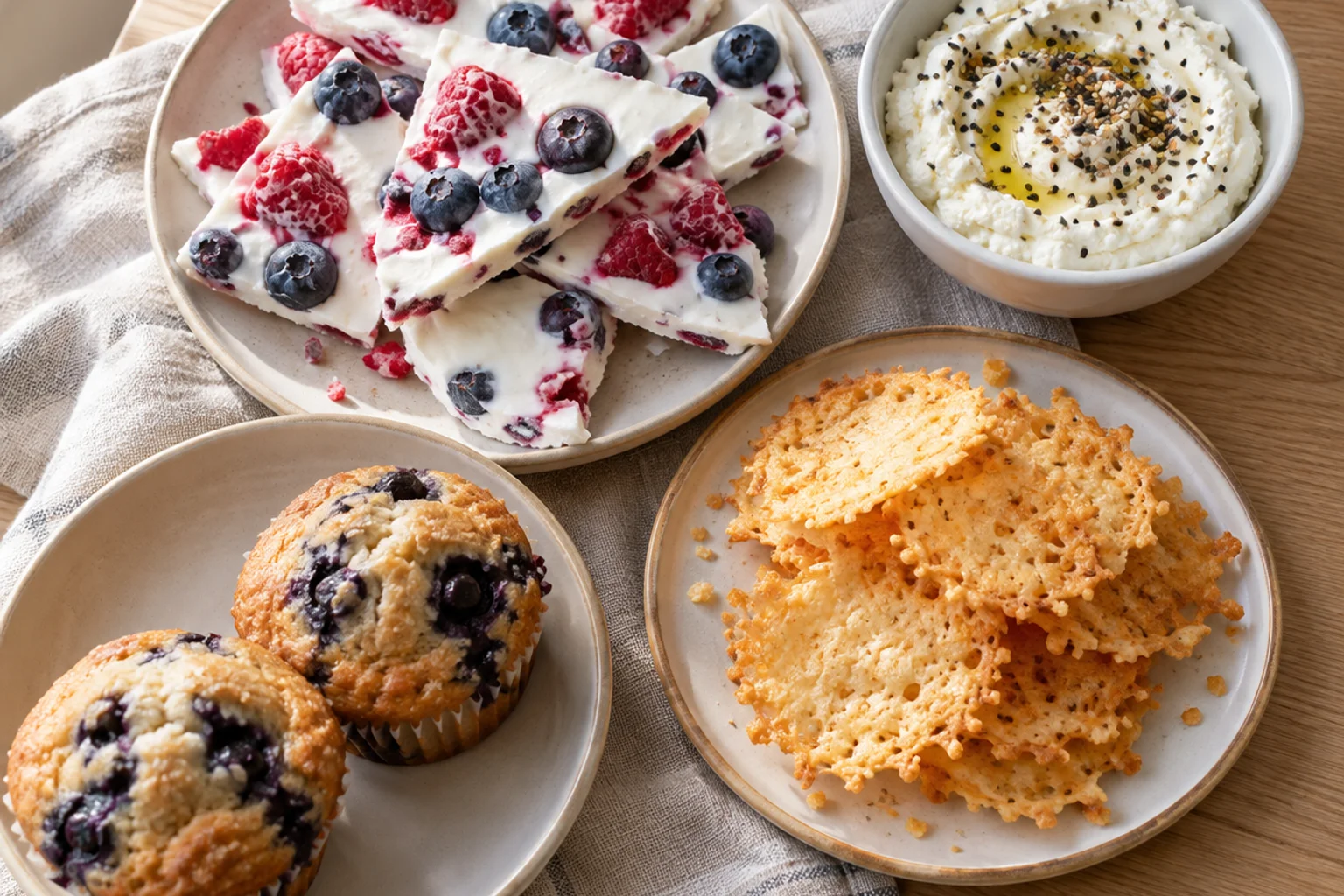
Greek yogurt and cottage cheese protein snacks give you 6 to 39 grams of protein per serving, because both start at about 24 to 28 grams per cup. The eight recipes below cover yogurt bark, a whipped cottage cheese dip, two puddings, cheese crisps, muffins, pancake bites and a mug cake, and each is done in under 2 hours.
Key takeaways
- Plain nonfat Greek yogurt, skyr and low-fat cottage cheese each have about 24 to 28 g of protein per cup for 130 to 185 calories.
- Flavored single-serve yogurt often carries 12 to 20 g of sugar, so buy plain and add a measured teaspoon of honey (about 6 g sugar) or half a cup of berries (5 to 7 g).
- Blend cottage cheese for 60 to 90 seconds and the curds disappear, which makes dips, puddings and pancake bites smooth.
- When baking, swap no more than about one third of the flour for protein powder, add moisture, and bake 25°F (14°C) cooler.
- Bark keeps about 2 months in the freezer, dips and puddings 4 days in the fridge, and muffins 5 days.
- Discard dairy snacks left out more than 2 hours (1 hour above 90°F / 32°C).
How much protein is in Greek yogurt, skyr and cottage cheese?
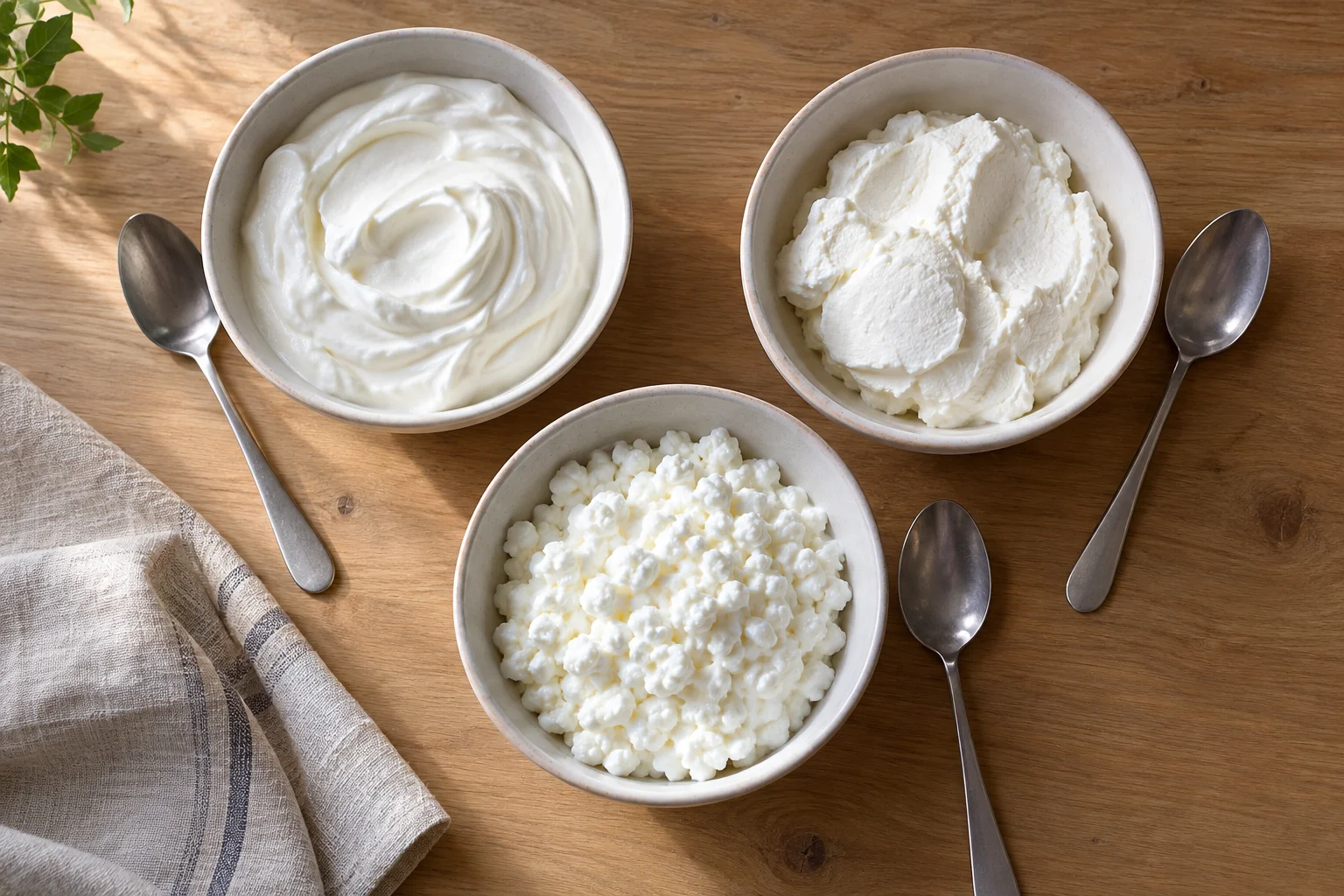
Plain nonfat Greek yogurt has about 24 to 25 g of protein per cup, skyr about 25 to 28 g and low-fat cottage cheese about 24 to 26 g, per USDA FoodData Central. All three are strained or drained milk, so they hold two to three times the protein of regular milk (about 8 g per cup).
Most of that protein is casein, about 80 percent of the protein in milk. Casein forms a gel in the stomach and digests more slowly than whey, which is one reason these foods feel filling. Greek yogurt and skyr are strained, which drains off watery whey and packs the protein tighter. Cottage cheese is drained curds, so it is concentrated the same way. Live-culture yogurt also adds bacteria that help with lactose.
| Food (plain, 1 cup) | Weight | Calories | Protein | Carbs | Sodium |
|---|---|---|---|---|---|
| Nonfat Greek yogurt | about 245 g | 130 | 24 to 25 g | 8 to 9 g | 70 to 90 mg |
| Skyr, nonfat | about 245 g | 140 to 160 | 25 to 28 g | 9 to 11 g | 70 to 100 mg |
| Low-fat (2%) cottage cheese | about 226 g | 180 to 185 | 24 to 26 g | 9 to 11 g | 700 to 900 mg |
| Regular nonfat yogurt | about 245 g | 120 | 12 to 13 g | 17 to 18 g | 170 to 190 mg |
Brands differ by a few grams, so check the label on your tub. Strained products give about twice the protein of regular yogurt for about the same calories, and cottage cheese is the saltiest of the group. If you watch sodium, choose "no salt added" cottage cheese or lean on Greek yogurt and skyr.
For a plain nonfat Greek yogurt (shop at Whole Foods, opens in a new tab) or plain skyr (shop at Whole Foods, opens in a new tab), look for a short ingredient list: milk and cultures. For cottage cheese, low-fat small-curd cottage cheese (shop at Whole Foods, opens in a new tab) blends smoothest. For a closer look at how much protein a snack should deliver, see how much protein a snack should have and protein per 100 calories.
Is plain or flavored yogurt better for protein snacks?
Plain yogurt is better. It has about 8 to 9 g of carbohydrate per cup, nearly all of it lactose from the milk. A flavored single-serve cup (about 5.3 oz / 150 g) commonly has 12 to 20 g of sugar, with "fruit on the bottom" cups at the top of that range. Some use sugar, some use non-nutritive sweeteners, and the protein often falls short of the plain version.
Start with plain and add what you want in a measured amount: a teaspoon of honey (shop at Amazon, opens in a new tab) (about 6 g sugar), half a cup of berries (about 5 to 7 g sugar and some fiber), or a splash of vanilla extract (shop at Amazon, opens in a new tab) and a pinch of cinnamon for no added sugar at all.
How do you make cottage cheese smooth and protein yogurt clump-free?
Blending cottage cheese for 60 to 90 seconds removes its curds, and mashing protein powder into a spoonful of yogurt first prevents clumps. Both steps take under 2 minutes, need only a blender or a spoon, and make the dips, puddings and pancake bites below smoother.
How to make cottage cheese smooth
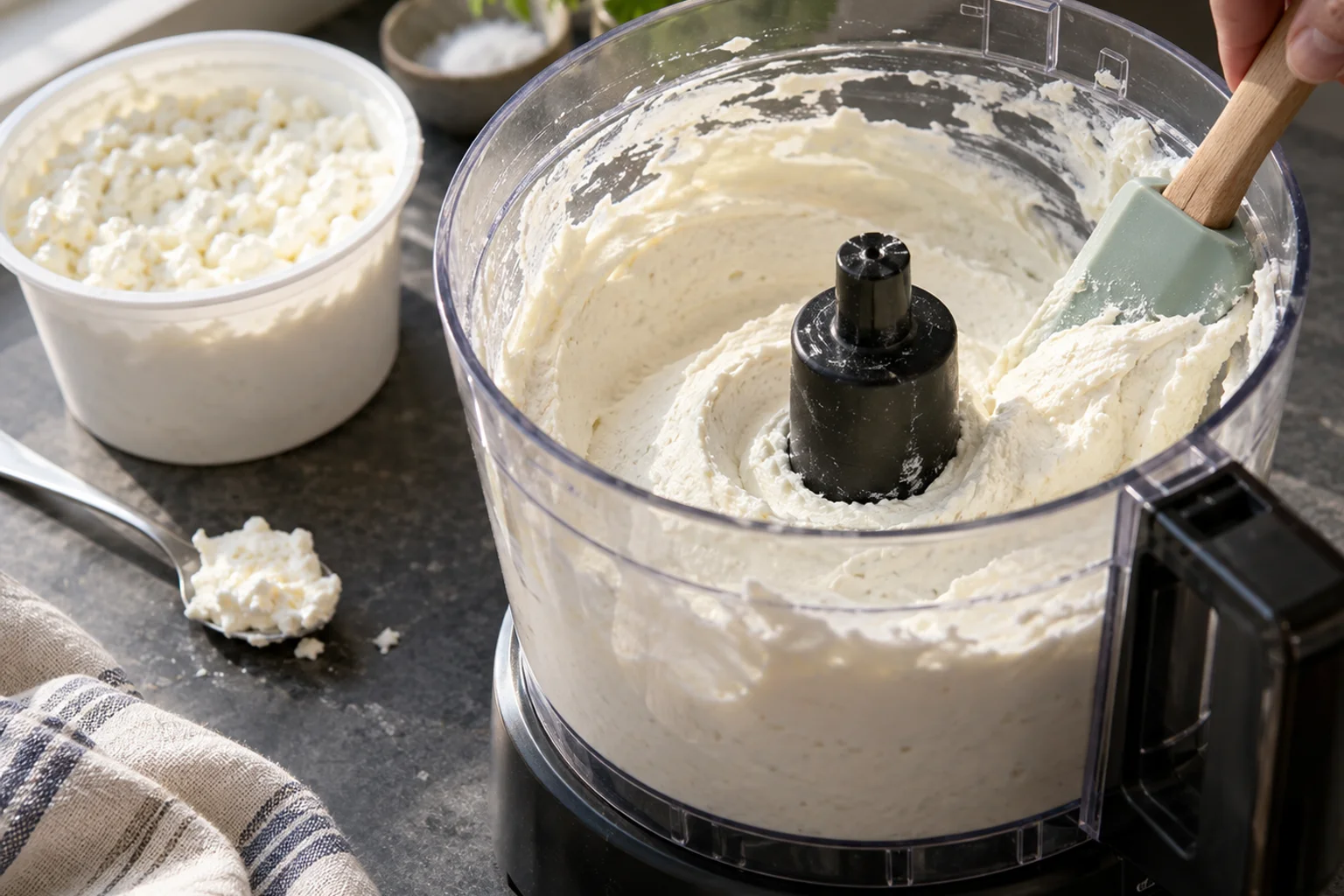
Cottage cheese is the cheapest protein in the dairy aisle, and many people skip it because of the lumpy texture. Add it to a blender or food processor (shop at Amazon, opens in a new tab) and run it for 60 to 90 seconds, stopping once to scrape the sides. It should look like thick Greek yogurt or ricotta cream.
- If the blades spin without catching, add 1 to 2 tablespoons of milk.
- Small-curd blends faster than large-curd. Low-fat (2%) tastes richer than nonfat and still blends well.
- Salt varies a lot between brands, so taste before you add any of your own.
- Blended cottage cheese keeps the same 5 to 7 day fridge life as the tub, so blend a batch and portion it.
How to stir protein powder into yogurt without clumps
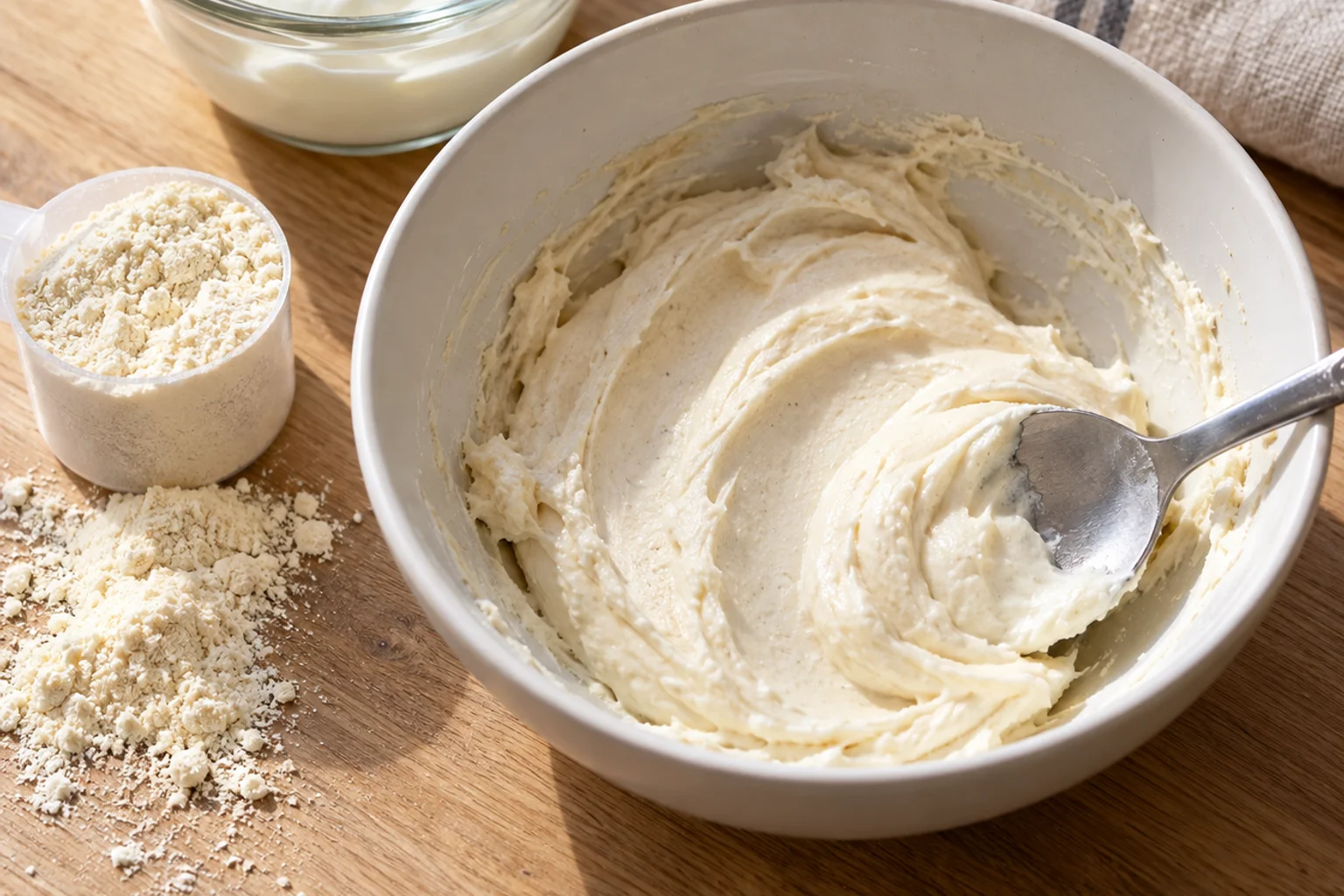
Clumps come from dry powder meeting a thick, cold mass. The water in yogurt is trapped in the protein network, so the powder cannot hydrate quickly. Mixing in the right order fixes it.
- Put 1 scoop (about 30 g) of whey protein isolate (shop at Amazon, opens in a new tab) in the bowl first.
- Add 2 tablespoons of yogurt or milk and mash with the back of a spoon until it is a smooth, thick paste with no dry spots.
- Add the remaining yogurt in two or three additions, stirring after each.
- Rest it 5 minutes. Protein powder keeps thickening as it hydrates, so judge the final texture after the rest.
Micellar casein (shop at Amazon, opens in a new tab) thickens far more than whey: one scoop can turn a cup of yogurt into something close to mousse. If it gets too stiff, stir in a tablespoon of milk at a time. Plant powders such as pea protein (shop at Amazon, opens in a new tab) take longer to hydrate and can taste gritty, so give them a full 10 minutes. A blender or shaker bottle also works if you would rather skip the spoon work.
How do you make Greek yogurt bark?
Greek yogurt bark is made by mixing yogurt with a scoop of protein powder, spreading it 1/4 inch (6 mm) thick on parchment, adding berries and freezing for 75 to 90 minutes. The recipe below makes 8 pieces with about 9 g of protein each, and freezing is the slowest step.
- Line a rimmed sheet pan with parchment and clear a flat spot in the freezer.
- Mash the whey with a little yogurt into a paste, then fold in the rest of the yogurt, honey and vanilla.
- Spread the mixture in an even layer, scatter berries on top and drizzle with melted chocolate.
- Freeze flat for 75 to 90 minutes, until a pressed finger leaves no dent.
- Lift out by the parchment and break into 8 pieces.
A scoop of vanilla whey adds protein and helps the bark freeze creamier, because protein binds free water. Use a rimmed sheet pan (shop at Amazon, opens in a new tab) lined with parchment paper (shop at Amazon, opens in a new tab), and take the pan out of the freezer only when the yogurt is solid to the touch.
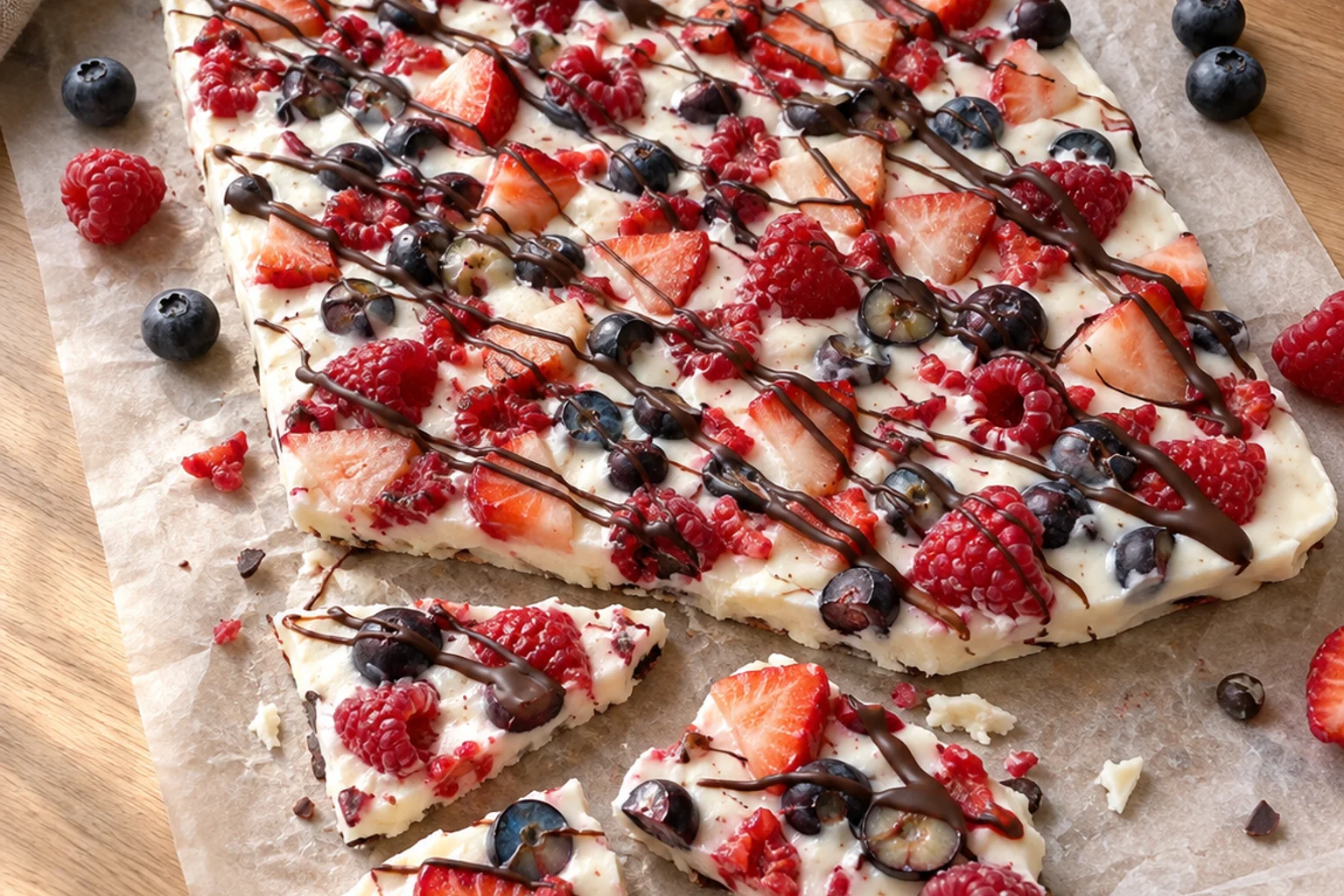
Recipe · Easy · gluten-free, vegetarian
Greek Yogurt Berry Protein Bark
A thin frozen yogurt slab with berries and a chocolate drizzle that snaps into 8 pieces with about 9 g of protein each.
- Prep
- 15 min
- Cook
- 0 min
- Chill/set
- 1 hr 20 min
- Total
- 1 hr 35 min
- Makes
- 8 pieces
- Protein
- 9g
- Calories
- 80
- Carbs
- 7g
- Fat
- 1.5g
- Fiber
- 0.5g
- Sodium
- 30mg
Per serving, approximate.
Ingredients
- 2 cups (454 g) plain nonfat Greek yogurt (shop at Whole Foods, opens in a new tab)
- 1 scoop (30 g) vanilla whey protein isolate (shop at Amazon, opens in a new tab)
- 1 tbsp (21 g) honey (shop at Amazon, opens in a new tab)
- 1/2 tsp vanilla extract (shop at Amazon, opens in a new tab)
- 1/2 cup (70 g) frozen mixed berries, roughly chopped (shop at Whole Foods, opens in a new tab)
- 1 oz (28 g) dark chocolate chips, melted (shop at Amazon, opens in a new tab)
Equipment
Steps
- Line a rimmed half-sheet pan with parchment paper and clear a flat spot in the freezer for it.
- In a bowl, mash the whey with 2 tablespoons of the yogurt into a smooth paste, then fold in the remaining yogurt, the honey and the vanilla until no streaks remain.
- Spread the yogurt on the parchment in an even layer about 1/4 inch (6 mm) thick, roughly 9 by 12 inches (23 by 30 cm).
- Scatter the chopped berries over the top and press them lightly into the yogurt.
- Melt the chocolate chips in the microwave in 20-second bursts, stirring between each, about 40 to 60 seconds total, then drizzle over the bark.
- Freeze, flat and uncovered, for 75 to 90 minutes, until a finger pressed into the center leaves no dent.
- Lift the slab out by the parchment, break or cut it into 8 pieces, and serve right away or flash freeze the pieces for storage.
Storage: Freezer in a zip-top bag with the air pressed out, up to 2 months for best quality. Eat within 3 minutes of removing from the freezer for the best bite.
Variations: swap the berries for diced mango and a sprinkle of unsweetened coconut, or stir 2 tablespoons of peanut butter (shop at Amazon, opens in a new tab) into half the yogurt and swirl it with a knife. Swapping in skyr for Greek yogurt gives a slightly denser, sourer bark, and 2 oz (56 g) of cream cheese stirred in makes it richer with slightly less protein per piece.
How do you keep frozen yogurt bark from turning icy?
Frozen yogurt turns icy when free water freezes slowly into large crystals. Start with thick strained yogurt, add protein powder or a little honey to bind water, spread the layer 1/4 inch (6 mm) thin, and never refreeze thawed pieces. Commercial frozen yogurt fights ice with fat, sugar and stabilizers; at home you have four simple tools.
- Strained Greek yogurt or skyr has less free water than regular yogurt. If your tub has a pool of liquid on top, stir it back in or pour it off.
- Protein powder, a spoonful of nut butter, or a little honey or maple syrup lowers the freezing point and makes the bite less brittle. Fully unsweetened nonfat yogurt freezes hardest.
- Bark at 1/4 inch freezes fast and stays soft enough to bite. A thick slab freezes slowly, which is how large crystals grow.
- Thawed and refrozen bark turns grainy every time.
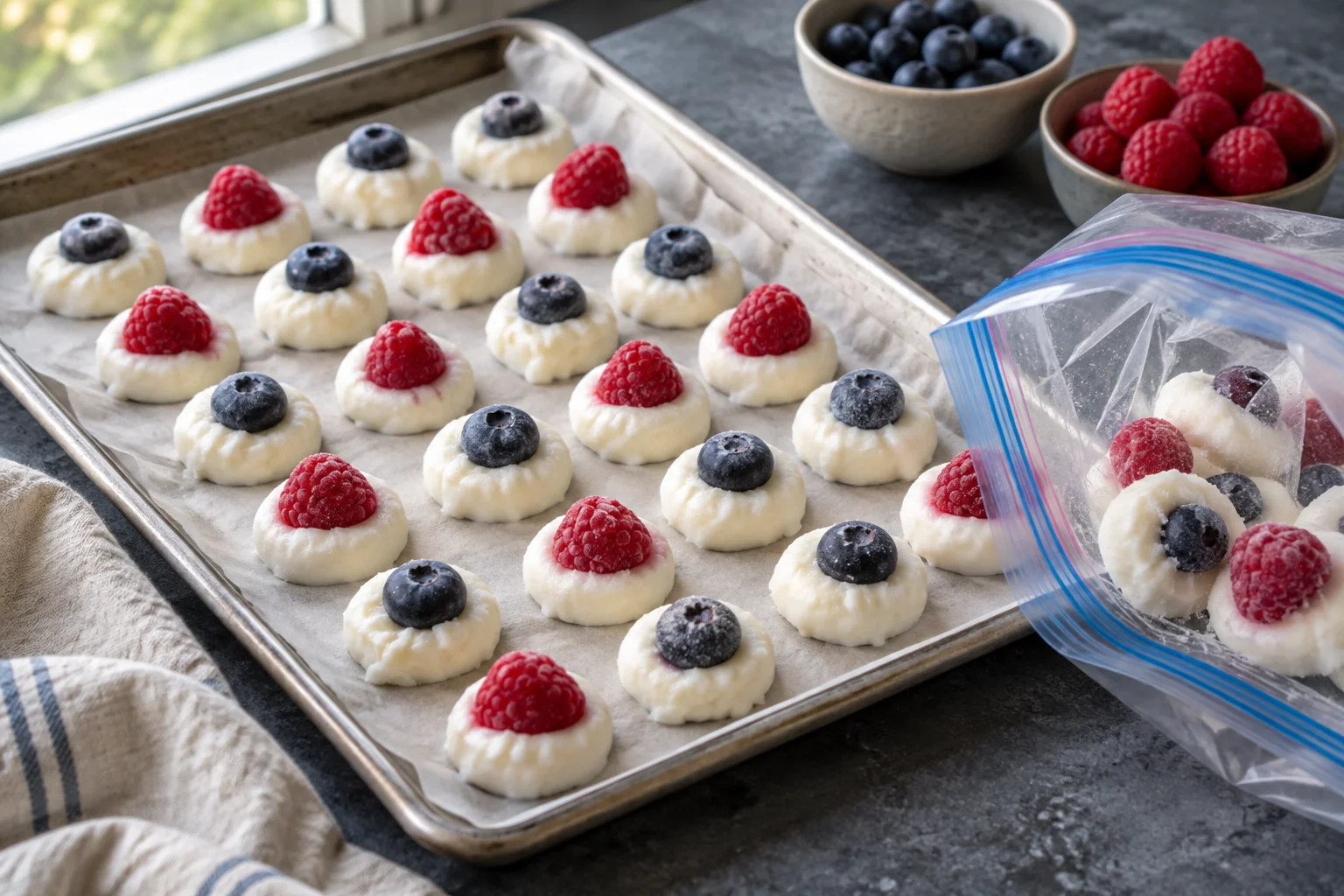
For bites instead of a slab, drop level tablespoons of the same mixture onto a parchment-lined tray with a cookie scoop (shop at Amazon, opens in a new tab), top each with a berry or two, and freeze for 75 to 90 minutes.
How long does Greek yogurt bark last in the freezer?
Greek yogurt bark keeps about 2 months in the freezer for the best flavor and texture. Frozen at 0°F (-18°C) it stays safe indefinitely, and the time limit is about taste, because the pieces slowly pick up freezer odors and ice crystals.
Cut with a sharp chef's knife (shop at Amazon, opens in a new tab) as soon as the slab is firm, because bark gets harder to cut after an hour of extra freezing. If it will not cut, let it sit 2 minutes. Pieces stick together once they warm, so flash freeze them first.
- Lay the cut pieces on a parchment-lined tray with space between them.
- Freeze 20 to 30 minutes until the surfaces are hard.
- Pack into zip-top freezer bags (shop at Amazon, opens in a new tab), press out the air, and label with the date.
Serve bark straight from the freezer for a snap, or give it 2 to 3 minutes on the counter for a softer bite. For the full cold-storage rules, see fridge and freezer storage for protein snacks.
How do you make whipped cottage cheese dip?
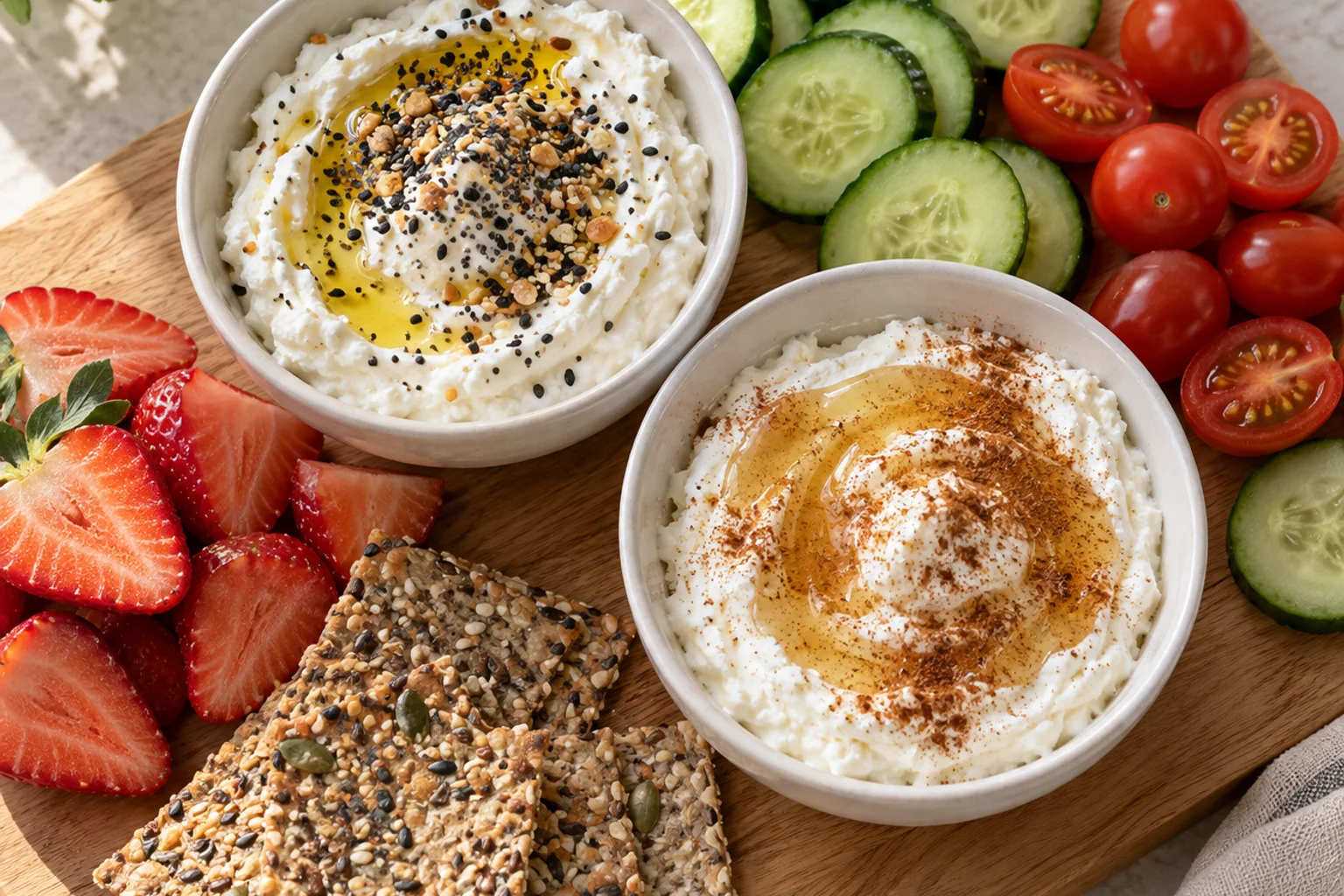
Whipped cottage cheese dip is made by blending 2 cups (452 g) of cottage cheese for 60 to 90 seconds until smooth, then seasoning half savory and half sweet. A 1/2-cup serving has about 12 g of protein, or about 6 g per 1/4 cup, and the whole batch takes 10 minutes with no cooking.
One half goes savory, with olive oil and everything seasoning, for vegetables and crackers. The other half goes sweet, with honey, vanilla and cinnamon, for fruit or toast. Blend until it is truly smooth, because small bits of curd ruin the whipped feel.
Recipe · Easy · gluten-free, vegetarian
Whipped Cottage Cheese Dip (Savory and Sweet)
One blender batch of cottage cheese split into a savory herb dip and a honey-cinnamon fruit dip, about 12 g of protein per serving.
- Prep
- 10 min
- Cook
- 0 min
- Total
- 10 min
- Makes
- 4 servings (about 1/2 cup / 110 g each, 2 savory and 2 sweet)
- Protein
- 12g
- Calories
- 140
- Carbs
- 10g
- Fat
- 6g
- Fiber
- 0g
- Sodium
- 480mg
Per serving, approximate.
Ingredients
- 2 cups (452 g) low-fat small-curd cottage cheese (shop at Whole Foods, opens in a new tab)
- 1 tbsp (15 ml) extra-virgin olive oil (savory half) (shop at Amazon, opens in a new tab)
- 1 tsp everything bagel seasoning (savory half) (shop at Amazon, opens in a new tab)
- 1/2 tsp garlic powder (savory half) (shop at Amazon, opens in a new tab)
- 1/4 tsp coarse-ground black pepper (savory half) (shop at Amazon, opens in a new tab)
- 1 tsp lemon juice (savory half)
- 1 tbsp (21 g) honey (sweet half) (shop at Amazon, opens in a new tab)
- 1/2 tsp vanilla extract (sweet half) (shop at Amazon, opens in a new tab)
- 1/4 tsp ground cinnamon (sweet half) (shop at Amazon, opens in a new tab)
Equipment
Steps
- Blend the cottage cheese in a food processor for 60 to 90 seconds, scraping the sides once, until completely smooth.
- Spoon half of the blended cottage cheese (about 1 cup / 226 g) into each of two bowls.
- To the first bowl, stir in the olive oil, everything bagel seasoning, garlic powder, black pepper and lemon juice. Taste before adding salt, since cottage cheese is already salty.
- To the second bowl, stir in the honey, vanilla and cinnamon until evenly mixed.
- Serve at once, or cover and chill 15 minutes for a slightly thicker dip. Pack each bowl in its own container.
Storage: Fridge in covered containers up to 4 days. Do not freeze; the texture turns grainy.
The savory bowl also works as a sandwich spread or baked potato topper. Make the sweet one thicker for toast, or stir in diced peaches or chopped strawberries. Per serving, the numbers above average one savory and one sweet portion. The cheese crisps in the baked section below make a crunchy scoop.
How do you make protein pudding with Greek yogurt?
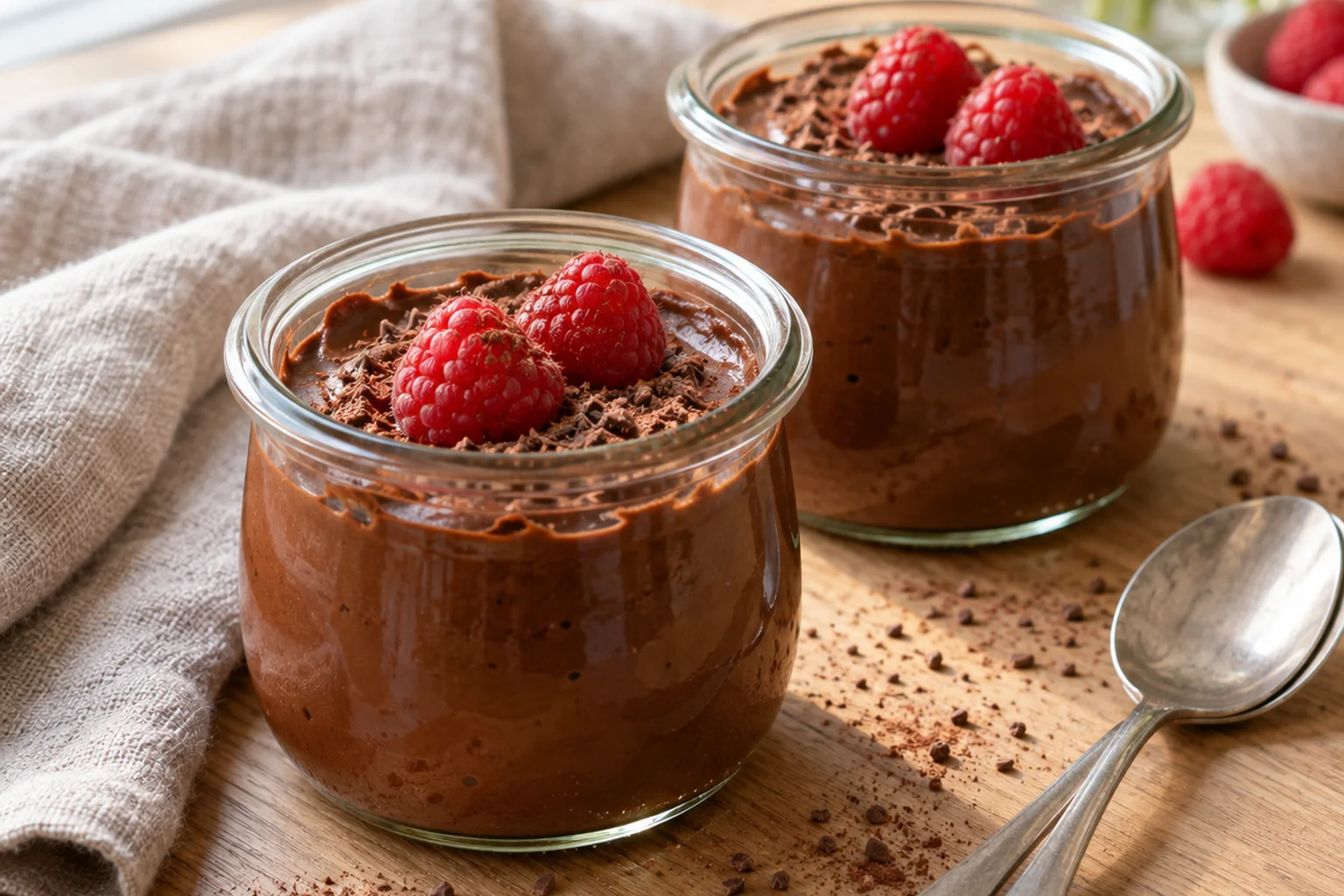
Protein pudding is a thick, spoonable mix of Greek yogurt, cottage cheese or casein with protein powder and a little milk. The recipe below makes 2 servings with 24 g of protein each in 25 minutes. Casein absorbs liquid and thickens as it sits, so the chill time matters.
The 20 minutes in the fridge is needed for pudding texture. Right after stirring, the mix is a thick shake-like mousse. After 20 minutes it is a thick pudding, and after an hour or more it firms further. This card uses Greek yogurt and chocolate whey, which most people already own.
Recipe · Easy · gluten-free, vegetarian
Chocolate Protein Pudding
A thick, creamy no-cook pudding from Greek yogurt and chocolate whey with 24 g of protein per serving.
- Prep
- 5 min
- Cook
- 0 min
- Chill/set
- 20 min
- Total
- 25 min
- Makes
- 2 servings (about 3/4 cup / 170 g each)
- Protein
- 24g
- Calories
- 160
- Carbs
- 13g
- Fat
- 2g
- Fiber
- 1g
- Sodium
- 120mg
Per serving, approximate.
Ingredients
- 1 cup (245 g) plain nonfat Greek yogurt (shop at Whole Foods, opens in a new tab)
- 1 scoop (30 g) chocolate whey protein powder (shop at Amazon, opens in a new tab)
- 1 tbsp (5 g) unsweetened cocoa powder (shop at Amazon, opens in a new tab)
- 2 tsp (14 g) pure maple syrup (shop at Amazon, opens in a new tab)
- 2 to 3 tbsp (30 to 45 ml) milk (shop at Whole Foods, opens in a new tab)
- 1/4 tsp vanilla extract (shop at Amazon, opens in a new tab)
- 1 pinch kosher salt (shop at Amazon, opens in a new tab)
Steps
- In a bowl, mash the chocolate whey, cocoa powder and 2 tablespoons of the yogurt into a smooth paste, pressing out any dry lumps.
- Stir in the remaining yogurt, the maple syrup, vanilla and salt until the mixture is a uniform dark brown.
- Add 2 tablespoons of milk and whisk for 30 seconds; add a third tablespoon only if the pudding looks too stiff to spoon.
- Divide between two small jars or cups and cover.
- Refrigerate for 20 minutes before eating. It firms up further if you leave it 1 to 2 hours.
Storage: Fridge, covered, up to 4 days. It thickens as it sits, so stir in a spoonful of milk before eating.
Casein version: whisk 1 scoop (about 33 g) of casein, 1 tablespoon of cocoa, 2 teaspoons of maple syrup, a pinch of salt and 3/4 cup (180 ml) of cold milk until smooth, then let it sit 5 minutes. It thickens to a spoonable pudding with about 30 g of protein in one serving. If it is too thick, add milk a tablespoon at a time; if too thin, wait another 5 minutes. Casein brands vary widely in how much liquid they absorb.
Without powder: leave out the whey and the card gives about 12 g of protein per serving from the yogurt alone. For a cottage cheese protein pudding, blend 1 cup (226 g) of cottage cheese with the cocoa and maple syrup until smooth, then chill 20 minutes.
Why is cottage cheese pudding grainy?
Grainy cottage cheese pudding means the curds were under-blended or the mixture was too warm. Blend small-curd cottage cheese 60 to 90 seconds with a splash of milk before adding anything else, keep liquids cold or lukewarm, and stir powder in last. If bits remain, pass the pudding through a fine sieve.
Can you make chia pudding with protein powder in 20 minutes?
Chia pudding can be made with protein powder and set in about 20 minutes if you grind the seeds and use warm milk, about 110°F (43°C). Whole seeds in cold milk gel loosely in 20 to 30 minutes but need 2 or more hours to firm. The recipe below has about 22 g of protein per serving.
Grinding exposes the seeds' gel-forming outer layer, and warm milk speeds hydration. The result is thick and spoonable but not as firm as an overnight batch, and it thickens if you wait. Chia seeds alone supply about 5 g of protein per 30 g, so the whey and peanut butter do most of the work. Keep the milk warm, not hot, because very hot liquid can make whey clump. Warm to the touch is enough.
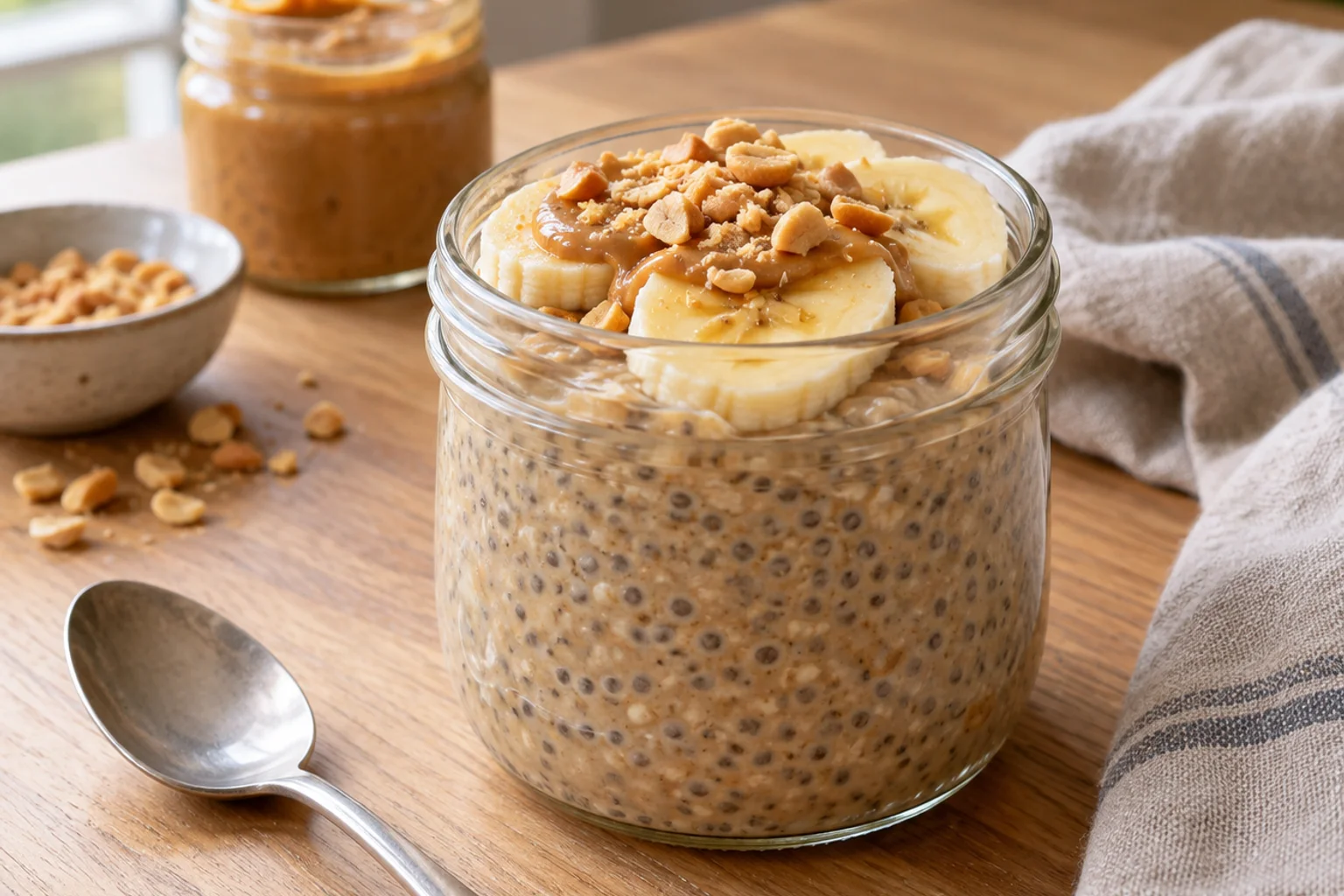
Recipe · Easy · gluten-free, vegetarian
Peanut Butter Chia Protein Pudding (20-Minute Express)
Ground chia and warm milk set a peanut butter protein pudding in 20 minutes, with about 22 g of protein per serving.
- Prep
- 8 min
- Cook
- 2 min
- Chill/set
- 20 min
- Total
- 30 min
- Makes
- 2 servings (about 1 cup / 240 g each)
- Protein
- 22g
- Calories
- 290
- Carbs
- 19g
- Fat
- 15g
- Fiber
- 6g
- Sodium
- 120mg
Per serving, approximate.
Ingredients
- 3 tbsp (30 g) chia seeds, ground to a fine powder (shop at Amazon, opens in a new tab)
- 1 cup (240 ml) milk, warmed to about 110°F (43°C) (shop at Whole Foods, opens in a new tab)
- 2 tbsp (32 g) natural peanut butter (shop at Amazon, opens in a new tab)
- 1 scoop (30 g) vanilla whey protein isolate (shop at Amazon, opens in a new tab)
- 1 tsp (7 g) honey (shop at Amazon, opens in a new tab)
- 1 pinch kosher salt (shop at Amazon, opens in a new tab)
Equipment
Steps
- Grind the chia seeds in a clean spice grinder or a small blender jar for 20 to 30 seconds until they look like coarse flour.
- Warm the milk in the microwave for 30 to 45 seconds, until it feels warm but not hot, about 110°F (43°C).
- Add the milk, ground chia, peanut butter, whey, honey and salt to a blender and blend for 30 seconds, until completely smooth with no streaks.
- Pour into two jars and refrigerate for 20 minutes. Stir once after 10 minutes so the chia does not settle.
- Check the texture after 20 minutes. For a firmer gel, chill another 30 to 60 minutes.
Storage: Fridge, covered, up to 4 days; it will keep thickening, so loosen with a splash of milk.
Dairy-free: use soy milk (about 7 g of protein per cup) and a plant protein blend such as pea and rice protein (shop at Amazon, opens in a new tab). The pudding tastes earthier and sets a little thicker. Swap ground flaxseed (shop at Amazon, opens in a new tab) for half of the chia for a looser texture, or stir in a tablespoon of hemp hearts for about 3 g more protein.
How does baking with protein powder change a recipe?
Protein powder in baking should replace no more than about one third of the flour, needs extra moisture such as Greek yogurt, pumpkin or applesauce, and bakes best about 25°F (14°C) cooler. Whey is mostly protein, which tightens and squeezes out water when heated, while flour is mostly starch, which swells and sets into a soft crumb.
Swap all the flour for whey and the result is dry, rubbery and flat. It also browns faster, because milk proteins and lactose caramelize at lower temperatures than starch. Four rules avoid most failures.
- Replace no more than about one third of the flour. If a recipe uses 1 cup (120 g) of flour, take out at most 1/3 cup (about 40 g) and add a scoop of protein powder (about 30 g). Starch still gives structure.
- For each scoop of powder, add roughly 1/4 cup (60 g) of Greek yogurt, pumpkin purée or unsweetened applesauce. Yogurt adds protein; pumpkin and applesauce add moisture with almost no fat.
- Drop the oven by about 25°F (14°C) and start checking 3 to 5 minutes early. A toothpick should come out with a few moist crumbs.
- Stir only until the flour disappears, so the crumb stays tender.
| Powder | In baking | Best for | Watch out for |
|---|---|---|---|
| Whey isolate or concentrate | Light, absorbs modest liquid, dries and toughens when overbaked | Muffins, pancakes, mug cakes | Rubbery texture if you use too much or bake too long |
| Micellar casein | Absorbs about twice as much liquid, makes batters thick, bakes moist and dense | Brownies, dense cakes, puddings | Gummy or heavy crumb; add more liquid |
| Whey and casein blend | Balanced: moisture holds and the crumb stays light | Most baked goods | Brands vary |
| Pea, rice or soy blends | Absorb a lot of liquid, earthy taste, slightly gritty | Dense muffins, cookies, bars | Dryness; add extra liquid and strong flavors like cocoa or cinnamon |
If your only powder is whey, stay near the one-third limit. If you only have a plant blend, add an extra tablespoon or two of liquid per scoop and expect a denser crumb. Oat flour and almond flour can replace part of the wheat flour, but almond flour adds fat and makes a denser crumb. A tablespoon or two of egg white powder (shop at Amazon, opens in a new tab) works as a binder; more than that can turn spongy. For help choosing a powder, see the protein snack pantry shopping guide.
Baked protein snacks: cheese crisps, muffins, mug cake and pancake bites
These four recipes put the baking rules to work, and each uses a different protein source: aged cheese, yogurt plus whey, a microwave mug, and blended cottage cheese.
How do you make baked parmesan cheese crisps?
Baked parmesan cheese crisps are made by baking mounds of finely grated cheese at 400°F (200°C) for 5 to 7 minutes until golden, then cooling them 5 minutes to crisp. Each crisp has about 4 to 5 g of protein, because hard cheese is roughly 25 to 36 percent protein by weight.
- Heat the oven to 400°F (200°C) and line a sheet pan with parchment.
- Toss the grated cheese with the seasonings.
- Spoon level tablespoons 2 inches (5 cm) apart and pat each flat.
- Bake 5 to 7 minutes, until the edges are deep golden.
- Cool on the pan 5 minutes, then lift off.
A cheese crisp is grated hard cheese melted into a lacy disc, and nothing else holds it together. Each of the 12 crisps uses about 13 g of cheese. Because the cheese is aged, the crisps have almost no carbohydrate and only trace lactose. Parmigiano-Reggiano (shop at Whole Foods, opens in a new tab) gives deep flavor and shatters crisp; sharp cheddar (shop at Whole Foods, opens in a new tab) gives a milder, slightly chewier crisp. Mixing the two is a good middle path.
Use finely grated cheese, not coarse shreds, and watch closely in the last 2 minutes: the line between golden and bitter is about 30 seconds.
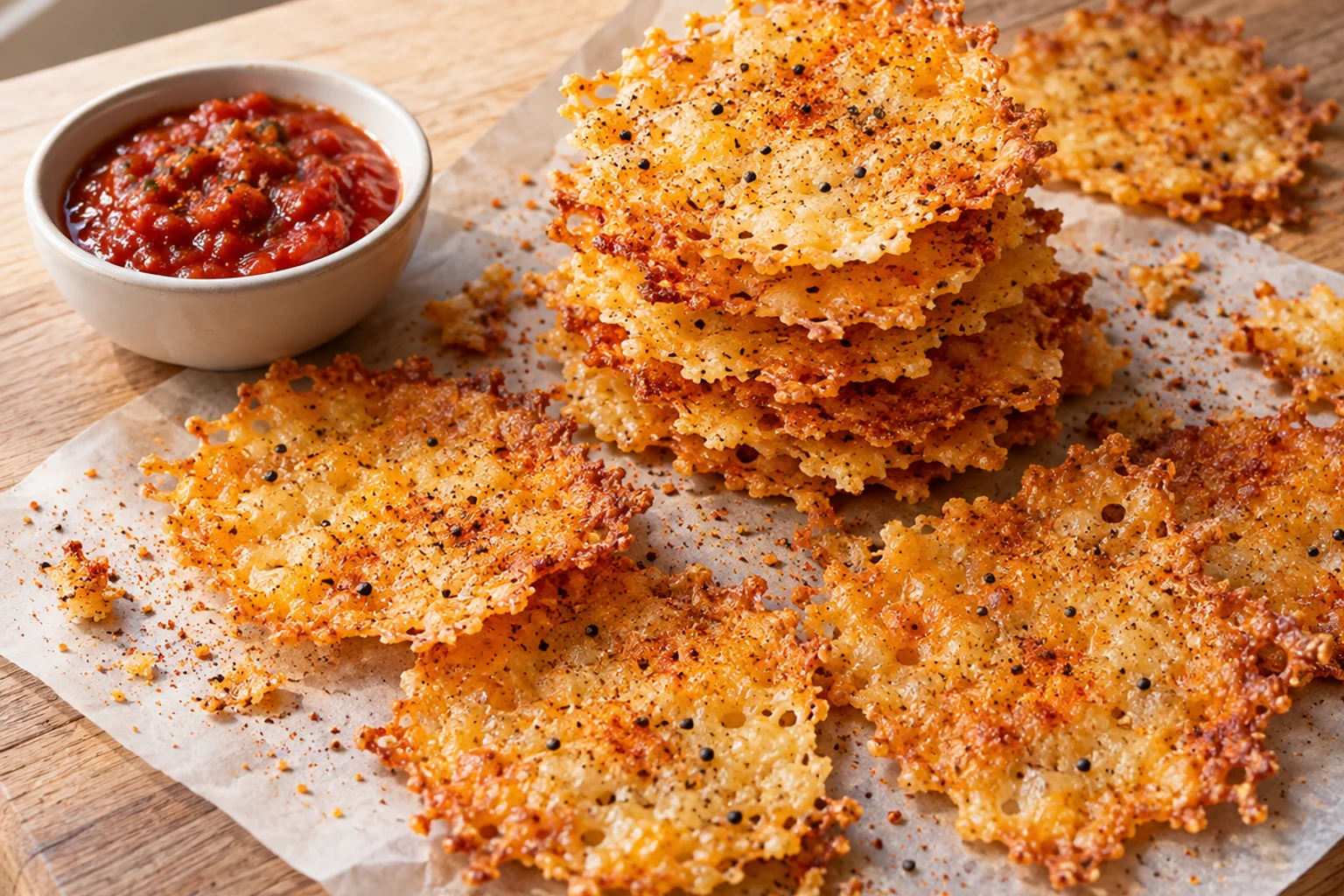
Recipe · Easy · gluten-free, vegetarian
Baked Parmesan and Cheddar Cheese Crisps
Two-cheese crisps baked at 400°F (200°C) with about 9 g of protein and 1 g of carbohydrate per serving.
- Prep
- 10 min
- Cook
- 7 min
- Chill/set
- 5 min
- Total
- 22 min
- Makes
- 6 servings (2 crisps each, 12 crisps)
- Protein
- 9g
- Calories
- 110
- Carbs
- 1g
- Fat
- 8g
- Fiber
- 0g
- Sodium
- 325mg
Per serving, approximate.
Ingredients
- 1 cup (100 g) finely grated Parmigiano-Reggiano (shop at Whole Foods, opens in a new tab)
- 1/2 cup (56 g) shredded sharp cheddar (shop at Whole Foods, opens in a new tab)
- 1/2 tsp smoked paprika (shop at Amazon, opens in a new tab)
- 1/4 tsp garlic powder (shop at Amazon, opens in a new tab)
- 1/4 tsp coarse-ground black pepper (shop at Amazon, opens in a new tab)
Equipment
Steps
- Heat the oven to 400°F (200°C) and line a rimmed half-sheet pan with parchment paper.
- Toss the Parmigiano-Reggiano, cheddar, paprika, garlic powder and black pepper in a bowl. Do not add salt; the cheese is already salty.
- Spoon 12 level tablespoons of the mixture onto the parchment, spacing the mounds 2 inches (5 cm) apart, and pat each into a flat 2-inch (5 cm) round.
- Bake 5 to 7 minutes, until the edges are deep golden and the centers have stopped bubbling.
- Cool on the pan 5 minutes; the crisps firm up as they cool. Lift off with a thin spatula.
Storage: Airtight container at room temperature up to 2 days, or in the fridge up to 5 days; re-crisp in a 300°F (150°C) oven for 3 minutes.
Add 1 teaspoon of everything bagel seasoning (shop at Amazon, opens in a new tab) or a pinch of red pepper flakes (shop at Amazon, opens in a new tab). Use the crisps as a crunchy scoop for the cottage cheese dip above.
How do you make Greek yogurt protein muffins?
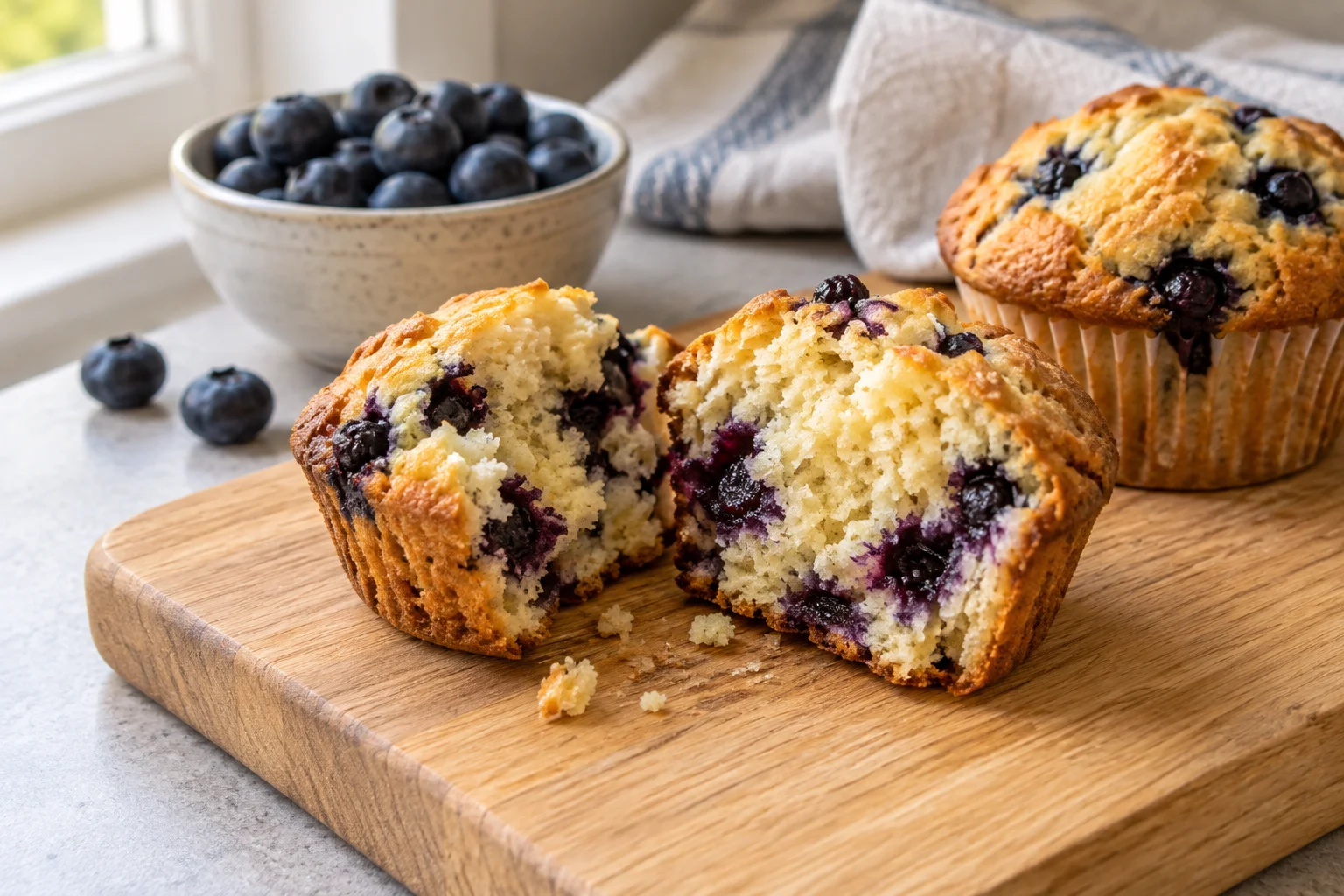
Greek yogurt protein muffins use 1 cup (227 g) of yogurt and one scoop of whey to give about 6 g of protein and 116 calories per muffin, baked at 350°F (175°C). One scoop replaces about a fifth of the flour and the yogurt supplies moisture, so the muffins eat like real muffins and do not taste of powder.
They are a snack, not a protein-bar replacement. Fold the blueberries in last, and toss frozen berries with a teaspoon of flour first so they do not sink or bleed purple through the batter. Spray the cups with avocado oil spray (shop at Amazon, opens in a new tab) or use a silicone muffin pan (shop at Amazon, opens in a new tab).
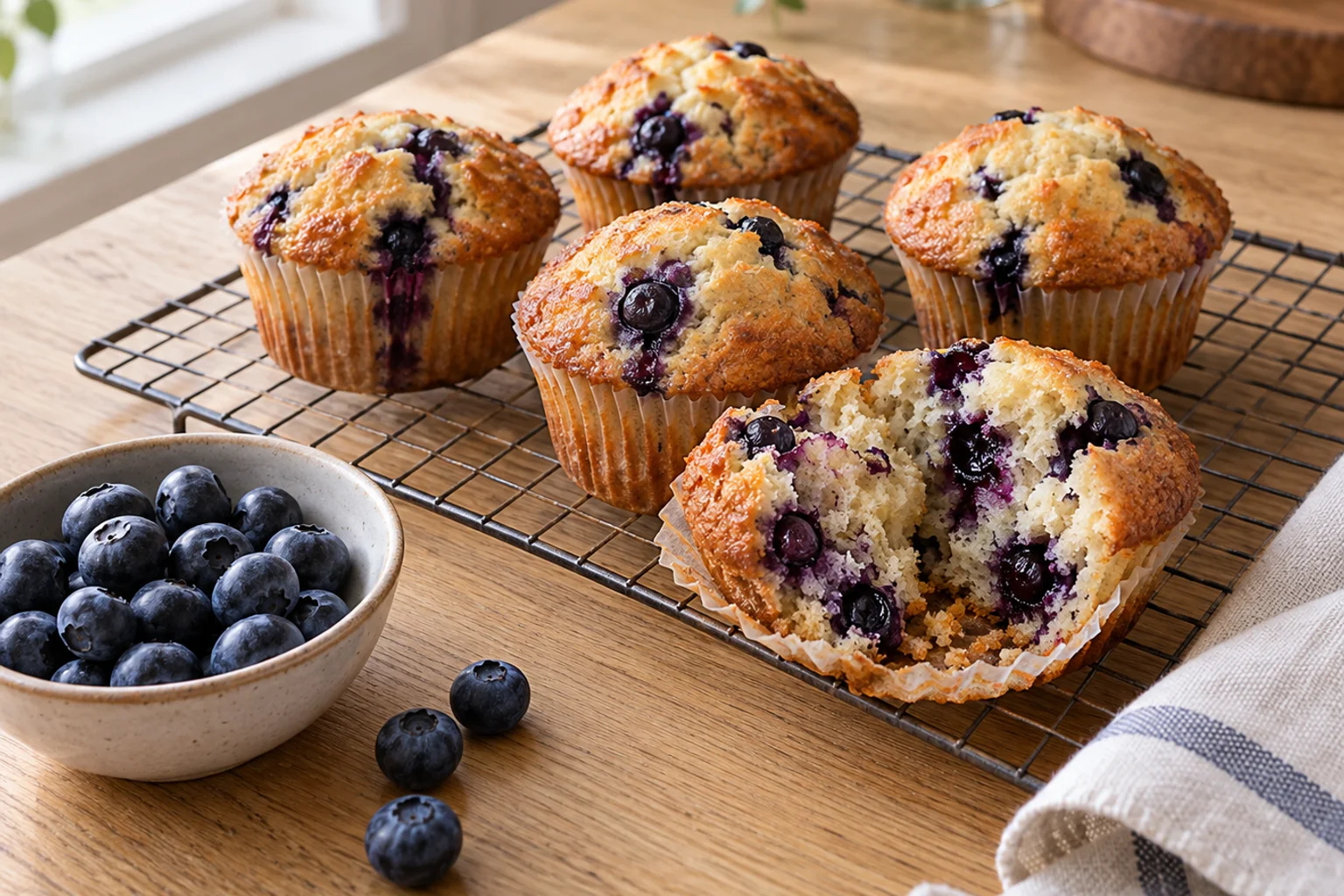
Recipe · Easy · vegetarian
Blueberry Greek Yogurt Protein Muffins
Moist blueberry muffins made with Greek yogurt and one scoop of whey, about 6 g of protein and 116 calories each.
- Prep
- 15 min
- Cook
- 22 min
- Chill/set
- 10 min
- Total
- 47 min
- Makes
- 12 muffins
- Protein
- 6g
- Calories
- 116
- Carbs
- 15g
- Fat
- 3.5g
- Fiber
- 1g
- Sodium
- 170mg
Per serving, approximate.
Ingredients
- 1 cup (120 g) all-purpose flour
- 1 scoop (30 g) vanilla whey protein isolate (shop at Amazon, opens in a new tab)
- 1 tsp baking powder
- 1/2 tsp baking soda
- 1/4 tsp kosher salt (shop at Amazon, opens in a new tab)
- 1 cup (227 g) plain nonfat Greek yogurt (shop at Whole Foods, opens in a new tab)
- 2 large eggs (shop at Whole Foods, opens in a new tab)
- 1/4 cup (80 g) pure maple syrup (shop at Amazon, opens in a new tab)
- 2 tbsp (30 ml) extra-virgin olive oil (shop at Amazon, opens in a new tab)
- 1/4 cup (60 ml) milk (shop at Whole Foods, opens in a new tab)
- 1 tsp vanilla extract (shop at Amazon, opens in a new tab)
- 1 cup (150 g) blueberries, fresh or frozen
Equipment
Steps
- Heat the oven to 350°F (175°C). Spray a 12-cup muffin pan with oil or set it on a sheet pan if you are using a silicone pan.
- Whisk the flour, whey, baking powder, baking soda and salt in a large bowl.
- In a second bowl, whisk the yogurt, eggs, maple syrup, olive oil, milk and vanilla until smooth.
- Pour the wet mixture into the dry and stir with a spatula just until no flour streaks remain. Fold in the blueberries.
- Divide the batter among the 12 cups, filling each about three-quarters full.
- Bake 20 to 22 minutes, until a toothpick inserted in the center comes out with a few moist crumbs and the tops are golden.
- Cool in the pan for 10 minutes, then move to a wire rack.
Storage: Cool completely, then store in the fridge in an airtight container up to 5 days, or freeze up to 3 months. Reheat from frozen in the microwave for 30 to 40 seconds.
Variations: use pumpkin purée in place of 1/2 cup of the yogurt and add 1/2 teaspoon of cinnamon. Replace half of the all-purpose flour with oat flour (shop at Amazon, opens in a new tab) for more fiber, though the crumb will be denser. Because the batter contains eggs and yogurt, refrigerate muffins within 2 hours of baking rather than leaving them in a bag on the counter.
How do you make a protein mug cake in the microwave?
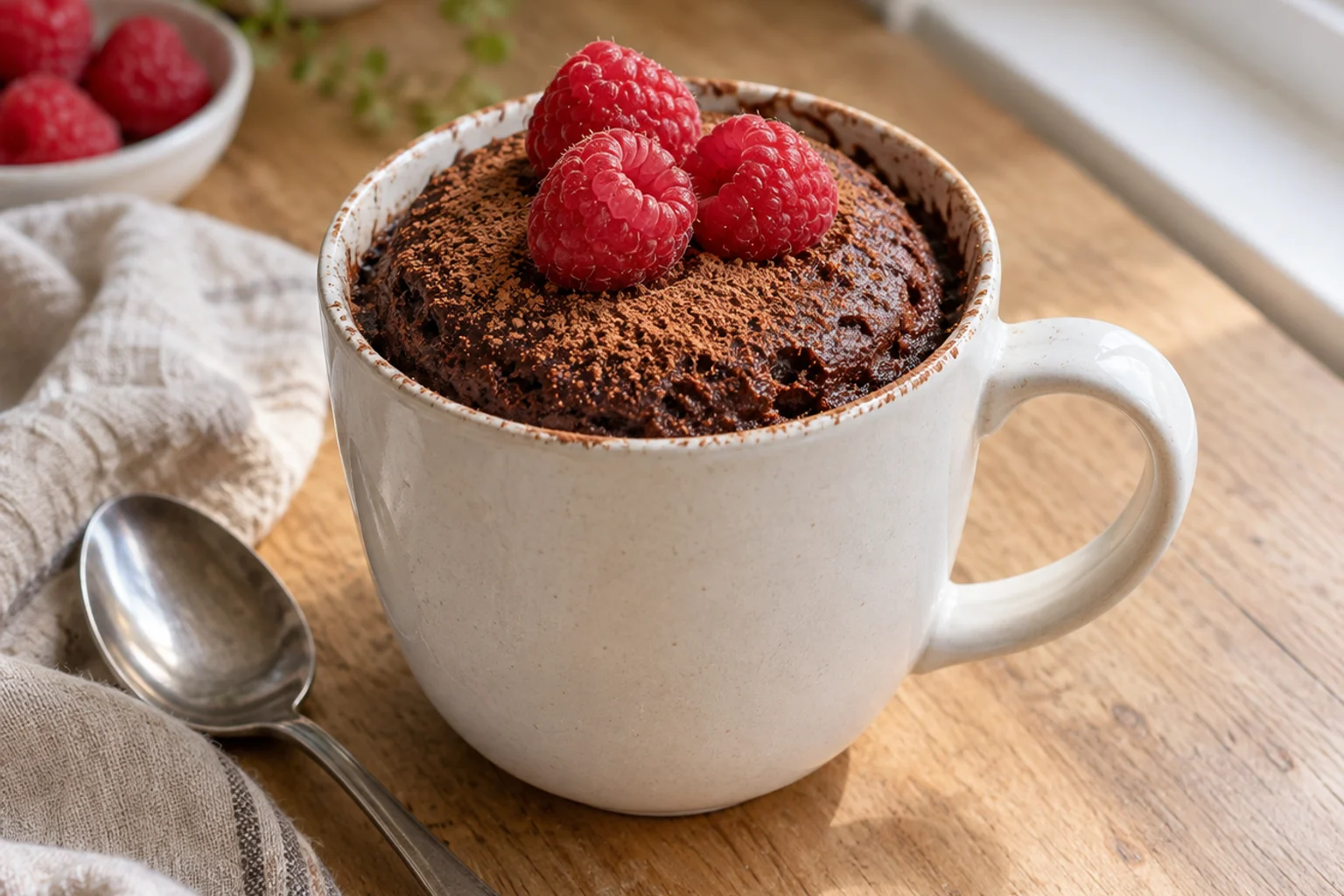
A protein mug cake is made by mixing whey, oat flour, baking powder, Greek yogurt, an egg, milk and maple syrup in a mug and microwaving it on high for 60 to 90 seconds. The recipe below has about 39 g of protein and 350 calories, and it takes 5 minutes.
The yogurt matters. Without it, whey in a microwave turns into a rubbery puck; with it, you get a soft, spongy, brownie-like cake. Microwaves range from 700 to 1,200 watts, so stop at 60 seconds, check, and add 10-second bursts if the center is still wet.
Recipe · Easy · vegetarian
2-Minute Chocolate Protein Mug Cake
A single-serving microwave chocolate cake with about 39 g of protein, ready in 5 minutes.
- Prep
- 3 min
- Cook
- 2 min
- Total
- 5 min
- Makes
- 1 serving
- Protein
- 39g
- Calories
- 350
- Carbs
- 31g
- Fat
- 9g
- Fiber
- 2g
- Sodium
- 400mg
Per serving, approximate.
Ingredients
- 1 scoop (30 g) chocolate whey protein powder (shop at Amazon, opens in a new tab)
- 2 tbsp (16 g) oat flour (shop at Amazon, opens in a new tab)
- 1/2 tsp baking powder
- 1/4 cup (60 g) plain nonfat Greek yogurt (shop at Whole Foods, opens in a new tab)
- 1 large egg (shop at Whole Foods, opens in a new tab)
- 2 tbsp (30 ml) milk (shop at Whole Foods, opens in a new tab)
- 1 tbsp (20 g) pure maple syrup (shop at Amazon, opens in a new tab)
Steps
- Mix the whey, oat flour and baking powder in a large microwave-safe mug with a fork.
- Add the yogurt, egg, milk and maple syrup and stir until smooth, scraping the bottom corners of the mug.
- Microwave on high for 60 seconds, then check the center. If it is still wet, continue in 10-second bursts, up to 90 seconds total.
- Rest the mug for 1 minute; the cake finishes setting from the residual heat, then eat from the mug.
Storage: Best eaten right away. The microwaved egg means leftovers should be refrigerated within 2 hours and eaten within 2 days.
Troubleshooting:
- Rubbery: cook 10 to 15 seconds less, or use a wider mug, which cooks more evenly.
- Dry: the batter was too stiff, so add 1 tablespoon of milk or yogurt next time.
- Raw in the middle: a 700 W microwave may need 15 to 30 seconds more, while a 1,200 W microwave may be done by 45 seconds.
- Gooey center: add 1 tablespoon of dark chocolate chips (shop at Amazon, opens in a new tab) before the rest.
How do you make cottage cheese pancake bites?
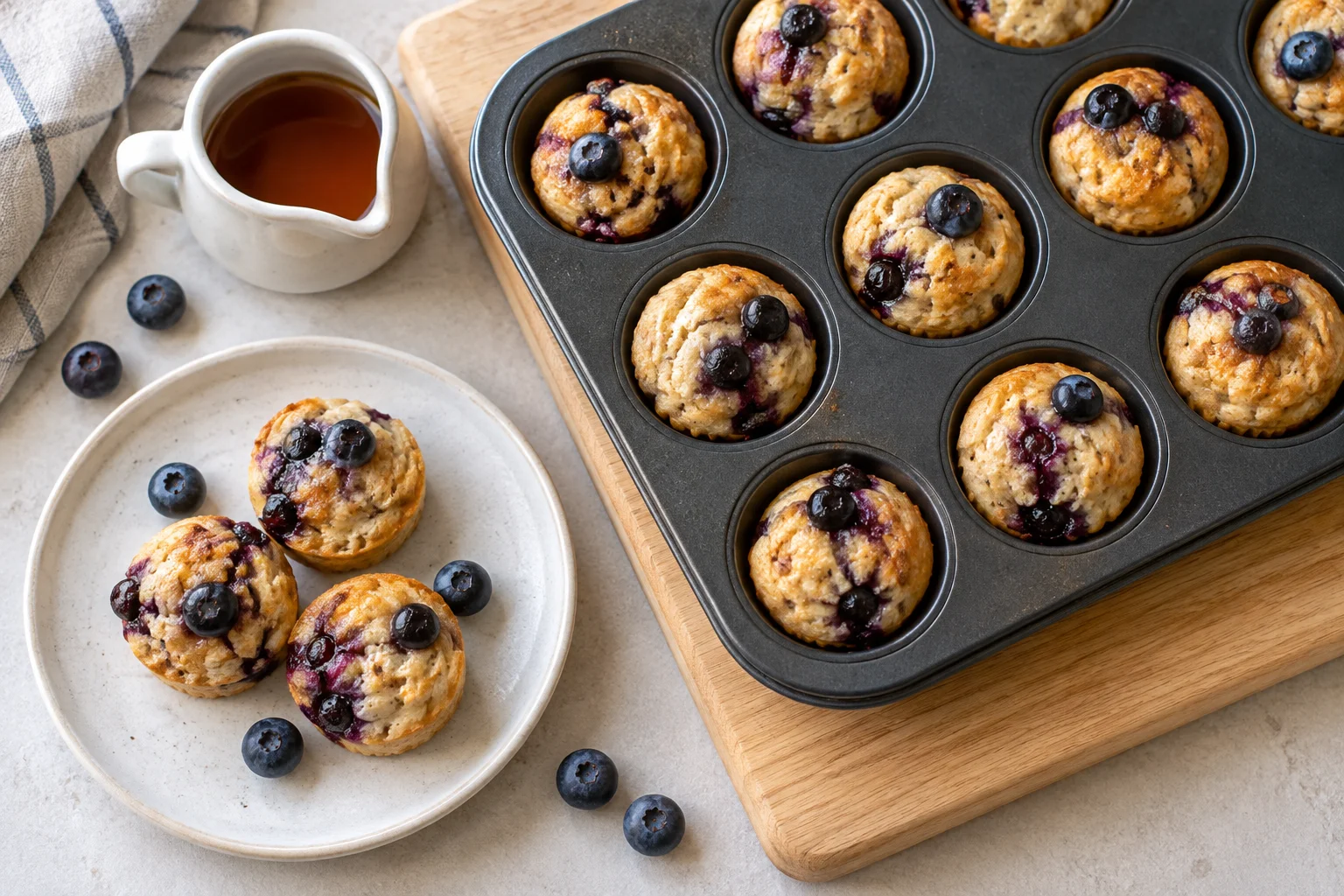
Cottage cheese pancake bites are mini oat pancakes baked in a 24-cup mini muffin pan at 375°F (190°C) for 18 to 20 minutes. Blended cottage cheese and eggs give them a tender, custardy center, and each 4-bite serving has about 9 g of protein.
A mini muffin pan bakes them without a griddle, so you can make 24 bites in one go for meal prep. Do not skip the blending step, because a thick, smooth batter is what makes the custardy center.
Recipe · Easy · vegetarian
Cottage Cheese Protein Pancake Bites
Twenty-four mini oat and cottage cheese pancake bites baked in a mini muffin pan, about 9 g of protein per 4-bite serving.
- Prep
- 10 min
- Cook
- 20 min
- Chill/set
- 5 min
- Total
- 35 min
- Makes
- 6 servings (4 bites each, 24 bites)
- Protein
- 9g
- Calories
- 125
- Carbs
- 13g
- Fat
- 4g
- Fiber
- 1.5g
- Sodium
- 270mg
Per serving, approximate.
Ingredients
- 1 cup (226 g) low-fat cottage cheese (shop at Whole Foods, opens in a new tab)
- 3 large eggs (shop at Whole Foods, opens in a new tab)
- 3/4 cup (68 g) old-fashioned rolled oats (shop at Amazon, opens in a new tab)
- 1 tbsp (20 g) pure maple syrup (shop at Amazon, opens in a new tab)
- 1 tsp vanilla extract (shop at Amazon, opens in a new tab)
- 1 tsp baking powder
- 1/3 cup (50 g) blueberries, fresh or frozen
- as needed avocado oil spray (shop at Amazon, opens in a new tab)
Equipment
Steps
- Heat the oven to 375°F (190°C) and spray a 24-cup mini muffin pan well with oil.
- Add the cottage cheese, eggs, oats, maple syrup, vanilla and baking powder to a food processor or blender and blend 60 seconds, until smooth with no whole oats visible.
- Rest the batter for 5 minutes so the oats absorb liquid; it will thicken slightly.
- Fill each cup about three-quarters full and drop 2 or 3 blueberries on top of each.
- Bake 18 to 20 minutes, until the tops are set and lightly golden and a toothpick comes out clean.
- Cool in the pan 5 minutes, run a knife around each bite, and lift out. Serve warm or cold.
Storage: Fridge in an airtight container up to 5 days; freezer up to 3 months. Reheat from frozen in the microwave for 20 seconds.
Variations: use mashed banana instead of maple syrup, or add 1 tablespoon of chia seeds (shop at Amazon, opens in a new tab) to the blender. The bites freeze well, so bake a double batch and bag them.
How do the eight recipes compare on protein and calories?
The mug cake leads on total protein at 39 g, and the chocolate pudding leads on protein density at about 15 g per 100 calories. The muffins trail at about 5 g per 100 calories. All numbers are estimates calculated from USDA FoodData Central entries for the listed ingredients, and brands vary.
| Recipe | Serving | Calories | Protein | Protein per 100 calories | Carbs | Total time |
|---|---|---|---|---|---|---|
| Greek Yogurt Berry Protein Bark | 1 piece (of 8) | 80 | 9 g | 11 g | 7 g | 95 min |
| Whipped Cottage Cheese Dip | 1/2 cup (of 4) | 140 | 12 g | 9 g | 10 g | 10 min |
| Chocolate Protein Pudding | 3/4 cup (of 2) | 160 | 24 g | 15 g | 13 g | 25 min |
| Peanut Butter Chia Pudding (express) | 1 cup (of 2) | 290 | 22 g | 8 g | 19 g | 30 min |
| Baked Cheese Crisps | 2 crisps (of 6) | 110 | 9 g | 8 g | 1 g | 22 min |
| Blueberry Yogurt Protein Muffins | 1 muffin (of 12) | 116 | 6 g | 5 g | 15 g | 47 min |
| Chocolate Protein Mug Cake | 1 mug | 350 | 39 g | 11 g | 31 g | 5 min |
| Cottage Cheese Pancake Bites | 4 bites (of 6) | 125 | 9 g | 7 g | 13 g | 35 min |
Our site method for a healthy protein snack is per serving: 10 g or more of protein, under 200 calories, 5 g or less of sugar, 3 g or more of fiber and under 400 mg of sodium, ranked by grams of protein per 100 calories. The full reasoning is in how to choose a healthy protein snack. The mug cake is the biggest meal-sized option, and the bark and crisps are the best portable snacks. Pair a muffin with a cup of plain Greek yogurt if you need more protein. For mix-and-match ideas, see build your own high-protein snacks, and for snacks that need no oven, see no-bake protein balls and bars.
How do you store dairy snacks safely, and are they lactose-friendly?
Dairy snacks stay safe when the fridge is at or below 40°F (4°C) and nothing sits out more than 2 hours, or 1 hour above 90°F (32°C). USDA FSIS calls 40 to 140°F (4 to 60°C) the danger zone, where bacteria multiply fastest, and these snacks all sit near it.
- Set the fridge at or below 40°F (4°C) and the freezer at 0°F (-18°C). A cheap fridge and freezer thermometer (shop at Amazon, opens in a new tab) takes the guessing out.
- Discard dairy snacks left out for more than 2 hours, or more than 1 hour if the temperature is above 90°F (32°C), such as in a car or at a picnic.
- Yogurt and cottage cheese are best within about 5 to 7 days of opening. Use a clean spoon, never eat from the tub and return it, and seal the lid. If the surface has pink or green spots, or it smells sharply sour, throw it out.
- Puddings and dips keep 4 days in the fridge, muffins and pancake bites 5 days, and cheese crisps 2 days at room temperature or 5 in the fridge. Bark lasts about 2 months in the freezer.
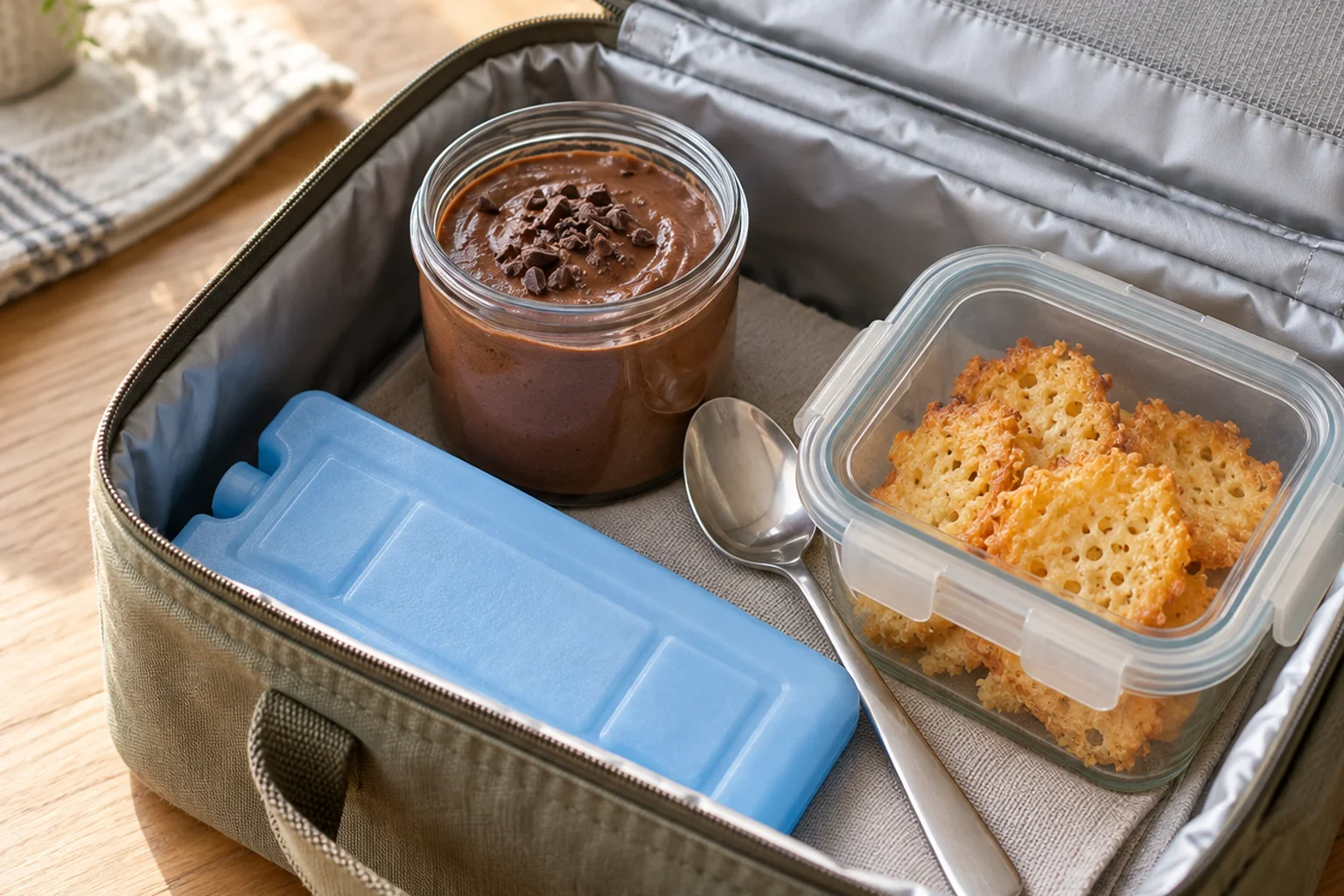
- For work, school or the gym, pack dairy snacks in an insulated snack bag with an ice pack (shop at Amazon, opens in a new tab) and refrigerate them on arrival. A leak-proof container (shop at Amazon, opens in a new tab) suits puddings. Frozen bark packed with an ice pack softens within 30 to 45 minutes.
Lactose notes
Lactose is the sugar in milk, and tolerance varies from person to person. Greek yogurt and skyr are strained, which removes much of the lactose along with the whey, and live cultures break down more of what is left. Aged hard cheeses such as Parmesan and sharp cheddar have only trace lactose, so the cheese crisps are usually fine. Cottage cheese has more lactose than strained yogurt, but lactose-free cottage cheese is sold at many grocery stores and works in every recipe above, as do lactose-free milk and yogurt. The NIDDK page in the sources has more detail. A milk allergy is different from lactose intolerance; if you have one, skip these recipes or use the plant-based swaps.
How do you meal prep dairy protein snacks for the week?
A Sunday prep session of about 2 hours covers a week of dairy protein snacks. Bake the muffins (47 minutes) while the bark freezes (95 minutes), blend a batch of cottage cheese for the dip while the oven is busy, and set a chocolate pudding to chill.
Mid-week, the mug cake and the cheese crisps take care of cravings in under 25 minutes. The dip and pudding last through Thursday, the muffins and pancake bites through Friday, and the bark for 2 months. For labeling, freezer limits and a full weekly schedule, see fridge and freezer storage for protein snacks.
Shop this article
43 ingredients and tools. Add them to your list, then send it to Amazon, Whole Foods or Instacart.
Protein powders
- Whey protein isolate (unflavored or vanilla)Amazon (opens in a new tab)Whole Foods (opens in a new tab)Instacart (opens in a new tab)
- Micellar casein protein powderAmazon (opens in a new tab)Whole Foods (opens in a new tab)Instacart (opens in a new tab)
- Pea protein isolateAmazon (opens in a new tab)Whole Foods (opens in a new tab)Instacart (opens in a new tab)
- Chocolate whey protein powderAmazon (opens in a new tab)Whole Foods (opens in a new tab)Instacart (opens in a new tab)
- Plant protein blend (pea + rice)Amazon (opens in a new tab)Whole Foods (opens in a new tab)Instacart (opens in a new tab)
- Egg white protein powderAmazon (opens in a new tab)Whole Foods (opens in a new tab)Instacart (opens in a new tab)
Eggs & dairy
- Plain nonfat Greek yogurtWhole Foods (opens in a new tab)Instacart (opens in a new tab)
- Plain skyr (Icelandic yogurt)Whole Foods (opens in a new tab)Instacart (opens in a new tab)
- Low-fat cottage cheeseWhole Foods (opens in a new tab)Instacart (opens in a new tab)
- Milk (or ultra-filtered milk)Whole Foods (opens in a new tab)Instacart (opens in a new tab)
- Parmigiano-Reggiano (wedge)Whole Foods (opens in a new tab)Instacart (opens in a new tab)
- Sharp cheddar cheeseWhole Foods (opens in a new tab)Instacart (opens in a new tab)
- Large eggsWhole Foods (opens in a new tab)Instacart (opens in a new tab)
Nuts, seeds & nut butters
- Natural peanut butter (peanuts + salt)Amazon (opens in a new tab)Whole Foods (opens in a new tab)Instacart (opens in a new tab)
- Chia seedsAmazon (opens in a new tab)Whole Foods (opens in a new tab)Instacart (opens in a new tab)
- Ground flaxseedAmazon (opens in a new tab)Whole Foods (opens in a new tab)Instacart (opens in a new tab)
Oats, grains & binders
Sweeteners & chocolate
- HoneyAmazon (opens in a new tab)Whole Foods (opens in a new tab)Instacart (opens in a new tab)
- Pure vanilla extractAmazon (opens in a new tab)Whole Foods (opens in a new tab)Instacart (opens in a new tab)
- Frozen mixed berriesWhole Foods (opens in a new tab)Instacart (opens in a new tab)
- Dark chocolate chips (60%+)Amazon (opens in a new tab)Whole Foods (opens in a new tab)Instacart (opens in a new tab)
- Unsweetened cocoa powderAmazon (opens in a new tab)Whole Foods (opens in a new tab)Instacart (opens in a new tab)
- Pure maple syrupAmazon (opens in a new tab)Whole Foods (opens in a new tab)Instacart (opens in a new tab)
Sauces, spices & flavor
- Extra-virgin olive oilAmazon (opens in a new tab)Whole Foods (opens in a new tab)Instacart (opens in a new tab)
- Everything bagel seasoningAmazon (opens in a new tab)Whole Foods (opens in a new tab)Instacart (opens in a new tab)
- Garlic powderAmazon (opens in a new tab)Whole Foods (opens in a new tab)Instacart (opens in a new tab)
- Coarse-ground black pepperAmazon (opens in a new tab)Whole Foods (opens in a new tab)Instacart (opens in a new tab)
- Ground cinnamonAmazon (opens in a new tab)Whole Foods (opens in a new tab)Instacart (opens in a new tab)
- Kosher saltAmazon (opens in a new tab)Whole Foods (opens in a new tab)Instacart (opens in a new tab)
- Smoked paprikaAmazon (opens in a new tab)Whole Foods (opens in a new tab)Instacart (opens in a new tab)
- Crushed red pepper flakesAmazon (opens in a new tab)Whole Foods (opens in a new tab)Instacart (opens in a new tab)
- Avocado oil sprayAmazon (opens in a new tab)Whole Foods (opens in a new tab)Instacart (opens in a new tab)
Kitchen tools
- Food processorAmazon (opens in a new tab)Instacart (opens in a new tab)
- Rimmed half-sheet pansAmazon (opens in a new tab)Instacart (opens in a new tab)
- Parchment paperAmazon (opens in a new tab)Whole Foods (opens in a new tab)Instacart (opens in a new tab)
- Cookie scoop (1 tablespoon)Amazon (opens in a new tab)Instacart (opens in a new tab)
- Sharp chef's knife or slicing knifeAmazon (opens in a new tab)Instacart (opens in a new tab)
- Silicone muffin pan / egg-bite moldsAmazon (opens in a new tab)Instacart (opens in a new tab)
- Refrigerator/freezer thermometerAmazon (opens in a new tab)Instacart (opens in a new tab)
Storage & preserving supplies
- Zip-top freezer bagsAmazon (opens in a new tab)Whole Foods (opens in a new tab)Instacart (opens in a new tab)
- Insulated snack bag with ice packAmazon (opens in a new tab)Instacart (opens in a new tab)
- Glass meal-prep containers with lidsAmazon (opens in a new tab)Instacart (opens in a new tab)
Frequently asked questions
Is whipped cottage cheese dip good for you?
Yes, for most people. A half-cup serving of the savory dip has about 12 g of protein and 140 calories, with about 480 mg of sodium because cottage cheese is salty. Choose low-fat or no-salt-added cottage cheese if you watch sodium, and scoop with cucumber or pepper strips instead of chips.
Why is my cottage cheese pudding grainy?
Grainy pudding usually means the curds were not blended long enough or the mixture got hot. Blend small-curd cottage cheese for 60 to 90 seconds, scraping the sides once, and keep every liquid cold or lukewarm. Whey protein stirred into hot liquid clumps, so add powder to the blended base.
Are cheese crisps healthy?
Cheese crisps are a high-protein, low-carb snack, with about 4 to 5 g of protein per crisp and about 1 g of carbohydrate per 2-crisp serving. They are also salty, at about 325 mg of sodium per serving, and have no fiber. Eat 2 to 4 crisps with vegetables or a yogurt dip.
How many calories are in a protein mug cake?
A mug cake made with whey, oat flour, an egg and Greek yogurt has about 350 calories and 39 g of protein, or about 11 g of protein per 100 calories. It is a dessert-sized snack. Leaving out the tablespoon of maple syrup saves about 50 calories if you want a lighter cake.
How do you make protein pudding without protein powder?
Use Greek yogurt or blended cottage cheese as the protein. One cup (245 g) of plain nonfat Greek yogurt, 1 tablespoon of cocoa and 2 teaspoons of maple syrup make two puddings with about 12 g of protein each. Chill 20 minutes, then loosen with a splash of milk if it is too thick.
Can you make chia pudding with protein powder?
Yes. Blend 3 tablespoons of ground chia, 1 cup of warm milk, 2 tablespoons of peanut butter and 1 scoop of whey for two servings with about 22 g of protein each. Ground seeds and milk at about 110°F (43°C) set it in 20 minutes. Whole seeds in cold milk need 2 or more hours.
Can you freeze cottage cheese dip?
Freezing is not worth it. Thawed cottage cheese separates and turns grainy, so keep the dip in a covered container in the fridge at or below 40°F (4°C) for up to 4 days. Freeze the bark, muffins and pancake bites instead, which hold their texture for 2 to 3 months.
Sources
- USDA FoodData Central (opens in a new tab)
- FoodSafety.gov: Cold Food Storage Chart (opens in a new tab)
- USDA FSIS: Danger Zone (40°F to 140°F) (opens in a new tab)
- NIDDK: Lactose Intolerance (opens in a new tab)
More reading on protein, sugar and snack labels is collected on our resources page.