Recipes
Homemade Vegan Protein Snacks: 8 Recipes Ready in Under 2 Hours
By Editorial Team. Updated . 14 min read. 8 recipes, each under 2 hours.
Store links may be affiliate links. We may earn a commission; it never changes what we recommend.
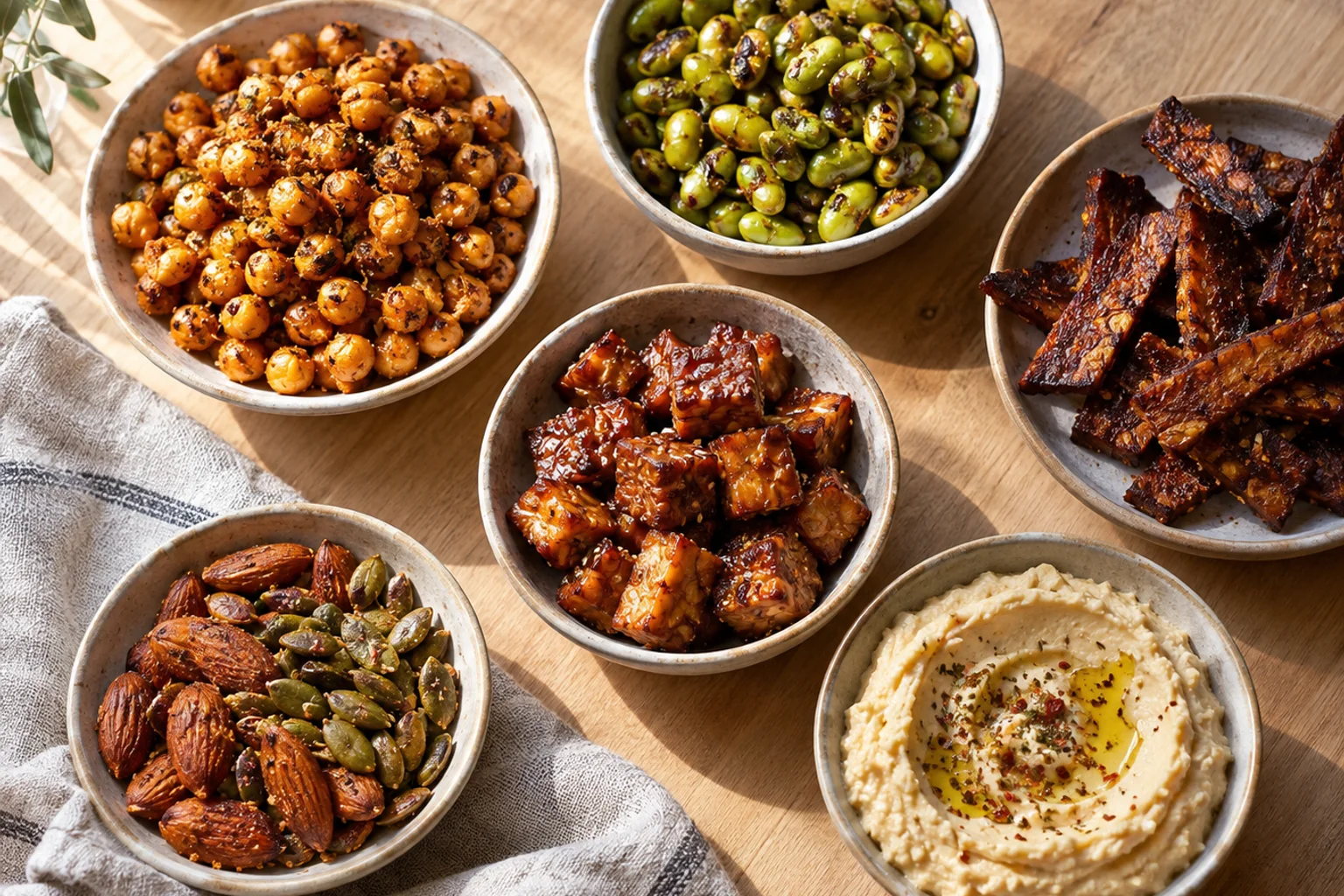
Homemade vegan protein snacks can reach 5 to 13 g of protein per serving, and each recipe here takes under 2 hours. Tofu jerky, tempeh bites and roasted edamame give the most protein per calorie, while chickpeas, lentil crackers and hummus add fiber and crunch.
Key takeaways
- Plant snacks here run about 4 to 10 g of protein per 100 calories. Tofu jerky leads at about 10 g; roasted chickpeas trail at about 4 g but bring 6 g of fiber.
- You do not need to pair "complementary" proteins in one snack. Variety across the week is enough.
- Soy and pea protein are leucine-rich, so a spoon of pea protein in a dip or bite makes a real difference to the protein count.
- Dry chickpeas thoroughly before roasting, cool them uncovered, and re-crisp for 5 minutes if they soften.
- Every recipe is 120 minutes or less from start to finish, including pressing tofu and setting time.
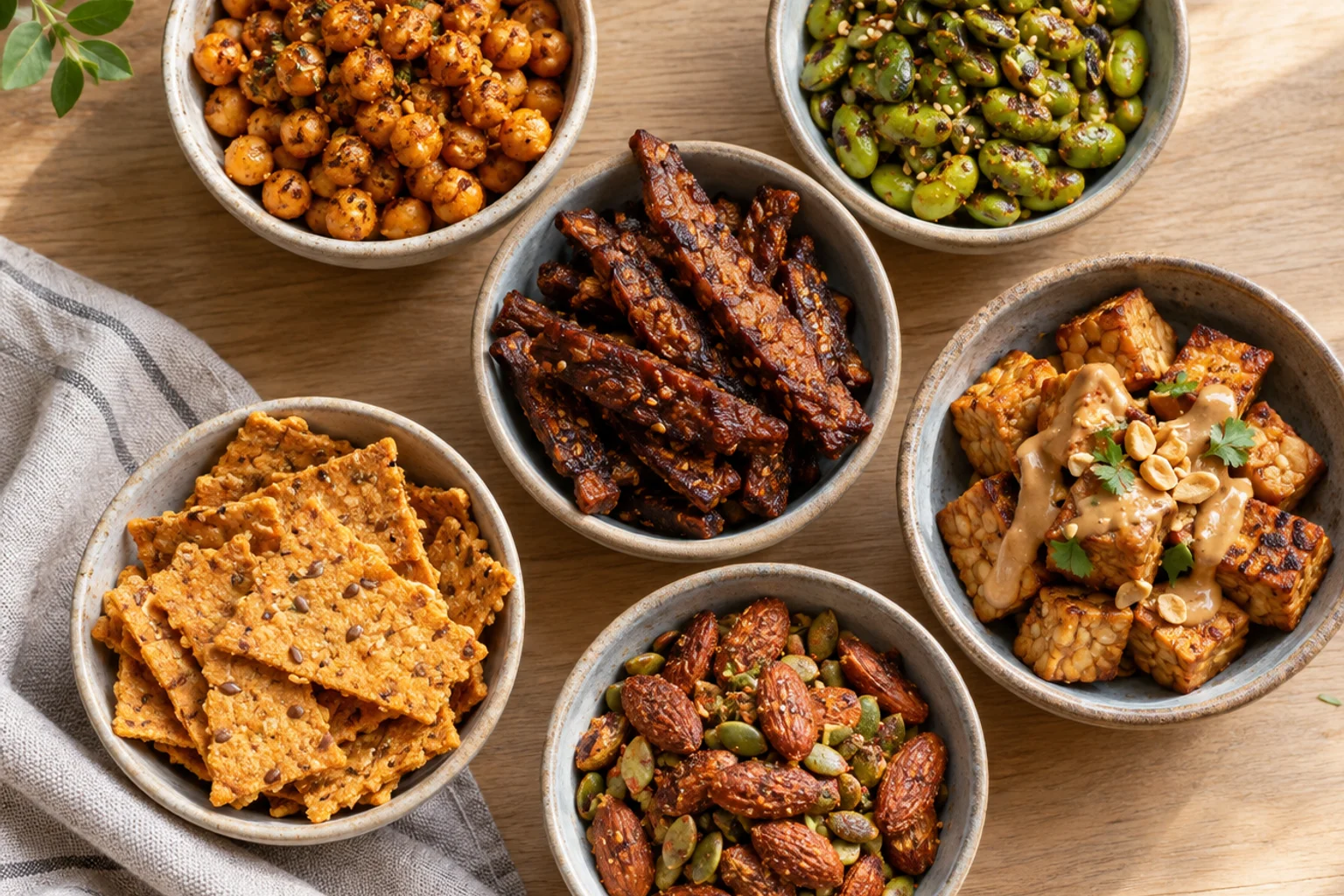
Do you need to combine plant proteins in one snack?
Plant proteins do not need to be paired in the same snack. The Harvard Nutrition Source notes that the body draws on an amino acid pool built up over the day, so variety across meals covers every essential amino acid. A complete protein contains all nine of them, and soy foods (edamame, tofu, tempeh) qualify on their own.
Beans, lentils and chickpeas are low in methionine, while grains and seeds are lower in lysine, so a varied diet fills the gaps. Quinoa and hemp seeds come close to complete. A snack only has to fit into a varied pattern.
The package is what changes with plants. Animal snacks such as jerky or egg bites deliver 10 to 20 g of protein in a small, low-carb bite. Plant foods bring protein together with carbohydrate and fiber, so the same 10 g comes with more calories and more bulk. Fiber slows eating and keeps you full, but it means you should read the protein per 100 calories figure, not only grams per serving. This site ranks snacks the same way; see how to choose a healthy protein snack and protein per 100 calories.
Realistic numbers, using USDA FoodData Central values:
- Extra-firm tofu has about 10 g protein per 100 g, or 8 to 10 g in a 1-oz (28 g) jerky serving once it is dried down.
- Tempeh has about 19 to 20 g per 100 g, the densest whole-food plant protein of the group.
- Edamame, which are immature soybeans, have about 11 g per 100 g, or about 9 g in a roasted 1/2-cup serving.
- Lentils and chickpeas have 7 to 9 g per cooked 100 g, and dry red lentils have 24 g per 100 g before cooking.
- Hemp hearts and pumpkin seeds have about 30 g per 100 g, but a serving is only 1 to 2 tablespoons, so they add 3 to 6 g.
Leucine, and why soy and pea powders help
Leucine is the amino acid most closely tied to switching on muscle protein synthesis. Studies on active adults often use roughly 2 to 3 g of leucine per meal as a working target. Animal proteins and soy are rich in it; most whole plant foods carry less per gram of protein. Soy and pea protein isolates both run around 8% leucine by weight, so a 25 g scoop supplies about 2 g. That is why a spoonful of pea protein isolate (shop at Amazon, opens in a new tab) in the hummus and the energy bites does more than pad the number. If you eat plant-based and train, a snack built around soy, tempeh or a pea-powder dip suits the hours after a workout.
If you have kidney disease, talk to your doctor before raising protein intake.
How do you make crispy roasted chickpeas?
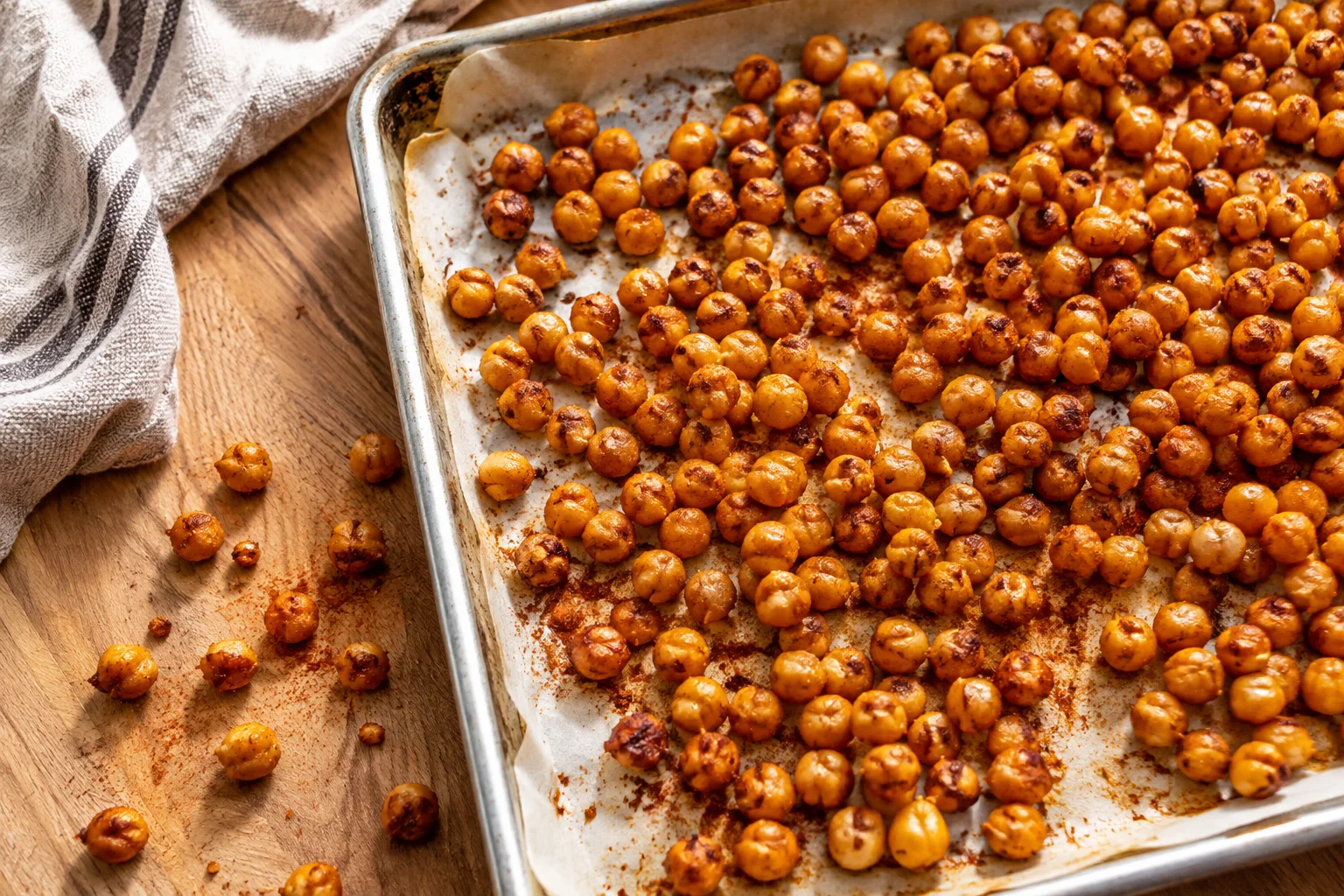
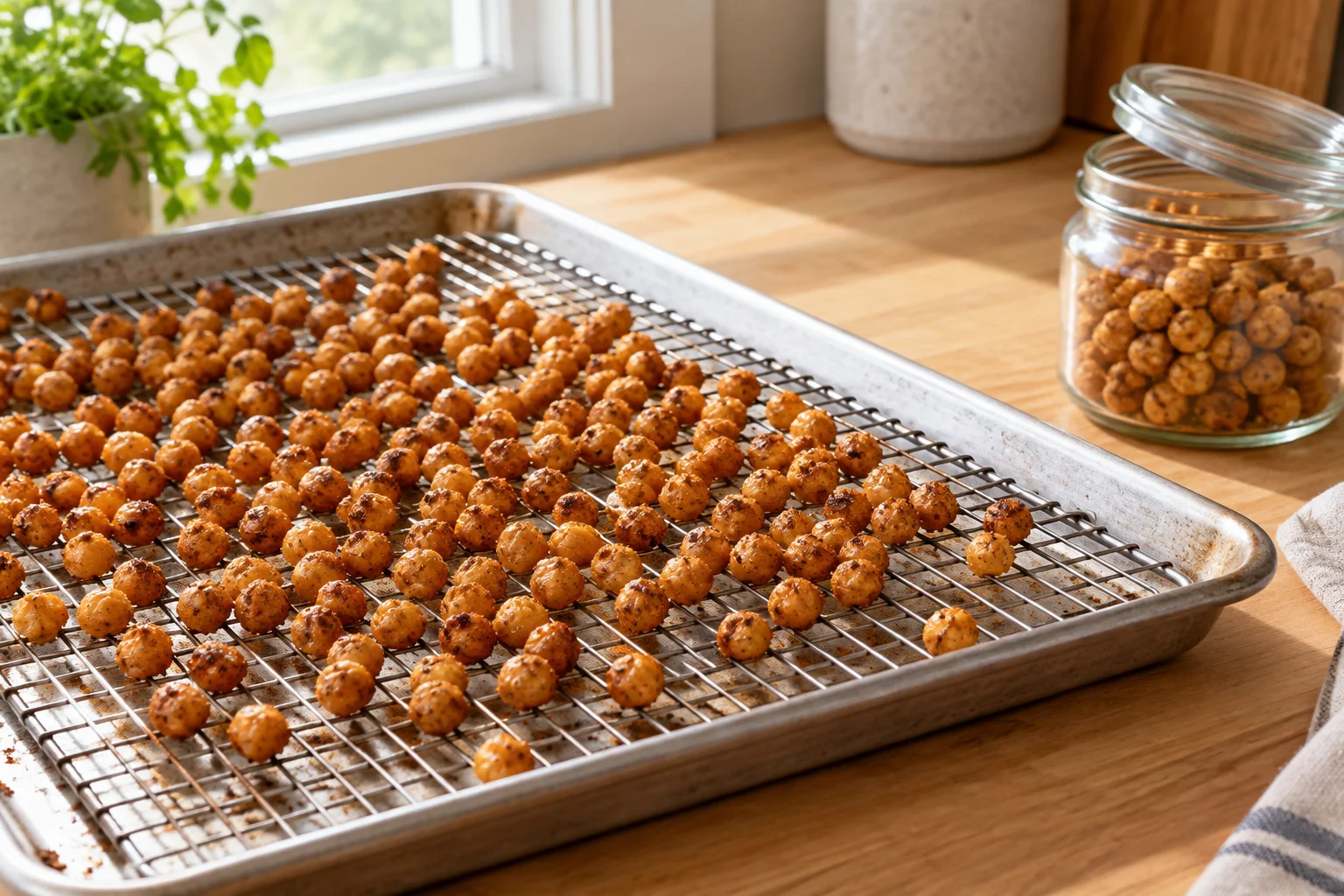
Crispy roasted chickpeas need dry beans, a hot oven and a slow cool-down. Drain and rinse canned chickpeas, dry them on a towel for 10 minutes, toss with oil, then roast at 425°F (220°C) for 35 to 40 minutes, seasoning in the last 10 to 15. Each 1/3-cup serving has about 6 g of protein.
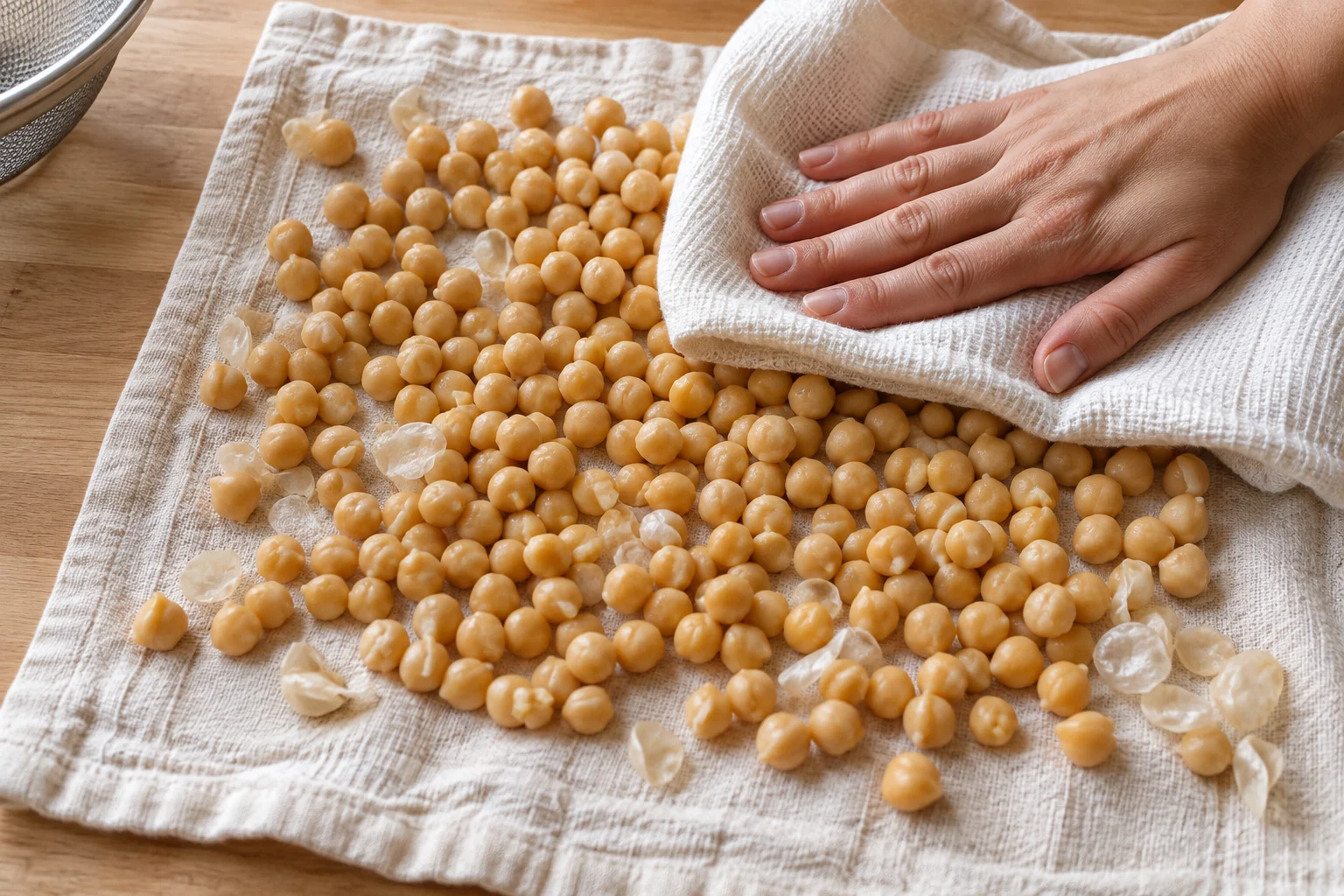
Roasted chickpeas are the entry-level plant snack: two cans, a sheet pan and about an hour. The usual complaint is leathery instead of crunchy, and the fix is almost entirely moisture. Canned chickpeas (shop at Amazon, opens in a new tab) are packed in water, and any left on the surface turns to steam in the oven and softens the skin. Drain them, rinse, then dry them twice: once by rolling in a clean towel, and once by letting them air-dry on the towel for 10 minutes while the oven heats.
Recipe · Easy · vegan, gluten-free, dairy-free, nut-free
Extra-Crispy Roasted Chickpeas
Crispy roasted chickpeas with four seasoning options, about 6 g of protein per serving, ready in about an hour.
- Prep
- 15 min
- Cook
- 40 min
- Chill/set
- 10 min
- Total
- 1 hr 5 min
- Makes
- 6 servings (about 1/3 cup / 45 g each)
- Protein
- 6g
- Calories
- 155
- Carbs
- 22g
- Fat
- 5g
- Fiber
- 6g
- Sodium
- 290mg
Per serving, approximate.
Ingredients
- 2 cans (15 oz / 425 g each) chickpeas, drained and rinsed (shop at Amazon, opens in a new tab)
- 2 tbsp (30 ml) extra-virgin olive oil (shop at Amazon, opens in a new tab)
- 3/4 tsp kosher salt (shop at Amazon, opens in a new tab)
- 1 tsp smoked paprika (for the smoky variation) (shop at Amazon, opens in a new tab)
- 1/2 tsp garlic powder (for the smoky variation) (shop at Amazon, opens in a new tab)
Equipment
Steps
- Heat the oven to 425°F (220°C) with a rack in the middle. Line a rimmed sheet pan with parchment.
- Drain and rinse the chickpeas, then spread them on a clean kitchen towel. Roll and pat until no visible water remains, rubbing gently so loose skins slip off. Discard the skins. Let the chickpeas air-dry for 10 minutes.
- Toss the dry chickpeas with the olive oil and salt in a bowl, then spread them in a single layer on the pan with space between them.
- Roast 15 minutes, shake the pan, and roast 10 more minutes.
- Sprinkle on the paprika and garlic powder (or your chosen variation), shake again, and roast 10 to 15 minutes more, until deep golden and a cooled chickpea cracks when bitten. Start checking at 10 minutes, since seasonings burn fast.
- Turn the oven off, crack the door, and leave the pan inside for 10 minutes to dry out further, then move the pan to a rack and cool completely before storing.
Storage: Uncovered or loosely covered at room temperature up to 24 hours at peak crunch; in a jar with the lid ajar 3 to 4 days. Re-crisp in a 350°F (175°C) oven for 5 minutes. Not for the fridge.
Four seasoning options
Add seasoning in the last 10 to 15 minutes, not at the start, because fine powders scorch and oil-coated spices turn bitter. The smoky blend is in the card. Three other combinations, each enough for the full batch:
- Ranch-style: 1 tablespoon nutritional yeast (shop at Amazon, opens in a new tab), 1/2 teaspoon onion powder (shop at Amazon, opens in a new tab), 1/2 teaspoon garlic powder and 1/4 teaspoon black pepper. Sprinkle on right out of the oven while the chickpeas are still slightly oily.
- Chili-lime: 2 teaspoons chili-lime seasoning (shop at Amazon, opens in a new tab). Finish with the zest of one lime after the chickpeas cool, so the zest stays fragrant.
- Cinnamon-maple: 1 teaspoon cinnamon (shop at Amazon, opens in a new tab) and 1 tablespoon maple syrup (shop at Amazon, opens in a new tab), tossed on in the last 5 minutes. These stay a little chewier, so eat them within a day.
Why do roasted chickpeas go soft, and how do you keep them crisp?
Roasted chickpeas lose most of their water but stay hygroscopic, meaning they pull moisture back out of the air. Two habits cause nearly all the sogginess. Sealing them while warm lets the steam get trapped, and by morning the batch has gone leathery. Storing them in a tight container in a humid kitchen does the same. To keep them crisp:
- Cool the chickpeas fully on the pan, 30 to 45 minutes, not in a bowl.
- Store them uncovered in a bowl the first day, or in a jar with the lid left loose.
- After 24 hours, move them to a jar with a tight lid if you need them to travel, and expect a slightly chewier bite.
- To re-crisp, spread them on a pan and warm them in a 350°F (175°C) oven for 5 minutes. They crisp as they cool.
Skip the fridge, since the humidity there makes them worse. Versions with a sugary coating soften fastest.
How do you roast edamame until crunchy?
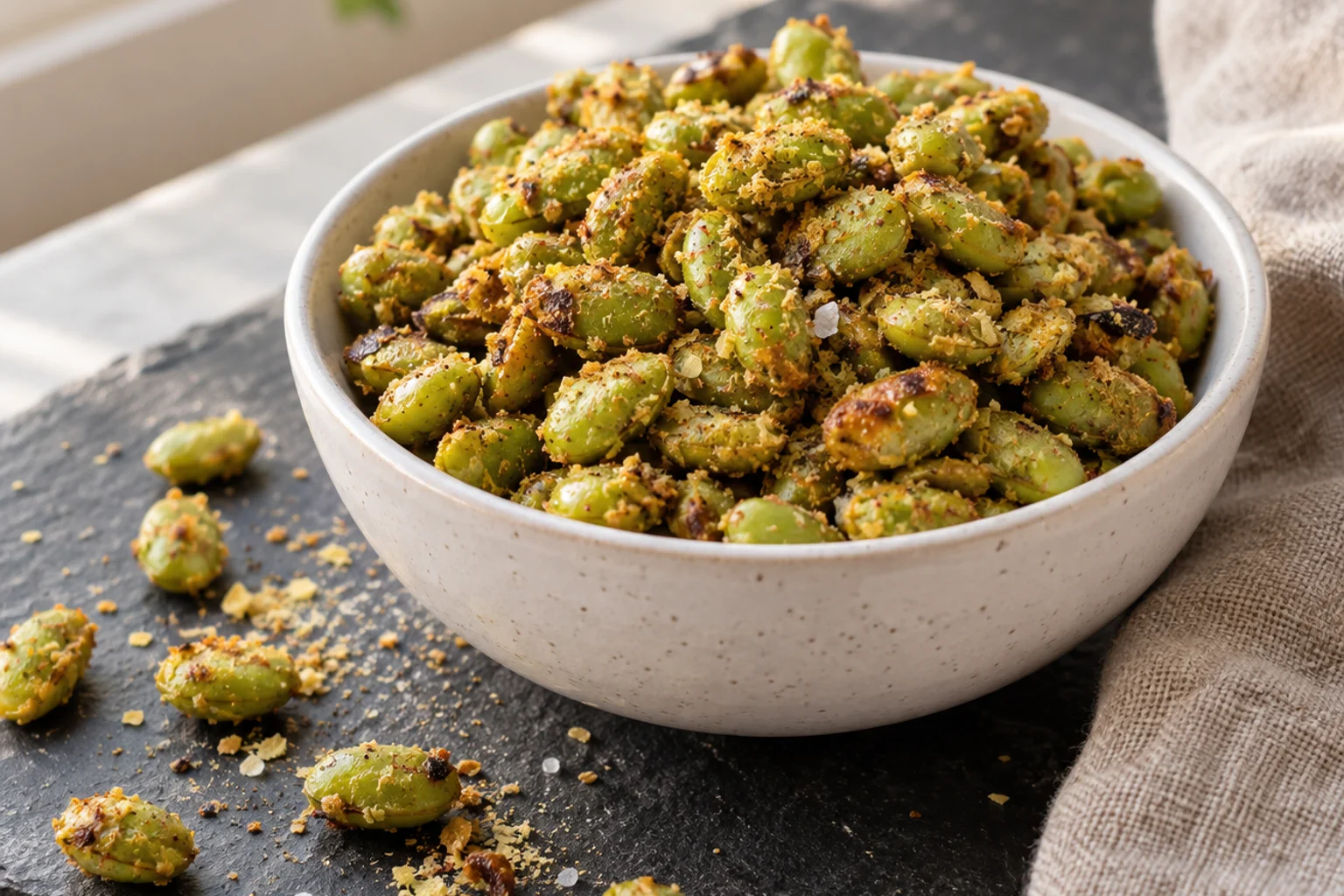
Edamame roasts crunchy when thawed beans are patted dry and baked at 400°F (200°C) for 30 to 35 minutes, shaking the pan halfway. Season right after roasting. A 1/2-cup serving has about 9 g of protein and 4 g of fiber. In an air fryer, frozen edamame cooks at 400°F in about 8 to 12 minutes.
Edamame is the easiest way to get nearly 10 g of protein from a roasted snack. Use frozen shelled edamame (most are already blanched) and thaw it under running water. As with chickpeas, the dry step matters: pat the beans until the surface is tacky, not wet. Nutritional yeast gives a cheesy savory note and a little extra protein; without it, a pinch more salt and garlic powder works.
Recipe · Easy · vegan, gluten-free, dairy-free, nut-free
Crunchy Oven-Roasted Edamame
Roasted edamame with a savory nutritional-yeast coating, about 9 g of protein per serving.
- Prep
- 15 min
- Cook
- 35 min
- Chill/set
- 10 min
- Total
- 1 hr
- Makes
- 4 servings (about 1/2 cup / 70 g each)
- Protein
- 9g
- Calories
- 130
- Carbs
- 9g
- Fat
- 5.5g
- Fiber
- 4g
- Sodium
- 240mg
Per serving, approximate.
Ingredients
- 12 oz (340 g) frozen shelled edamame, thawed (shop at Whole Foods, opens in a new tab)
- 1 tbsp (15 ml) extra-virgin olive oil (shop at Amazon, opens in a new tab)
- 2 tbsp nutritional yeast (shop at Amazon, opens in a new tab)
- 1/2 tsp garlic powder (shop at Amazon, opens in a new tab)
- 1/2 tsp kosher salt (shop at Amazon, opens in a new tab)
- 1/4 tsp crushed red pepper flakes, optional (shop at Amazon, opens in a new tab)
Equipment
Steps
- Heat the oven to 400°F (200°C) and line a rimmed sheet pan with parchment.
- Rinse the thawed edamame in a colander, then pat dry with a clean towel and let them sit for 10 minutes.
- Toss with the olive oil, then spread in a single layer with a little space between beans.
- Roast 20 minutes, shake the pan, and roast 10 to 15 minutes more, until the beans are browned in spots and shrunken.
- Immediately toss with the nutritional yeast, garlic powder, salt and pepper flakes. Cool on the pan for 10 minutes; they crisp as they cool.
Storage: Room temperature in a loosely covered jar 2 to 3 days at best crunch; fridge up to 5 days in an airtight container, chewier. Re-crisp in a 350°F (175°C) oven for 5 minutes.
Pick bags labeled "shelled" or "mukimame," not edamame in the pod. For the air fryer version, shake the basket halfway; frozen beans need no thaw. For a sweet-salty batch, skip the yeast and toss with 1 teaspoon maple syrup (shop at Amazon, opens in a new tab) and a pinch of cinnamon in the last 5 minutes. Like chickpeas, roasted edamame prefers a loose lid. For ready-made options, see store-bought vegan protein snacks.
How do you make tofu jerky chewy?
Tofu jerky turns chewy when the block is pressed for 20 minutes, sliced 1/4 inch (6 mm) thick and baked low at 250°F (120°C) until firm and dry on the surface. Pressing removes the water that makes tofu rubbery. One 1-oz (28 g) serving has about 10 g of protein and 100 calories.
Dehydrator jerky usually dries for hours, but tofu does not need that. Unlike meat, tofu carries no raw-meat pathogen risk, so the only goal is to remove water and build chew. The express path is to press, slice thin, marinate briefly, then bake low. Total time is about 100 minutes, and the air fryer is faster still.
The tradeoff is texture. A 15-minute marinade seasons the surface rather than the center, and a one-hour bake gives chewy strips with crisp edges, not the dense bite of an overnight dehydrator batch. Brushing on extra marinade halfway through helps make up for it. Start with a super-firm or extra-firm tofu (shop at Whole Foods, opens in a new tab) so there is less water to remove.
Recipe · Medium · vegan, dairy-free
Smoky Tofu Jerky
Chewy smoky tofu jerky baked low in the oven or air fryer, about 10 g of protein per serving.
- Prep
- 35 min
- Cook
- 1 hr 5 min
- Total
- 1 hr 40 min
- Makes
- 4 servings (about 1 oz / 28 g dried jerky each)
- Protein
- 10g
- Calories
- 100
- Carbs
- 5g
- Fat
- 5g
- Fiber
- 1g
- Sodium
- 380mg
Per serving, approximate.
Ingredients
- 1 block (14 oz / 400 g) extra-firm or super-firm tofu (shop at Whole Foods, opens in a new tab)
- 3 tbsp (45 ml) low-sodium soy sauce (use tamari for gluten-free) (shop at Amazon, opens in a new tab)
- 1 tbsp (15 ml) pure maple syrup (shop at Amazon, opens in a new tab)
- 1 tsp liquid smoke (shop at Amazon, opens in a new tab)
- 1 tsp smoked paprika (shop at Amazon, opens in a new tab)
- 1/2 tsp garlic powder (shop at Amazon, opens in a new tab)
- 1/4 tsp coarse black pepper (shop at Amazon, opens in a new tab)
Equipment
- Rimmed half-sheet pans (shop at Amazon, opens in a new tab)
- Parchment paper (shop at Amazon, opens in a new tab)
- Oven-safe wire cooling racks (fit half-sheet) (shop at Amazon, opens in a new tab)
- Sharp chef's knife or slicing knife (shop at Amazon, opens in a new tab)
- Air fryer (with dehydrate setting) (shop at Amazon, opens in a new tab)
Steps
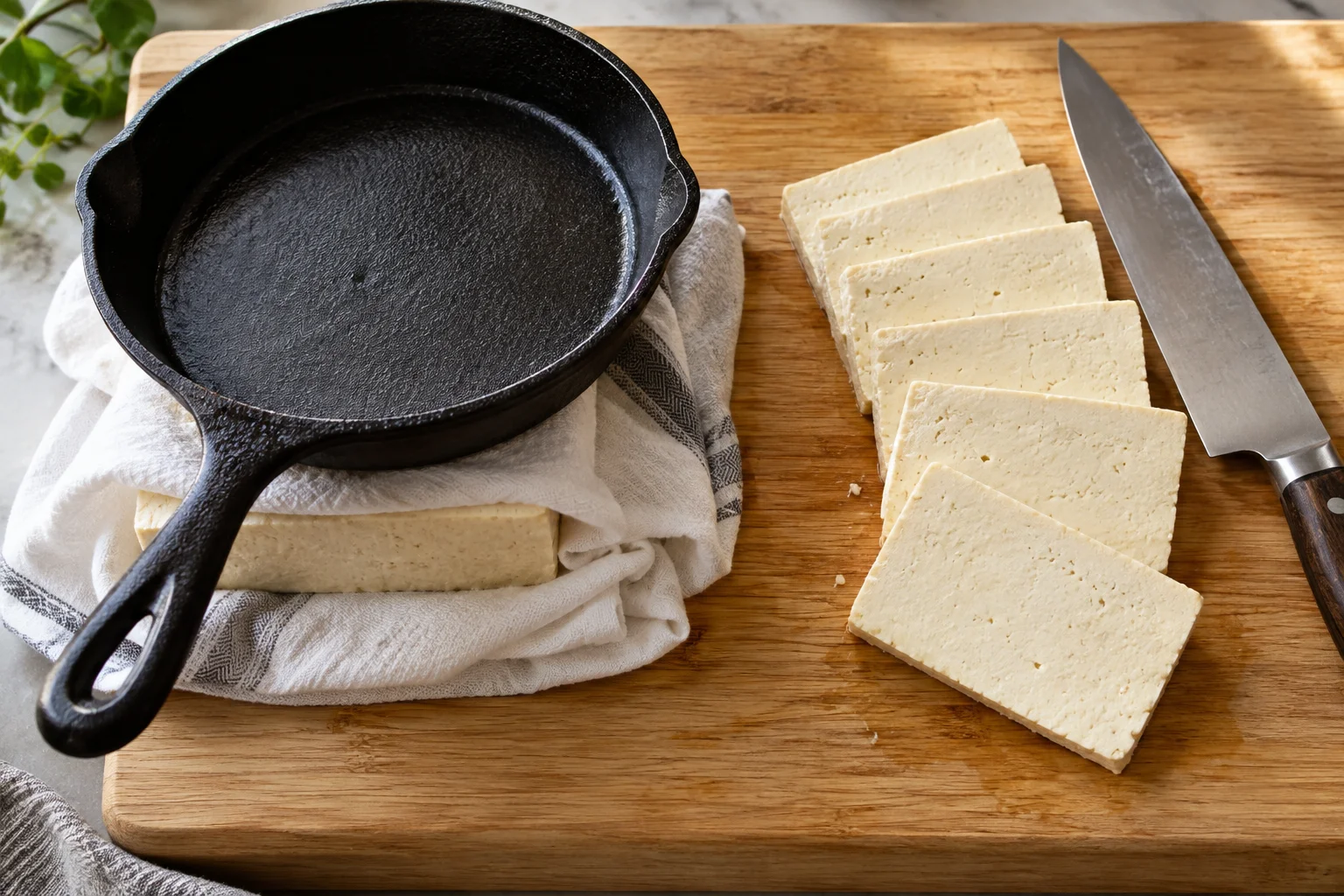
- Drain the tofu, wrap it in a clean kitchen towel, set a heavy skillet or a plate with two cans on top, and press for 20 minutes. Change the towel after 10 minutes if it is soaked.
- While it presses, whisk the soy sauce, maple syrup, liquid smoke, paprika, garlic powder and pepper in a wide shallow dish.
- Slice the pressed tofu crosswise into planks 1/4 inch (6 mm) thick, then cut each plank in half to make strips about 2 inches (5 cm) wide.
- Lay the strips in the marinade, turn once, and let them sit 15 minutes, flipping at the halfway point.
- Heat the oven to 250°F (120°C). Set a wire rack on a parchment-lined sheet pan and lay the strips on the rack without overlap, reserving the leftover marinade.
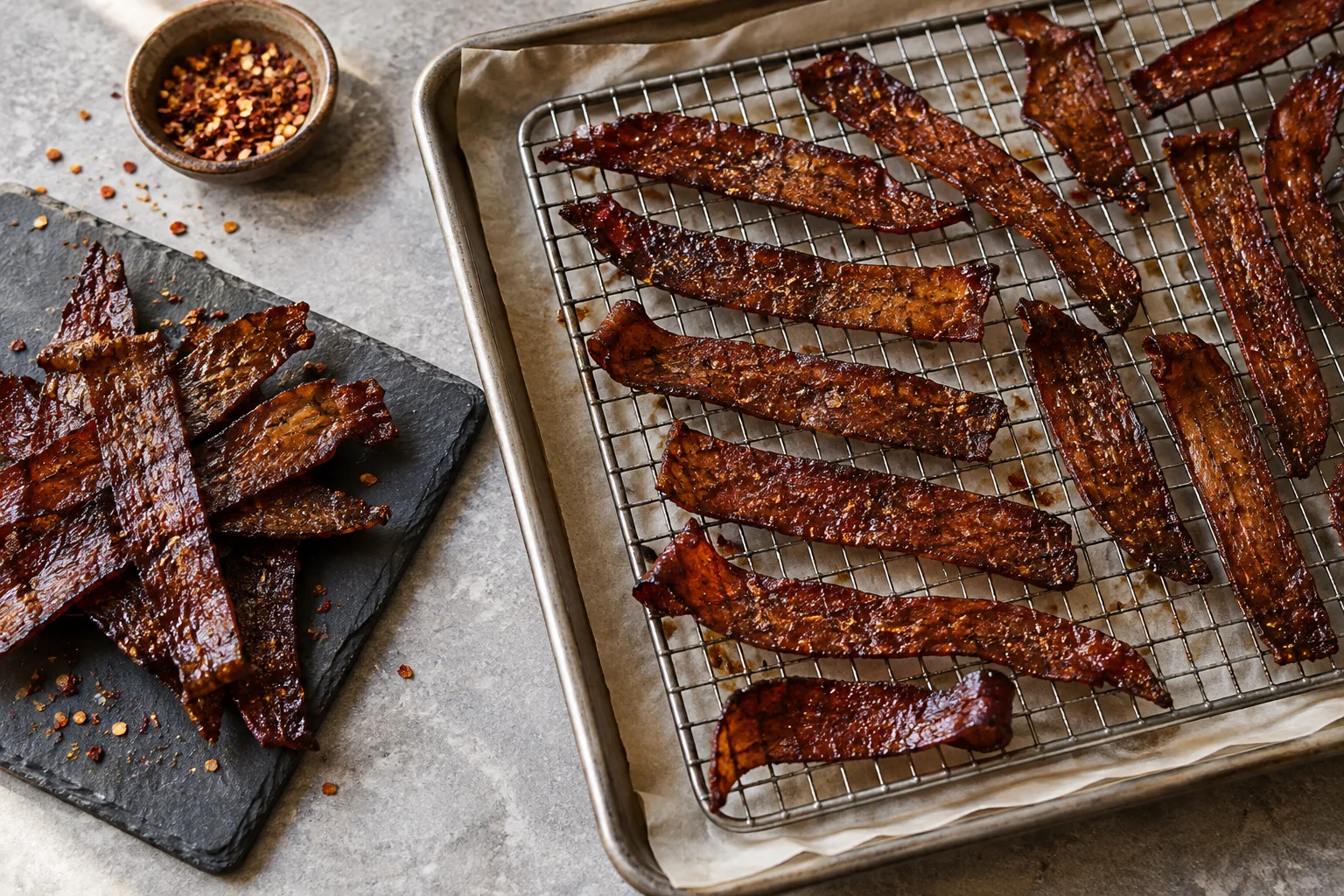
- Bake 30 minutes, brush with the reserved marinade, flip, and bake 25 to 30 minutes more, until the strips are firm, dry on the surface and bend without breaking.
- Turn the oven off and leave the strips in with the door ajar for 10 minutes, then cool on the rack. Air-fryer option: arrange strips in one layer at 300°F (150°C) for 20 to 25 minutes, flipping and brushing at 10 minutes; work in batches.
Storage: Cool fully, then store in an airtight container in the fridge up to 1 week, or freeze up to 2 months. Re-crisp in a 300°F (150°C) oven for 5 minutes.
Pressing matters more than marinating. Wet tofu steams and ends up rubbery, while pressed tofu takes the marinade and browns. If you slice a day ahead, you can marinate overnight in the fridge for deeper flavor, though the recipe does not require it. USDA time-and-temperature jerky rules do not apply because there is no raw meat, but tofu is still perishable: keep it cold and do not leave finished jerky out for more than two hours. For the meat version, see the homemade beef jerky in 2 hours guide.
What if homemade tofu jerky comes out soft?
Homemade tofu jerky is usually softer than store-bought. To firm it up:
- Slice thinner, closer to 1/8 inch (3 mm), so the strips dry through.
- Bake 10 to 15 minutes longer, then leave the strips in the turned-off oven with the door ajar.
- Start with super-firm tofu, or press for a full 30 minutes.
- Cool on the wire rack. The strips firm up as they cool.
Tempeh bites with peanut sauce
Tempeh is a fermented soybean cake with the highest protein density in this article, about 19 to 20 g per 100 g. It can taste bitter or earthy straight from the package. A 10-minute simmer in salted water takes the edge off and softens it so it absorbs sauce, and roasting in cubes then browns and crisps the outsides.
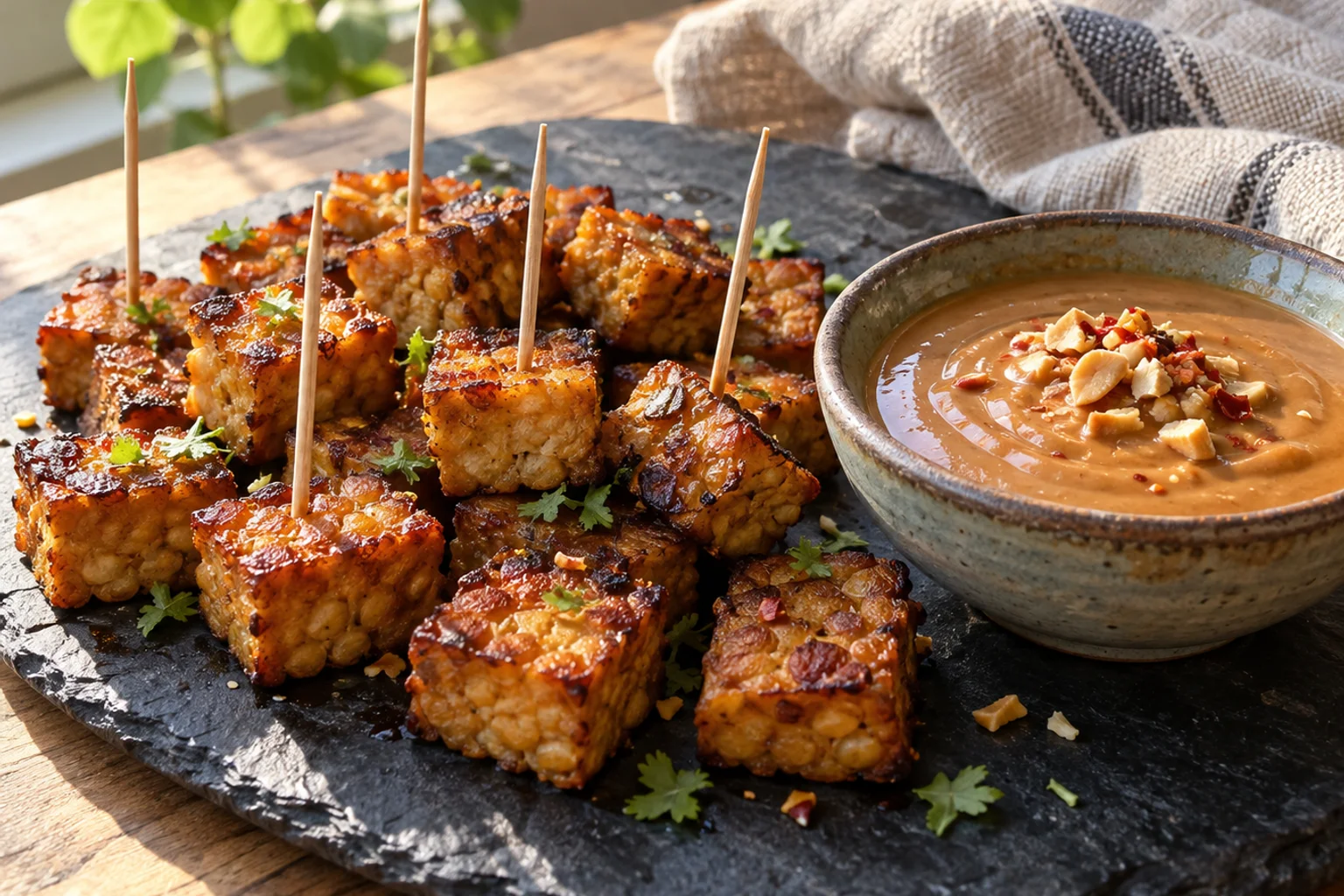
Recipe · Easy · vegan, dairy-free
Tempeh Bites with Peanut Sauce
Simmered, then roasted tempeh cubes with a quick peanut-lime dipping sauce, about 13 g of protein per serving.
- Prep
- 20 min
- Cook
- 30 min
- Total
- 50 min
- Makes
- 4 servings (about 8 bites and 1 1/2 tbsp sauce each)
- Protein
- 13g
- Calories
- 190
- Carbs
- 12g
- Fat
- 11g
- Fiber
- 2g
- Sodium
- 360mg
Per serving, approximate.
Ingredients
- 8 oz (227 g) tempeh, cut into 3/4-inch (2 cm) cubes (shop at Whole Foods, opens in a new tab)
- 1 tbsp (15 ml) extra-virgin olive oil (shop at Amazon, opens in a new tab)
- 2 tbsp (30 ml) low-sodium soy sauce, divided (shop at Amazon, opens in a new tab)
- 2 tbsp (32 g) natural peanut butter (shop at Amazon, opens in a new tab)
- 1 tbsp (15 ml) lime juice
- 1 tsp pure maple syrup (shop at Amazon, opens in a new tab)
- 1 tsp sriracha, or to taste (shop at Amazon, opens in a new tab)
- 2 to 3 tbsp (30 to 45 ml) warm water, to thin the sauce
Equipment
Steps
- Bring a medium pot of salted water to a simmer. Add the tempeh cubes and simmer for 10 minutes, then drain and pat dry.
- Heat the oven to 400°F (200°C) and line a sheet pan with parchment.
- Toss the tempeh with the olive oil and 1 tablespoon of the soy sauce, then spread in a single layer.
- Roast 25 to 30 minutes, flipping once at the halfway mark, until the edges are deep golden and crisp.
- Meanwhile, whisk the peanut butter, remaining soy sauce, lime juice, maple syrup and sriracha. Thin with warm water, 1 tablespoon at a time, until it falls off a spoon in a ribbon.
- Serve the bites warm with toothpicks and the sauce on the side.
Storage: Fridge in separate airtight containers (bites and sauce) 4 to 5 days; reheat bites in a 375°F (190°C) oven for 8 minutes to re-crisp. Bites freeze up to 2 months.
Tempeh bites also suit a snack plate for kids who like dipping foods. Tempeh is made from soy and is usually gluten-free, but some brands add grains such as barley or rice, so check the label if gluten matters. Sunflower seed butter makes the sauce peanut-free, and coconut aminos replace the soy sauce.
How do you make lentil crackers?
Lentil crackers are made by soaking 1 cup (192 g) of dry red lentils in hot water for 30 minutes, blending them with oil and seasoning into a batter, spreading it 1/16 to 1/8 inch thick and baking at 350°F (175°C) for 28 to 35 minutes. Each serving of 6 crackers has about 9 g of protein.
These are crisp, gluten-free crackers with no flour. Red lentils soften quickly in hot water, so they blend into a thin batter you can spread right on parchment. Dry red lentils are about 24% protein, which works out to about 1.5 g of protein per cracker. You need a blender or food processor (shop at Amazon, opens in a new tab) that can hold a smooth purée.
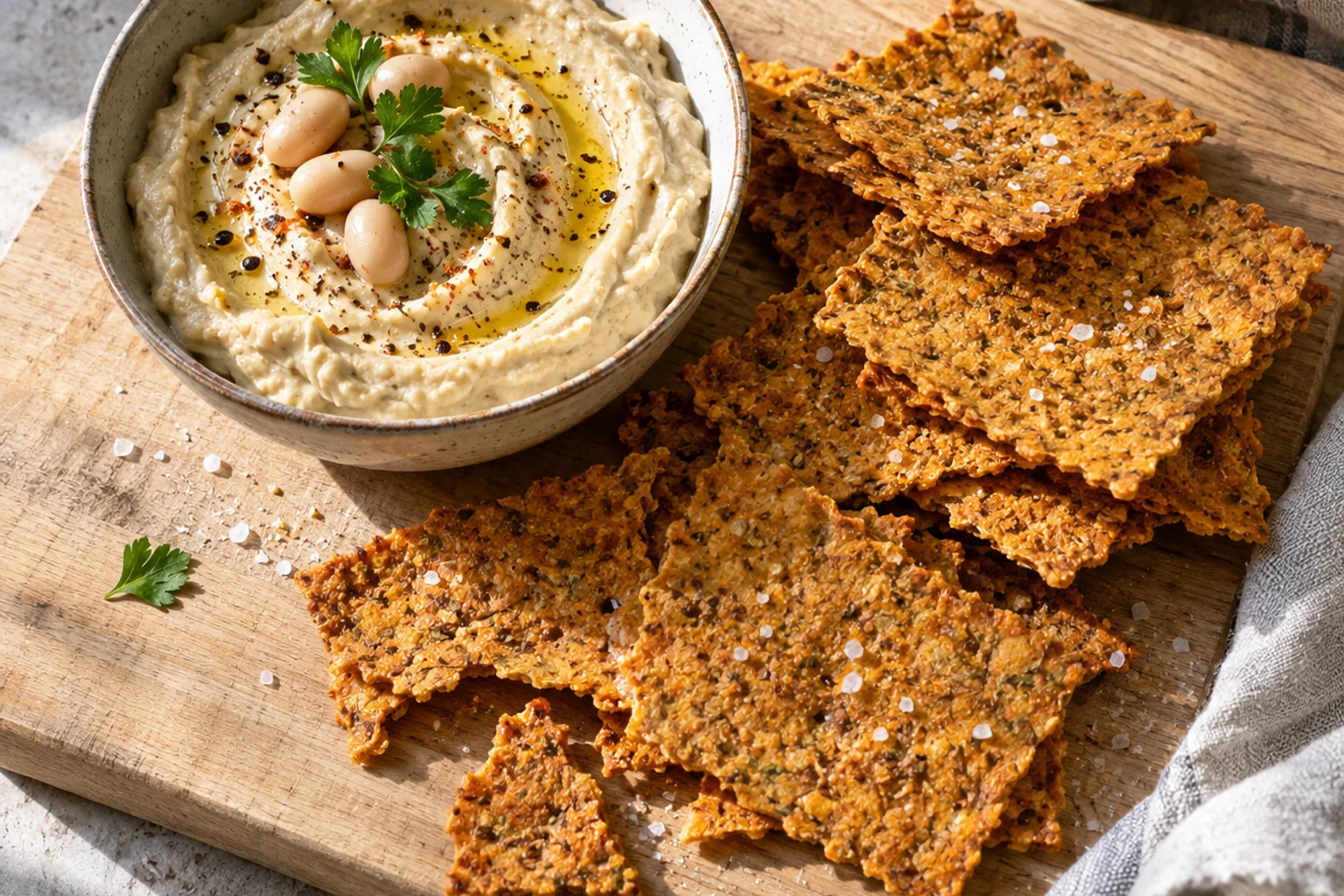
Recipe · Medium · vegan, gluten-free, dairy-free, nut-free
Red-Lentil Crackers
Thin, crisp lentil crackers from soaked red lentils with no flour, about 9 g of protein per serving.
- Prep
- 40 min
- Cook
- 40 min
- Total
- 1 hr 20 min
- Makes
- 6 servings (about 6 crackers each)
- Protein
- 9g
- Calories
- 155
- Carbs
- 21g
- Fat
- 5g
- Fiber
- 4g
- Sodium
- 200mg
Per serving, approximate.
Ingredients
- 1 cup (192 g) dry red lentils, rinsed (shop at Amazon, opens in a new tab)
- 2 tbsp (30 ml) extra-virgin olive oil (shop at Amazon, opens in a new tab)
- 2 tbsp nutritional yeast (shop at Amazon, opens in a new tab)
- 1/2 tsp kosher salt, plus more for the top (shop at Amazon, opens in a new tab)
- 1/2 tsp garlic powder (shop at Amazon, opens in a new tab)
- 1 tsp smoked paprika (shop at Amazon, opens in a new tab)
- 2 tbsp (30 ml) water
Equipment
Steps
- Cover the lentils with 2 cups (480 ml) of very hot tap water and soak 30 minutes. Drain well.
- Heat the oven to 350°F (175°C). Line two sheet pans with parchment (or bake one at a time).
- Blend the soaked lentils with the olive oil, nutritional yeast, salt, garlic powder, paprika and the 2 tablespoons of water until a thick, smooth batter forms, scraping down the sides.
- Divide the batter between the pans. With a spatula, spread each into a rectangle about 1/16 to 1/8 inch (2 to 3 mm) thick; the thinner the crispier. Sprinkle with a little salt.
- Bake 18 to 20 minutes until the surface is dry and the edges are lightly golden. Score into 2-inch (5 cm) squares with a knife or pizza cutter.
- Bake 10 to 15 minutes more, rotating the pans, until crisp and golden. Check the edges first; the center and thin edges finish at different times.
- Break the crackers apart and cool completely on a wire rack for 15 minutes before storing.
Storage: Airtight jar at room temperature 5 to 7 days; freezer up to 2 months. Re-crisp in a 300°F (150°C) oven for 5 minutes if they soften.
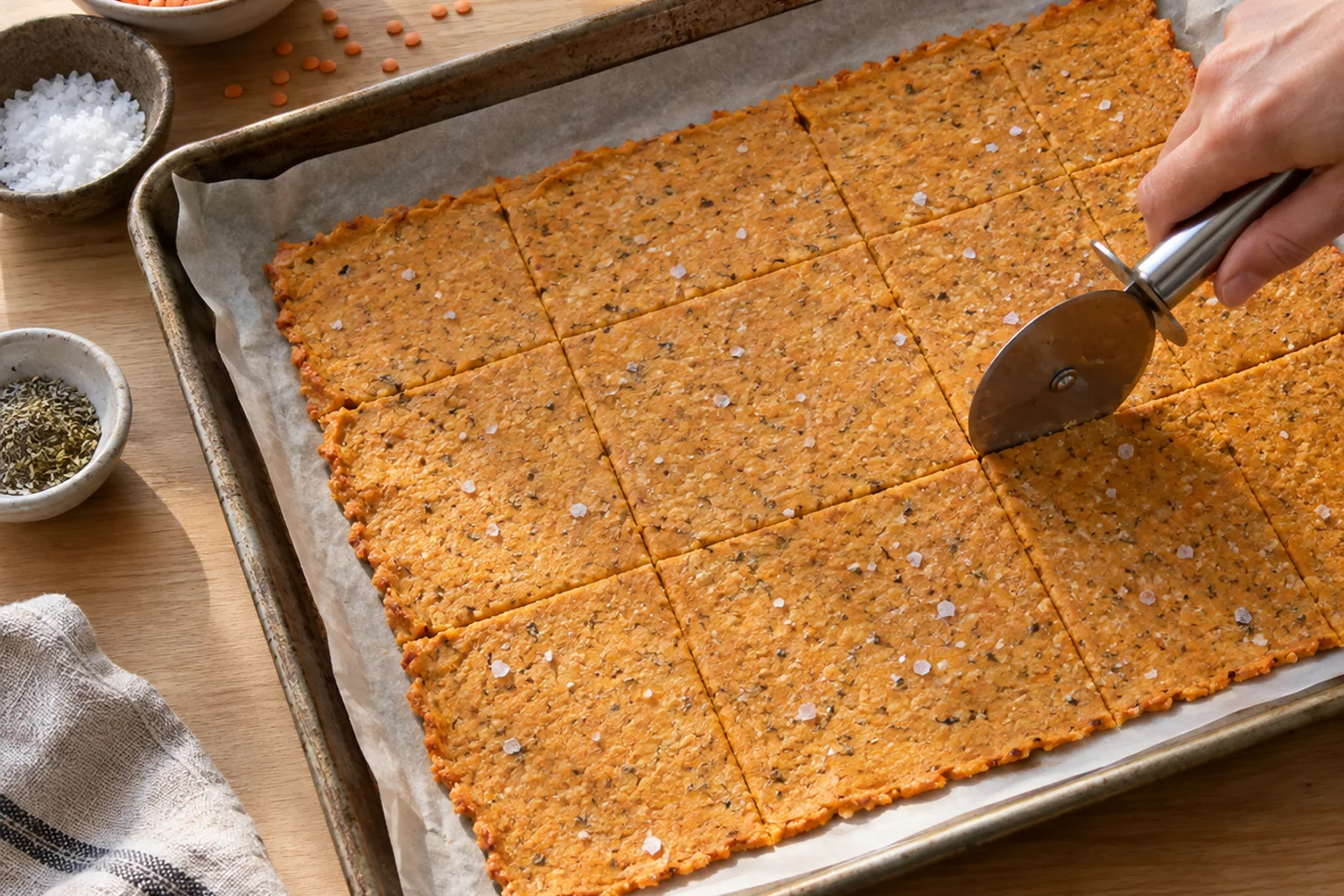
Thickness is the biggest variable. A cracker spread 1/8 inch thick can stay soft in the middle, so spread it thinner or bake longer. The crackers taste like toasted lentils with paprika and yeast, and they pair well with the hummus below. If the batter is too runny to hold its shape, add a spoonful of ground flaxseed; if it is too thick to spread, add a tablespoon of water.
Savory spiced nut and seed mix
Spiced nut mixes usually use an egg-white glaze for crunch. This version swaps in maple syrup and oil that cook into a thin candy shell, so it stays vegan and avoids raw egg. Almonds (shop at Amazon, opens in a new tab) bring protein and vitamin E, and pumpkin seeds (shop at Amazon, opens in a new tab) add zinc and about 9 g of protein per ounce, among the highest of any seed. A 1-oz serving here, about 3 tablespoons, has about 7 g of protein. Protein claims for nut mixes vary widely with portion size, so check the serving weight.
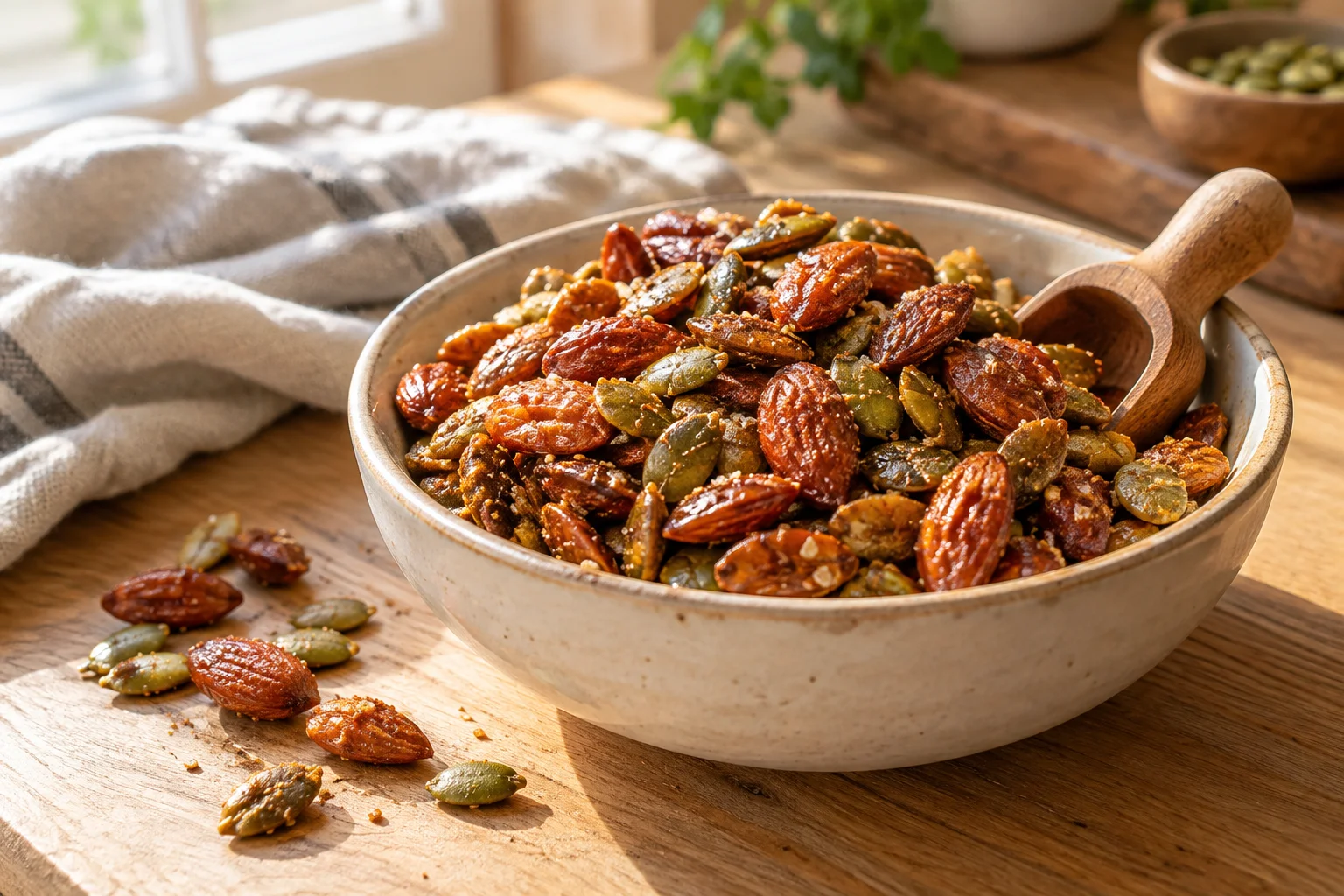
Recipe · Easy · vegan, gluten-free, dairy-free
Savory Maple-Spiced Nut and Seed Mix
Oven-toasted spiced almonds and pumpkin seeds in a thin vegan maple glaze, about 7 g of protein per ounce.
- Prep
- 10 min
- Cook
- 22 min
- Chill/set
- 20 min
- Total
- 52 min
- Makes
- 10 servings (about 1 oz / 28 g each)
- Protein
- 7g
- Calories
- 165
- Carbs
- 7g
- Fat
- 13g
- Fiber
- 3g
- Sodium
- 170mg
Per serving, approximate.
Ingredients
- 1 cup (143 g) raw almonds (shop at Amazon, opens in a new tab)
- 1 cup (130 g) raw pumpkin seeds (pepitas) (shop at Amazon, opens in a new tab)
- 2 tbsp (30 ml) pure maple syrup (shop at Amazon, opens in a new tab)
- 1 tbsp (15 ml) extra-virgin olive oil (shop at Amazon, opens in a new tab)
- 1 tsp smoked paprika (shop at Amazon, opens in a new tab)
- 1/2 tsp garlic powder (shop at Amazon, opens in a new tab)
- 1/4 tsp cayenne or red pepper flakes (shop at Amazon, opens in a new tab)
- 3/4 tsp kosher salt (shop at Amazon, opens in a new tab)
Equipment
Steps
- Heat the oven to 325°F (165°C) and line a rimmed sheet pan with parchment.
- In a large bowl, whisk the maple syrup, olive oil, paprika, garlic powder, cayenne and salt.
- Add the almonds and pumpkin seeds and stir until evenly coated.
- Spread in a single layer on the pan. Bake 10 minutes, stir, and bake 8 to 12 minutes more, until the almonds smell toasted and the seeds puff and brown lightly.
- Stir once right out of the oven to break up clumps, then cool on the pan for 20 minutes; the glaze hardens as it cools.
Storage: Airtight jar at room temperature up to 2 weeks; freezer up to 3 months. Keep away from heat and light to protect the fats.
Cooling sets the glaze. The maple coating looks tacky in the oven and hardens as the sugar cools, so do not re-bake it. For a crust with more cling, replace the oil with 1 tablespoon of aquafaba (the liquid from a chickpea can) whipped for 20 seconds. It behaves like a mild egg white and is fully vegan. A seed-only mix of pumpkin and sunflower seeds is tree-nut free.
How do you make hummus higher in protein?
Hummus gets higher in protein when white beans, edamame, tahini and 2 tablespoons of unflavored pea protein replace part of the chickpeas. Plain hummus has about 2 g of protein per 2-tablespoon serving; this version has about 7 g per 1/4 cup. Cottage cheese or Greek yogurt also work, but they are not vegan.
White beans are mild, so the tahini and lemon still lead, and the result is smoother and creamier than chickpeas alone. Use cooked, shelled edamame (most frozen bags are already blanched; check the label).
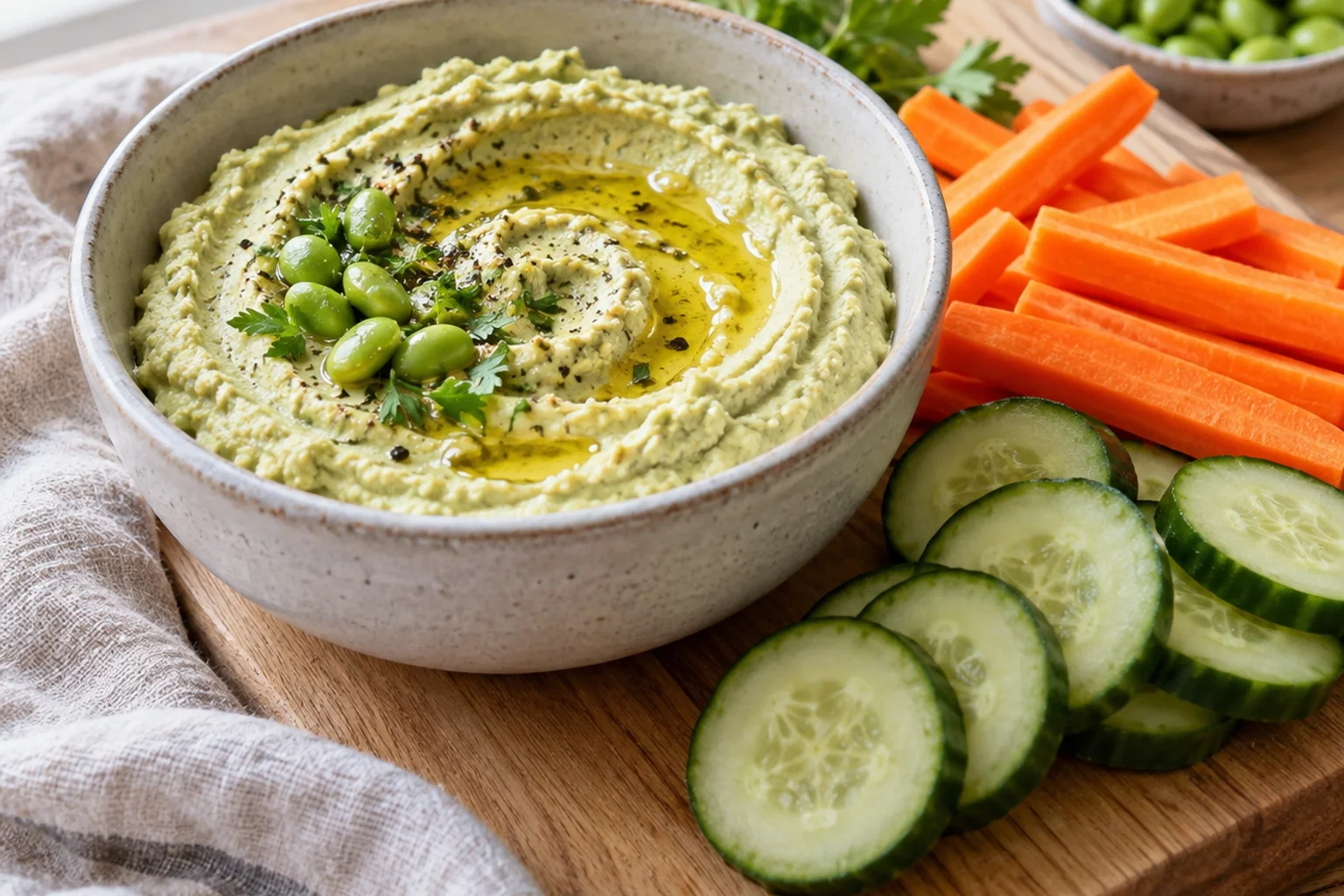
Recipe · Easy · vegan, gluten-free, dairy-free
Protein White-Bean Edamame Hummus
Creamy protein hummus from white beans, edamame, tahini and pea protein, about 7 g of protein per serving.
- Prep
- 15 min
- Cook
- 5 min
- Total
- 20 min
- Makes
- 8 servings (about 1/4 cup / 65 g each)
- Protein
- 7g
- Calories
- 120
- Carbs
- 9g
- Fat
- 6g
- Fiber
- 3g
- Sodium
- 220mg
Per serving, approximate.
Ingredients
- 1 can (15 oz / 425 g) white (cannellini) beans, drained and rinsed (shop at Amazon, opens in a new tab)
- 1 cup (155 g) frozen shelled edamame, thawed and cooked per bag (shop at Whole Foods, opens in a new tab)
- 3 tbsp (45 g) tahini (shop at Amazon, opens in a new tab)
- 2 tbsp (16 g) unflavored pea protein isolate (shop at Amazon, opens in a new tab)
- 3 tbsp (45 ml) lemon juice
- 1 tbsp (15 ml) extra-virgin olive oil (shop at Amazon, opens in a new tab)
- 1 small garlic clove
- 3/4 tsp kosher salt (shop at Amazon, opens in a new tab)
- 1/4 to 1/3 cup (60 to 80 ml) cold water, as needed
Equipment
Steps
- Warm the edamame in the microwave or in hot water for 2 minutes so they blend smoothly; drain.
- Add the tahini, lemon juice and garlic to the food processor and blend 1 minute, until pale and thick.
- Add the beans, edamame, pea protein, olive oil and salt. Blend 2 to 3 minutes, scraping the sides, until smooth.
- With the processor running, add cold water 1 tablespoon at a time until the hummus is creamy. Pea protein thickens it, so you may need the full 1/3 cup.
- Taste and adjust the lemon and salt. Rest 10 minutes before serving; it thickens slightly.
Storage: Airtight container in the fridge up to 5 days; freeze up to 2 months and stir well after thawing.
Pea protein can taste chalky if you add too much, so 2 tablespoons per batch is the limit. Use cold water, since warm water makes the tahini seize slightly. A 1/4-cup serving with 6 lentil crackers gives about 16 g of protein. Hummus is a perishable dip: keep it below 40°F (4°C) and do not leave it out longer than two hours. Canned chickpeas work in place of white beans for the classic flavor.
Hemp-seed energy bites
No-bake bites are usually built on whey. Hemp hearts and pea protein fill that role here. Hemp hearts (shop at Amazon, opens in a new tab) provide about 10 g of protein per 3 tablespoons, plus a soft, nutty chew. The mixture is sticky, so wet your hands before rolling. For more ideas, see no-bake protein balls and bars.
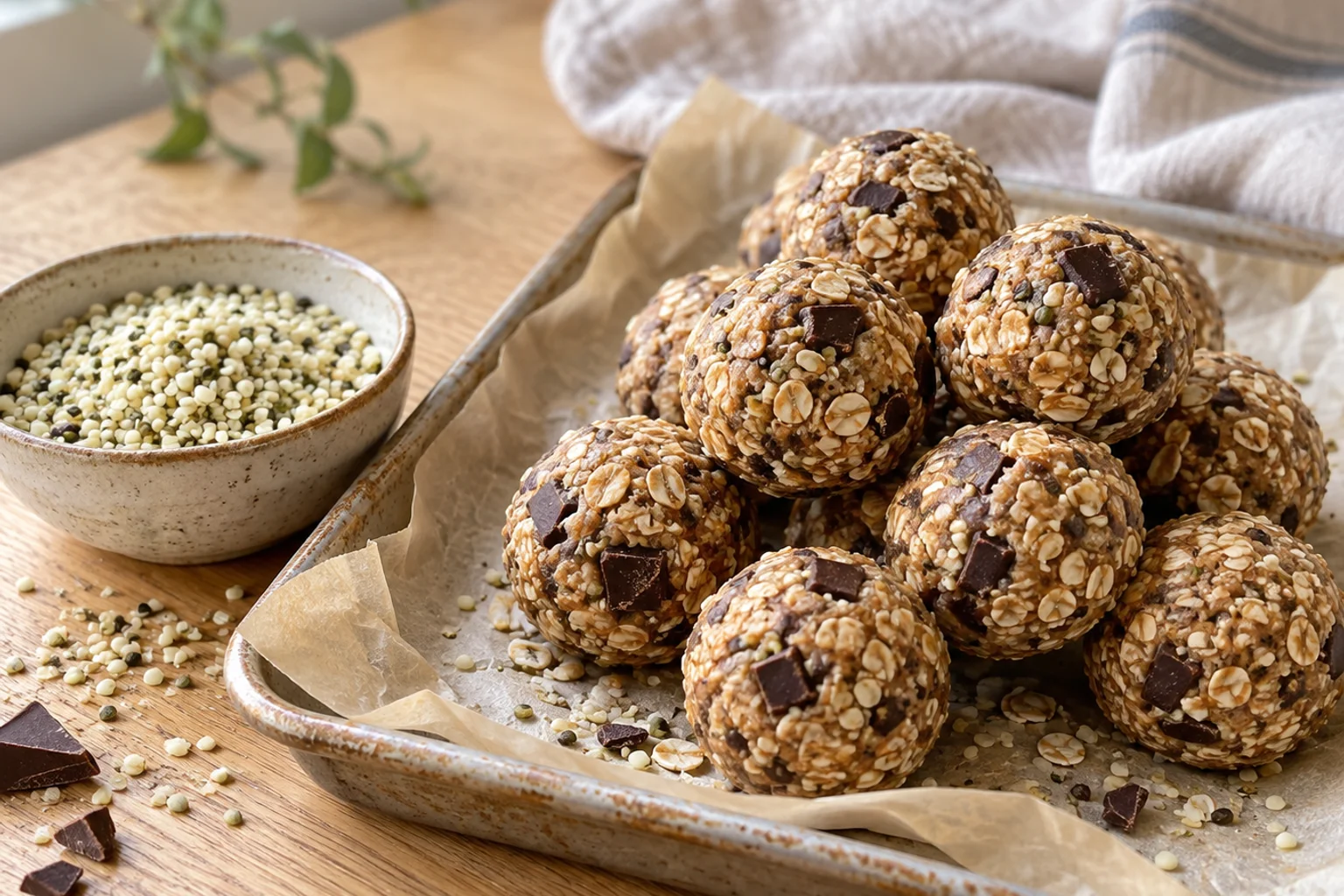
Recipe · Easy · vegan, dairy-free
Hemp-Seed Energy Bites
Vegan no-bake oat, hemp and almond-butter bites with pea protein, about 10 g of protein per 2-bite serving.
- Prep
- 15 min
- Cook
- 0 min
- Chill/set
- 20 min
- Total
- 35 min
- Makes
- 8 servings (2 bites each, 16 bites total)
- Protein
- 10g
- Calories
- 235
- Carbs
- 20g
- Fat
- 13g
- Fiber
- 3g
- Sodium
- 60mg
Per serving, approximate.
Ingredients
- 1/2 cup (80 g) hemp hearts (shop at Amazon, opens in a new tab)
- 1 cup (90 g) old-fashioned rolled oats (shop at Amazon, opens in a new tab)
- 1/3 cup (85 g) almond butter (shop at Amazon, opens in a new tab)
- 3 tbsp (45 ml) pure maple syrup (shop at Amazon, opens in a new tab)
- 1/4 cup (30 g) unflavored or vanilla pea protein (shop at Amazon, opens in a new tab)
- 1/4 cup (45 g) dark chocolate chips (shop at Amazon, opens in a new tab)
- 1 tsp vanilla extract
- 2 to 4 tbsp (30 to 60 ml) water or plant milk, as needed
- 1 pinch kosher salt
Equipment
Steps
- Combine the hemp hearts, oats, pea protein and salt in a large bowl.
- Stir in the almond butter, maple syrup and vanilla until crumbly.
- Add the water 1 tablespoon at a time and knead with your hands until the mixture holds together when pinched. Fold in the chocolate chips.
- Roll into 16 bites using a 1-tablespoon scoop and wet hands, and set them on a parchment-lined tray.
- Chill 20 minutes so they firm up. Overnight chilling is optional.
Storage: Airtight container in the fridge up to 1 week; freezer up to 3 months.
Pea protein absorbs moisture, so the water amount depends on your brand. If the mix sticks to your hands, chill the bowl for 10 minutes before rolling. For a nut-free batch, use sunflower seed butter (shop at Amazon, opens in a new tab) instead of almond butter; the bites taste a little earthier but hold together the same way. Finished bites also freeze well, so they suit weekend batch prep.
Which snack fits which moment
For a desk drawer, the nut and seed mix and the lentil crackers travel well and need no cooler. For a gym bag, the energy bites are compact at about 10 g of protein for two bites, though they should ride with an ice pack in warm weather. For an afternoon slump, tofu jerky or roasted edamame gives the most protein for the fewest calories. For a kids' plate or a party tray, hummus with crackers and tempeh bites with dip are the easiest to share.
Texture matters too. Plant snacks fall into two camps, crunchy and dry or soft and moist, and a good week includes both. Cook the crunchy ones last in the day, since they are best fresh, and make the soft ones first, since they keep and improve as they rest.
Which homemade vegan protein snacks have the most protein?
Tofu jerky has the most protein per calorie at about 10 g protein per 100 calories, followed by roasted edamame and tempeh bites at about 7 g. Tempeh bites have the most protein per serving at 13 g. Roasted chickpeas have the least protein per calorie, about 4 g, but the most fiber at 6 g.
Numbers are estimates based on USDA FoodData Central values for the listed ingredients and the serving sizes in each card.
| Snack | Serving | Protein | Calories | Protein per 100 kcal | Fiber | Shelf life |
|---|---|---|---|---|---|---|
| Roasted chickpeas | 1/3 cup (45 g) | 6 g | 155 | 3.9 g | 6 g | 1 to 4 days (crisp) |
| Roasted edamame | 1/2 cup (70 g) | 9 g | 130 | 6.9 g | 4 g | 2 to 5 days |
| Smoky tofu jerky | 1 oz (28 g) | 10 g | 100 | 10.0 g | 1 g | 1 week fridge |
| Tempeh bites + sauce | 8 bites | 13 g | 190 | 6.8 g | 2 g | 4 to 5 days fridge |
| Red-lentil crackers | 6 crackers | 9 g | 155 | 5.8 g | 4 g | 5 to 7 days |
| Maple-spiced nut and seed mix | 1 oz (28 g) | 7 g | 165 | 4.2 g | 3 g | 2 weeks |
| Protein white-bean hummus | 1/4 cup (65 g) | 7 g | 120 | 5.8 g | 3 g | 5 days fridge |
| Hemp-seed energy bites | 2 bites | 10 g | 235 | 4.3 g | 3 g | 1 week fridge |
For the most protein per calorie, choose tofu jerky, edamame or tempeh. For fullness and fiber, choose chickpeas, lentil crackers or hummus. Pairing crackers with hummus, or edamame with nuts, covers both. A 15 to 20 g protein target is reasonable for a homemade snack, and the build-your-own formula shows how to combine these into one.
Are these vegan protein snacks safe for soy, nut or sesame allergies?
Several of these snacks contain soy, peanut, tree nuts or sesame, so they are not allergy-safe as written. The chickpeas, the lentil crackers and a seed-only nut mix avoid most of them. Swaps are listed below. With a serious allergy, read each label for "may contain" warnings and ask an allergist.
- Soy: edamame, tofu, tempeh and tamari. Use chickpeas, lentil crackers or the seed mix, and coconut aminos in place of tamari. Pea protein is soy-free in the hummus and bites.
- Peanut: only the tempeh sauce uses it. Swap in sunflower seed butter, or almond butter if tree nuts are fine.
- Tree nuts: the nut mix and the almond butter in the bites. Use all pumpkin and sunflower seeds in the mix, and sunflower seed butter in the bites.
- Sesame: tahini in the hummus. Use sunflower seed butter and a little extra lemon; the flavor is milder and the texture just as creamy.
- Cross-contact: keep tools separate for anyone with a serious allergy.
Most of these snacks are naturally gluten-free. Use tamari (shop at Amazon, opens in a new tab) instead of regular soy sauce in the tofu jerky and tempeh bites, and check tempeh labels, since some blends add barley or other grains. Use certified gluten-free oats in the energy bites, because standard oats can be cross-contaminated in processing.
Storing, batch-prepping and shopping for vegan protein snacks
Different snacks need different storage. The crunchy ones (chickpeas, edamame, crackers) want dry, loosely covered storage and no fridge. The moist ones (tofu jerky, tempeh, hummus, bites) need the fridge and should not sit out for more than two hours. The nut mix keeps longest, about two weeks. For temperatures, containers and thawing, see how to preserve homemade protein snacks.
A Sunday plan takes about 90 minutes with one oven. Press the tofu first, make the hummus while it presses, then roast the chickpeas and the nut mix on two racks at once (lower the chickpea temperature if needed). Bake the tofu jerky and crackers in the next round and finish the bites while everything cools. That gives you five or six snacks for the week.
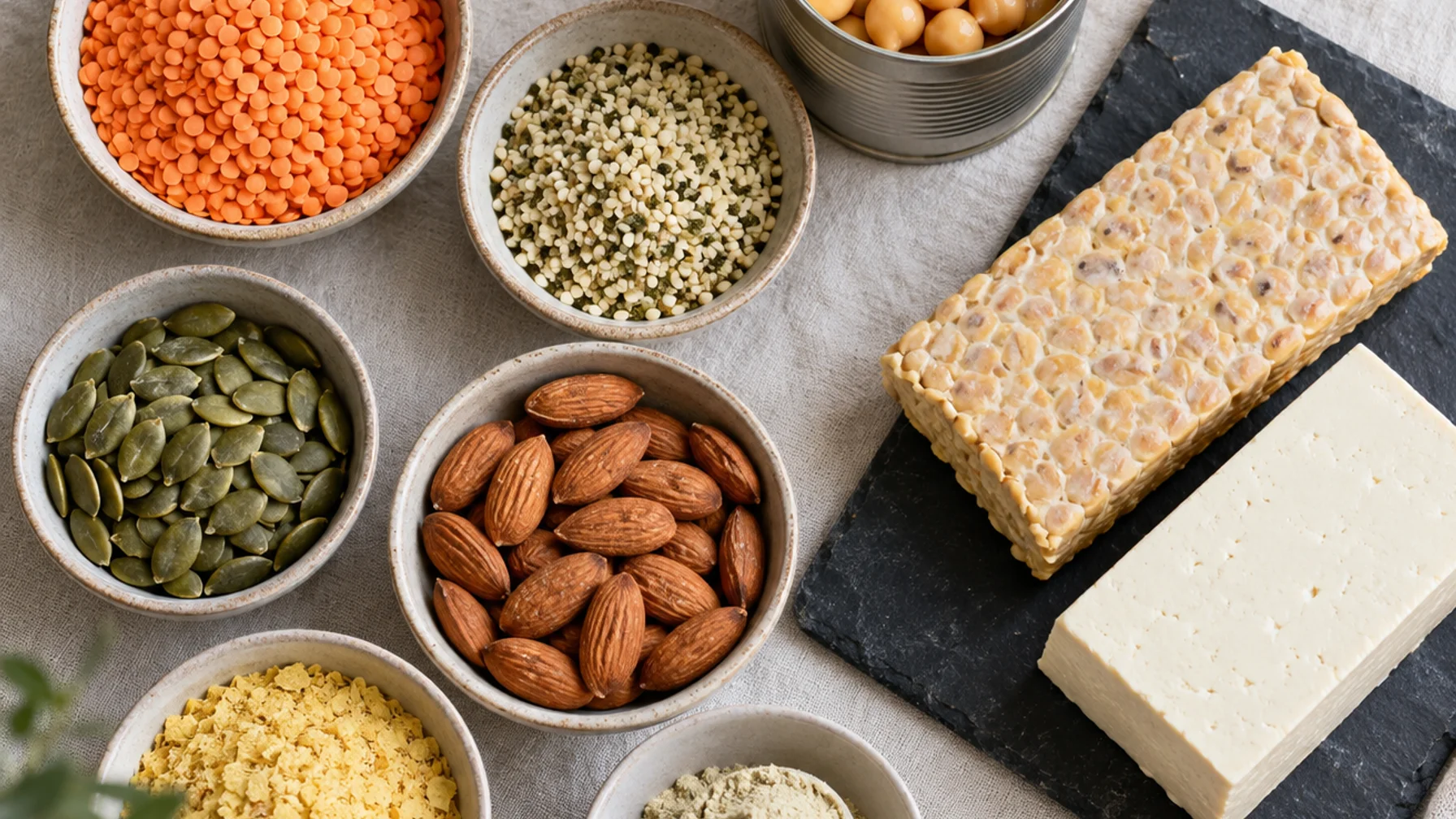
For a first shop, buy red lentils (shop at Amazon, opens in a new tab), canned chickpeas (shop at Amazon, opens in a new tab), hemp hearts (shop at Amazon, opens in a new tab), tahini (shop at Amazon, opens in a new tab) and pea protein (shop at Amazon, opens in a new tab), all shelf-stable. Pick up tofu and tempeh fresh each week. The pantry shopping guide covers brands, price ranges and what to look for in powders and seeds.
Shop this article
39 ingredients and tools. Add them to your list, then send it to Amazon, Whole Foods or Instacart.
Protein powders
Beans, soy & plant protein
- Canned chickpeasAmazon (opens in a new tab)Whole Foods (opens in a new tab)Instacart (opens in a new tab)
- Nutritional yeastAmazon (opens in a new tab)Whole Foods (opens in a new tab)Instacart (opens in a new tab)
- Frozen shelled edamameWhole Foods (opens in a new tab)Instacart (opens in a new tab)
- Extra-firm or super-firm tofuWhole Foods (opens in a new tab)Instacart (opens in a new tab)
- TempehWhole Foods (opens in a new tab)Instacart (opens in a new tab)
- Red lentils (dry)Amazon (opens in a new tab)Whole Foods (opens in a new tab)Instacart (opens in a new tab)
- Canned white (cannellini) beansAmazon (opens in a new tab)Whole Foods (opens in a new tab)Instacart (opens in a new tab)
Nuts, seeds & nut butters
- Natural peanut butter (peanuts + salt)Amazon (opens in a new tab)Whole Foods (opens in a new tab)Instacart (opens in a new tab)
- Raw almondsAmazon (opens in a new tab)Whole Foods (opens in a new tab)Instacart (opens in a new tab)
- Pumpkin seeds (pepitas)Amazon (opens in a new tab)Whole Foods (opens in a new tab)Instacart (opens in a new tab)
- TahiniAmazon (opens in a new tab)Whole Foods (opens in a new tab)Instacart (opens in a new tab)
- Hemp hearts (shelled hemp seeds)Amazon (opens in a new tab)Whole Foods (opens in a new tab)Instacart (opens in a new tab)
- Almond butterAmazon (opens in a new tab)Whole Foods (opens in a new tab)Instacart (opens in a new tab)
- Sunflower seed butter (nut-free)Amazon (opens in a new tab)Whole Foods (opens in a new tab)Instacart (opens in a new tab)
Oats, grains & binders
- Old-fashioned rolled oatsAmazon (opens in a new tab)Whole Foods (opens in a new tab)Instacart (opens in a new tab)
Sweeteners & chocolate
Sauces, spices & flavor
- Extra-virgin olive oilAmazon (opens in a new tab)Whole Foods (opens in a new tab)Instacart (opens in a new tab)
- Kosher saltAmazon (opens in a new tab)Whole Foods (opens in a new tab)Instacart (opens in a new tab)
- Smoked paprikaAmazon (opens in a new tab)Whole Foods (opens in a new tab)Instacart (opens in a new tab)
- Garlic powderAmazon (opens in a new tab)Whole Foods (opens in a new tab)Instacart (opens in a new tab)
- Onion powderAmazon (opens in a new tab)Whole Foods (opens in a new tab)Instacart (opens in a new tab)
- Chili-lime seasoningAmazon (opens in a new tab)Whole Foods (opens in a new tab)Instacart (opens in a new tab)
- Ground cinnamonAmazon (opens in a new tab)Whole Foods (opens in a new tab)Instacart (opens in a new tab)
- Crushed red pepper flakesAmazon (opens in a new tab)Whole Foods (opens in a new tab)Instacart (opens in a new tab)
- Low-sodium soy sauce or tamariAmazon (opens in a new tab)Whole Foods (opens in a new tab)Instacart (opens in a new tab)
- Liquid smokeAmazon (opens in a new tab)Whole Foods (opens in a new tab)Instacart (opens in a new tab)
- Coarse-ground black pepperAmazon (opens in a new tab)Whole Foods (opens in a new tab)Instacart (opens in a new tab)
- SrirachaAmazon (opens in a new tab)Whole Foods (opens in a new tab)Instacart (opens in a new tab)
Kitchen tools
- Rimmed half-sheet pansAmazon (opens in a new tab)Instacart (opens in a new tab)
- Parchment paperAmazon (opens in a new tab)Whole Foods (opens in a new tab)Instacart (opens in a new tab)
- Oven-safe wire cooling racks (fit half-sheet)Amazon (opens in a new tab)Instacart (opens in a new tab)
- Sharp chef's knife or slicing knifeAmazon (opens in a new tab)Instacart (opens in a new tab)
- Air fryer (with dehydrate setting)Amazon (opens in a new tab)Instacart (opens in a new tab)
- Food processorAmazon (opens in a new tab)Instacart (opens in a new tab)
- Cookie scoop (1 tablespoon)Amazon (opens in a new tab)Instacart (opens in a new tab)
- Digital kitchen scale (grams)Amazon (opens in a new tab)Instacart (opens in a new tab)
Storage & preserving supplies
- Glass meal-prep containers with lidsAmazon (opens in a new tab)Instacart (opens in a new tab)
Frequently asked questions
How much protein can a vegan snack realistically have?
Most whole-food plant snacks land between 5 and 13 g of protein per serving. Tofu jerky and tempeh bites reach 10 to 13 g, edamame and lentil crackers about 9 g, and nuts or chickpeas 6 to 7 g. Adding pea or soy protein powder, as in the hummus, lifts a dip without changing the texture much.
Can you cook frozen edamame without thawing it?
Yes. Frozen shelled edamame can go straight into a 400°F (200°C) air fryer for about 8 to 12 minutes, shaking the basket halfway. For the crunchiest oven-roasted version, thaw the beans and pat them dry first, because ice melts into steam and softens the surface. Season right after cooking.
Can I make tofu jerky without a dehydrator?
Yes. This recipe uses a 250°F (120°C) oven for about an hour or an air fryer at 300°F (150°C) for 20 to 25 minutes. Press the tofu first and slice it thin. The result is chewy with crisp edges, a little softer than dehydrated jerky, and it keeps about a week in the fridge.
Is tofu jerky good for you?
Tofu jerky is a reasonable high-protein snack: this recipe has about 10 g of protein and 100 calories per 1-oz (28 g) serving. It has only 1 g of fiber, and soy sauce brings about 380 mg of sodium, so use low-sodium soy sauce or tamari and watch your total for the day.
Are roasted nuts a good source of protein?
Yes, in small servings. One ounce (28 g) of almonds has about 6 g of protein and pumpkin seeds about 9 g, based on USDA FoodData Central values, but each ounce also carries roughly 160 calories. That is about 4 to 5 g of protein per 100 calories, so nuts work best as a side to edamame or tofu jerky.
Is pea protein or soy protein better for snacks?
Both work. Pea protein is neutral enough to blend into hummus or energy bites. Soy protein has a slightly more complete amino acid profile, and both supply roughly 8% leucine by weight. Pick whichever you tolerate and enjoy. Blends of pea and rice are also fine and often taste smoother.
How should you store homemade tofu jerky?
Cool the strips completely, then keep them in an airtight container in the fridge for up to 1 week, or freeze them for up to 2 months. Tofu is a perishable protein, so do not leave finished jerky out for more than 2 hours. A 5-minute stint in a 300°F (150°C) oven re-crisps it.
Sources
- USDA FoodData Central (opens in a new tab)
- Harvard T.H. Chan School of Public Health: The Nutrition Source, Protein (opens in a new tab)
- NIH Office of Dietary Supplements (opens in a new tab)
- USDA FSIS: Food Safety (opens in a new tab)
- FoodSafety.gov (opens in a new tab)
More reading on protein, sugar and snack labels is collected on our resources page.